Frequently Asked Questions
Q: What do the colors blue, purple, and scarlet represent in Exodus 35:6?
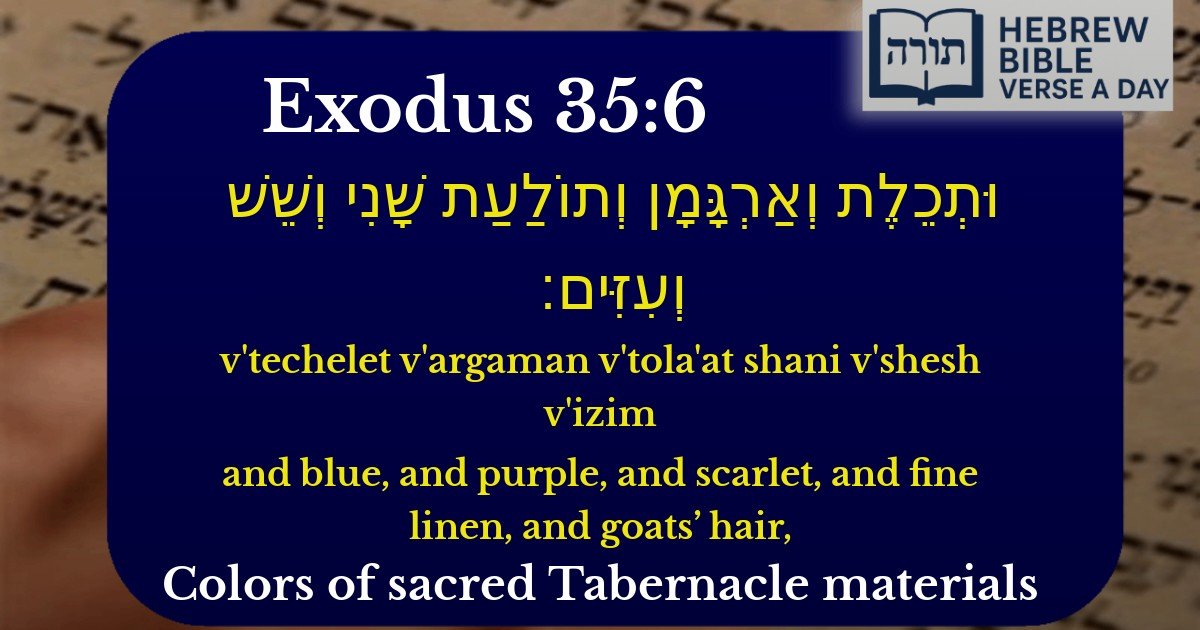
A: According to Rashi and other commentators, these colors were used in the construction of the Mishkan (Tabernacle) and the priestly garments. The blue (תְּכֵלֶת - techelet) represents the heavens and divine connection, purple (אַרְגָּמָן - argaman) symbolizes royalty, and scarlet (תּוֹלַעַת שָׁנִי - tola'at shani) represents atonement and sacrifice.
Q: Why were fine linen and goats' hair mentioned in Exodus 35:6?
A: Fine linen (שֵׁשׁ - shesh) was used for the priestly garments and the Mishkan's curtains, symbolizing purity and refinement. Goats' hair (עִזִּים - izzim) was used for the outer covering of the Mishkan, representing durability and protection, as taught in the Talmud (Shabbat 28a) and Midrash.
Q: What is the significance of these materials in the Mishkan?
A: These materials were donated by the Israelites for building the Mishkan, as described in Exodus 35. Each material had a specific purpose, reflecting the holiness and order of the Mishkan. The Rambam explains that the use of these materials teaches us about the importance of dedicating our finest resources to serving Hashem.
Q: How does the concept of donating materials for the Mishkan apply today?
A: The donation of materials for the Mishkan teaches the value of contributing to holy causes with generosity and joy. Today, this applies to supporting synagogues, Torah study, and acts of kindness, as the Midrash teaches that our contributions should be given with a full heart, just as the Israelites gave willingly (Shemot Rabbah 33:6).
Q: What is the spiritual meaning behind the colors and materials in this verse?
A: The colors and materials symbolize different spiritual qualities. Techelet (blue) reminds us of the heavens and mitzvot (Menachot 43b), argaman (purple) represents humility despite royalty, and tola'at shani (scarlet) signifies repentance. The fine linen and goats' hair teach balance between refinement and practicality in serving Hashem, as explained in Kabbalistic sources like the Zohar.


Colors and Materials in the Mishkan
The verse lists materials used in the construction of the Mishkan (Tabernacle), each carrying deep symbolic meaning according to traditional Jewish sources:
Symbolic Unity
The Kli Yakar (Shemot 25:4) explains these materials correspond to different aspects of divine service: Tekhelet represents heavenly aspirations, Argaman represents royal devotion, Tola'at Shani represents passionate commitment, Shesh represents pure intentions, and Izim represents practical protection - showing that complete avodat Hashem requires multiple dimensions working in harmony.