

Join Our Newsletter To Be Informed When New Videos Are Posted
Hebrew Text
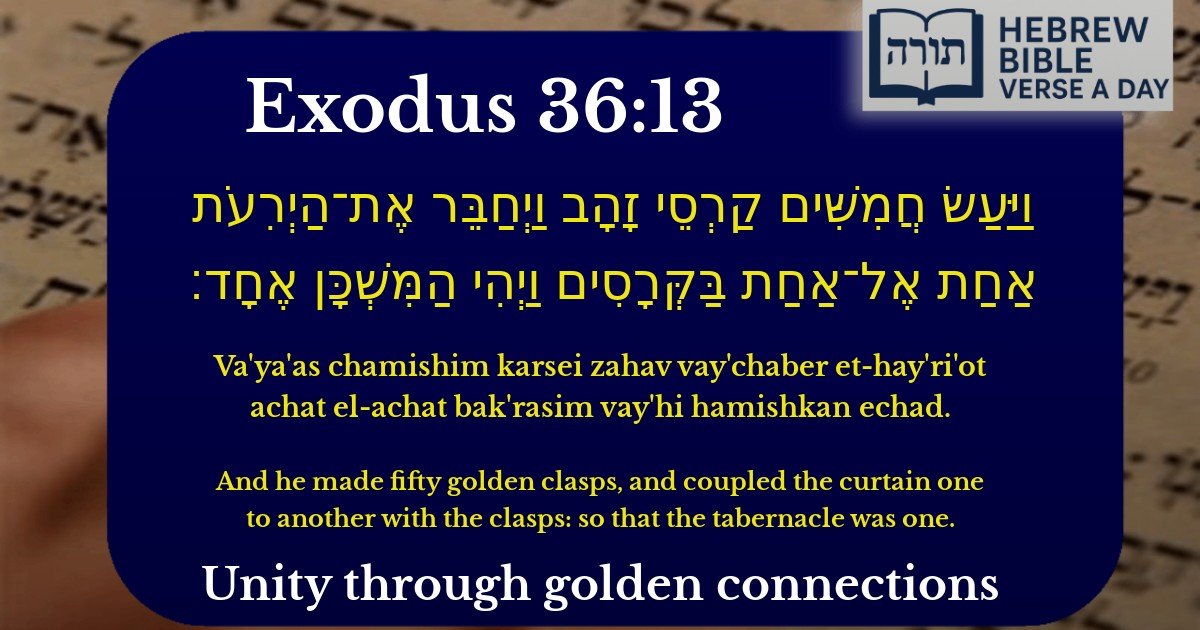
וַיַּעַשׂ חֲמִשִּׁים קַרְסֵי זָהָב וַיְחַבֵּר אֶת־הַיְרִעֹת אַחַת אֶל־אַחַת בַּקְּרָסִים וַיְהִי הַמִּשְׁכָּן אֶחָד׃
English Translation
And he made fifty golden clasps, and coupled the curtain one to another with the clasps: so that the tabernacle was one.
Transliteration
Va'ya'as chamishim karsei zahav vay'chaber et-hay'ri'ot achat el-achat bak'rasim vay'hi hamishkan echad.
Hebrew Leining Text
וַיַּ֕עַשׂ חֲמִשִּׁ֖ים קַרְסֵ֣י זָהָ֑ב וַיְחַבֵּ֨ר אֶת־הַיְרִיעֹ֜ת אַחַ֤ת אֶל־אַחַת֙ בַּקְּרָסִ֔ים וַיְהִ֥י הַמִּשְׁכָּ֖ן אֶחָֽד׃ {פ}
🎵 Listen to leining
Parasha Commentary
📚 Talmud Citations
This verse is not quoted in the Talmud.
The Unity of the Mishkan
The verse (Shemot 36:13) describes the joining of the curtains of the Mishkan with golden clasps (קרסי זהב), resulting in the Mishkan becoming "one" (ויהי המשכן אחד). Rashi explains that these clasps symbolize unity, as they physically connected the separate curtains into a single structure. The Midrash Tanchuma (Pekudei 3) further elaborates that this unity reflects the harmony required among the Jewish people, just as the Mishkan's components were joined together.
Symbolism of the Fifty Golden Clasps
The number fifty holds deep significance in Jewish thought. Ramban (Nachmanides) notes that fifty represents completion and transcendence, alluding to the fifty gates of understanding (שערי בינה) mentioned in Kabbalistic teachings. The golden clasps, made from the people's donations (Shemot 35:22), also signify the collective contribution of Klal Yisrael to the Mishkan's construction.
The Mishkan as a Microcosm of Am Yisrael
The Talmud (Yoma 72a) teaches that the Mishkan serves as a model for the Jewish people—just as its parts were interconnected, so too must Jews be united. The Sforno emphasizes that the phrase "ויהי המשכן אחד" teaches that despite the diversity of materials and craftsmen, the Mishkan functioned as a singular entity, mirroring the ideal state of Klal Yisrael.