
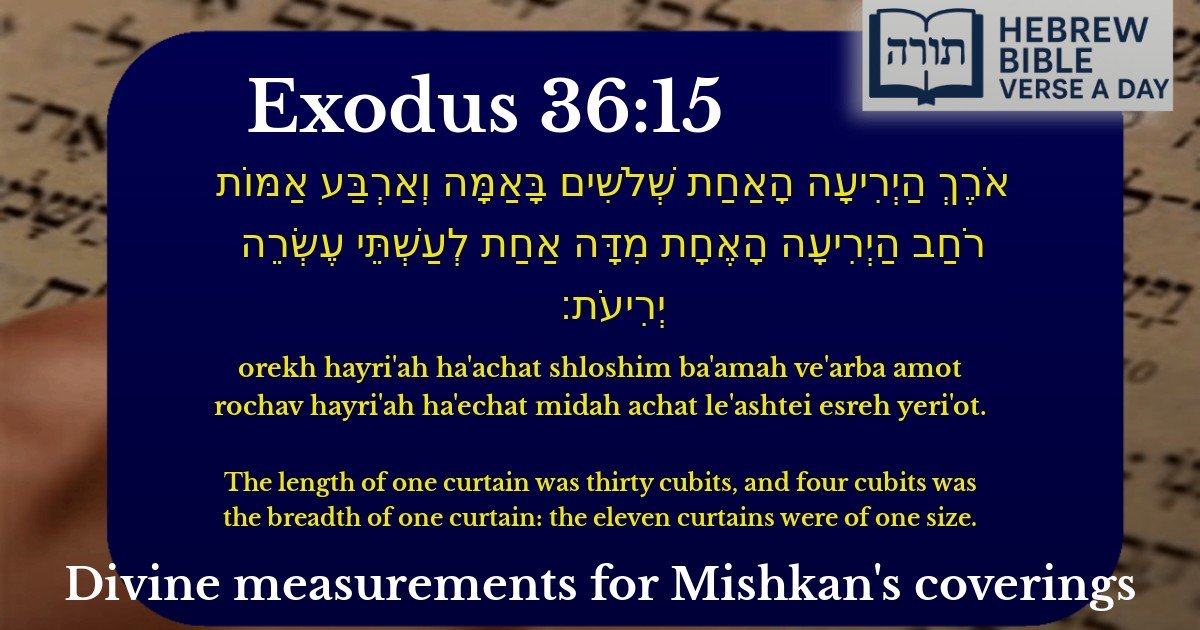

Exodus 36:15 - Divine measurements for Mishkan's coverings

Exodus 36:15 - שמות 36:15

Hebrew Text

אֹרֶךְ הַיְרִיעָה הָאַחַת שְׁלֹשִׁים בָּאַמָּה וְאַרְבַּע אַמּוֹת רֹחַב הַיְרִיעָה הָאֶחָת מִדָּה אַחַת לְעַשְׁתֵּי עֶשְׂרֵה יְרִיעֹת׃

English Translation

The length of one curtain was thirty cubits, and four cubits was the breadth of one curtain: the eleven curtains were of one size.

Transliteration

Orekh hayri'ah ha'achat shloshim ba'amah ve'arba amot rochav hayri'ah ha'echat midah achat le'ashtei esreh yeri'ot.

Hebrew Leining Text

אֹ֜רֶךְ הַיְרִיעָ֣ה הָאַחַ֗ת שְׁלֹשִׁים֙ בָּֽאַמָּ֔ה וְאַרְבַּ֣ע אַמּ֔וֹת רֹ֖חַב הַיְרִיעָ֣ה הָאֶחָ֑ת מִדָּ֣ה אַחַ֔ת לְעַשְׁתֵּ֥י עֶשְׂרֵ֖ה יְרִיעֹֽת׃

🎵 Listen to leining

Parasha Commentary

Dimensions of the Curtains in the Mishkan

The verse (Shemot 26:8) describes the dimensions of the curtains (yeriot) that formed the covering of the Mishkan. Each curtain was 30 cubits in length and 4 cubits in width, with all eleven curtains being of identical size. Rashi explains that these measurements were divinely ordained and carried deep symbolic meaning in the construction of the Mishkan.

Symbolism of the Measurements

The Ramban (Nachmanides) notes that the number 30 cubits corresponds to the height of the Mishkan's structure, emphasizing completeness in its sacred design. The 4 cubits in width, as discussed in the Midrash Tanchuma (Terumah 8), may allude to the four directions of the world, symbolizing that the Divine Presence (Shechinah) encompasses all of creation.

Eleven Curtains and Their Significance

The eleven curtains are interpreted by the Talmud (Shabbat 99a) as representing the unity of the Jewish people in their service to Hashem. The number eleven is also connected to the concept of yichud (unity), as it exceeds the complete number ten (associated with the Ten Commandments) and signifies an additional level of spiritual elevation.

Practical Construction Insights

  • Uniformity: The identical size of all eleven curtains, as emphasized in the verse, teaches the importance of consistency and harmony in sacred work (Malbim).
  • Material and Craftsmanship: The Ibn Ezra highlights that these curtains were made of fine twisted linen and dyed wool, reflecting the meticulous care required in fulfilling divine commandments.

📚 Talmud Citations

This verse is not quoted in the Talmud.

Frequently Asked Questions

Q: What is the significance of the measurements of the curtains in Exodus 36:15?
A: The measurements of the curtains (30 cubits long and 4 cubits wide) were divinely commanded for the construction of the Mishkan (Tabernacle). According to Rashi, these precise dimensions ensured that the curtains would perfectly cover the structure, symbolizing the importance of following Hashem's instructions meticulously in sacred matters.
Q: Why were there exactly eleven curtains for the Mishkan?
A: The eleven curtains (as mentioned in Exodus 36:15) were designed to provide complete coverage for the Mishkan. The Talmud (Shabbat 98b) explains that the extra width (since 11 curtains × 4 cubits wide = 44 cubits, while the Mishkan's circumference was only 30 cubits) allowed for overlapping and secure covering, reflecting the idea of 'hiddur mitzvah' (beautifying a commandment) by ensuring no gaps.
Q: What lesson can we learn from the uniform size of all the curtains?
A: The Torah emphasizes that all eleven curtains were of 'one size' (Exodus 36:15), teaching unity and harmony in serving Hashem. The Midrash Tanchuma notes that just as the curtains worked together seamlessly, the Jewish people must unite in their dedication to Torah and mitzvot, each contributing equally to the greater spiritual structure.
Q: How do the materials of the Mishkan apply to us today?
A: While we no longer have the Mishkan, the Rambam (Hilchot Beit HaBechirah) explains that its details teach eternal principles. The precise measurements of the curtains remind us that our actions in avodat Hashem (divine service) must be measured with care, intention, and attention to detail—whether in prayer, kindness, or Torah study.