
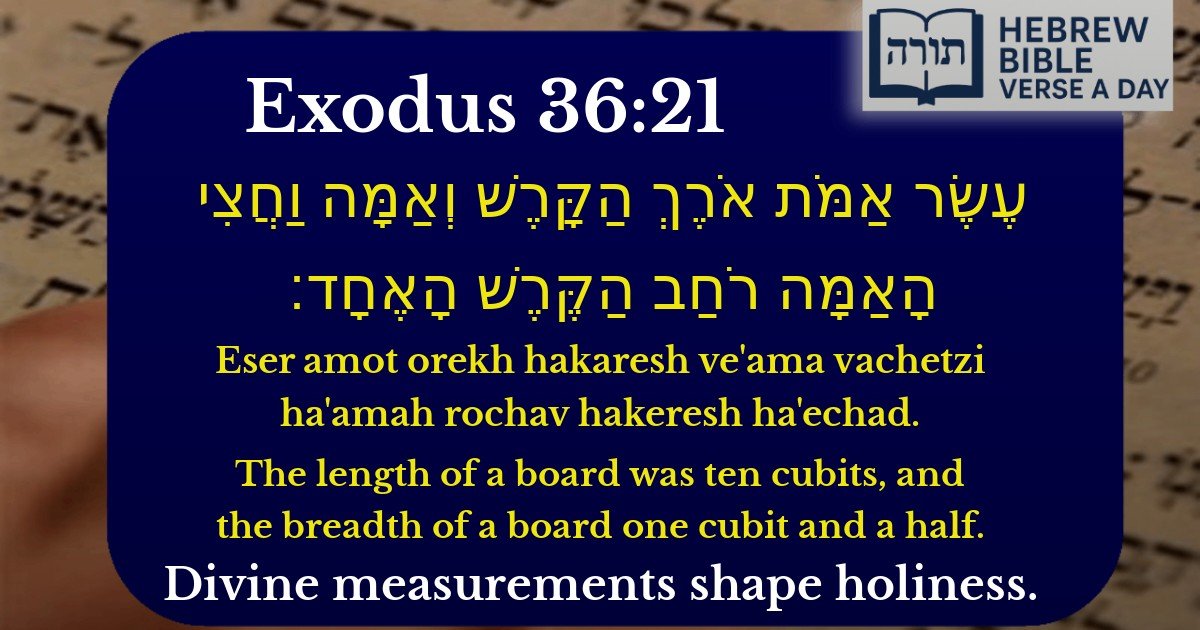

Exodus 36:21 - Divine measurements shape holiness.

Exodus 36:21 - שמות 36:21

Hebrew Text

עֶשֶׂר אַמֹּת אֹרֶךְ הַקָּרֶשׁ וְאַמָּה וַחֲצִי הָאַמָּה רֹחַב הַקֶּרֶשׁ הָאֶחָד׃

English Translation

The length of a board was ten cubits, and the breadth of a board one cubit and a half.

Transliteration

Eser amot orekh hakaresh ve'ama vachetzi ha'amah rochav hakeresh ha'echad.

Hebrew Leining Text

עֶ֥שֶׂר אַמֹּ֖ת אֹ֣רֶךְ הַקָּ֑רֶשׁ וְאַמָּה֙ וַחֲצִ֣י הָֽאַמָּ֔ה רֹ֖חַב הַקֶּ֥רֶשׁ הָאֶחָֽד׃

🎵 Listen to leining

Parasha Commentary

Dimensions of the Mishkan's Boards

The verse (Shemot 26:16) describes the dimensions of the wooden boards (kerashim) used in the construction of the Mishkan (Tabernacle). Each board was ten cubits in length and one and a half cubits in width. Rashi explains that these measurements were divinely ordained, reflecting the precise design given to Moshe at Har Sinai.

Symbolism of the Measurements

According to the Midrash (Shemot Rabbah 35:6), the dimensions carry deeper spiritual significance:

  • Ten cubits in length: Corresponds to the Ten Commandments, emphasizing that the Mishkan was a dwelling place for the Divine Presence, rooted in Torah.
  • One and a half cubits in width: Represents unity (echad) and the half-cubit alludes to humility, teaching that Torah and avodah (service) require both wholeness and submission to Hashem's will.

Structural Insights from the Talmud

The Talmud (Shabbat 98b) discusses the arrangement of the boards, noting that their width (1.5 cubits) allowed for stability when placed side by side. The boards stood upright, with their ten-cubit height forming the walls of the Mishkan. Rambam (Hilchot Beit HaBechirah 1:12) derives architectural principles from these measurements, emphasizing the precision required in sacred construction.

Kabbalistic Interpretation

The Zohar (Terumah 152a) connects the boards' dimensions to the spiritual structure of the universe:

  • The ten-cubit length parallels the Ten Sefirot, through which divine energy flows into the world.
  • The half-cubit signifies the incomplete state of this world, awaiting completion through human mitzvot and tikkun (rectification).

📚 Talmud Citations

This verse is not quoted in the Talmud.

Frequently Asked Questions

Q: What is the significance of the measurements for the boards in Exodus 36:21?
A: The measurements (10 cubits in length and 1.5 cubits in width) for the boards of the Mishkan (Tabernacle) were given by Hashem with precise details to ensure the sanctity and proper construction of the holy structure. According to Rashi, these exact dimensions reflect the importance of following divine instructions meticulously in sacred matters.
Q: Why does the Torah specify the size of the Mishkan's boards?
A: The Torah specifies the size of the boards to teach us that every detail in avodat Hashem (service of G-d) matters. The Rambam explains that the Mishkan's construction symbolizes the order and precision required in spiritual service, showing that even physical dimensions carry deeper meaning in fulfilling the divine will.
Q: How do the measurements of the Mishkan's boards apply to us today?
A: While we no longer build the Mishkan, the lesson remains relevant: precision and care in mitzvot (commandments) reflect our dedication to Hashem. The Midrash teaches that just as the boards had exact measurements, our actions in Torah and mitzvot should be performed with attention to detail and sincerity.
Q: What is a cubit (amah), and why is it used in the Mishkan's measurements?
A: An amah (cubit) is an ancient unit of measurement, approximately the length of a forearm (18-24 inches). The Torah uses it for the Mishkan to emphasize that sacred spaces must be built with standardized, meaningful units. The Talmud (Sukkah 7a) discusses its importance in ensuring uniformity in halachic measurements.
Q: Why were the boards of the Mishkan made with these specific dimensions?
A: The dimensions (10 cubits tall and 1.5 cubits wide) created a sturdy and proportional structure for the Mishkan. The Midrash Tanchuma notes that these measurements also allude to spiritual concepts—such as the Ten Commandments (10 cubits) and the unity of the Jewish people (1.5 cubits representing completeness).