Frequently Asked Questions
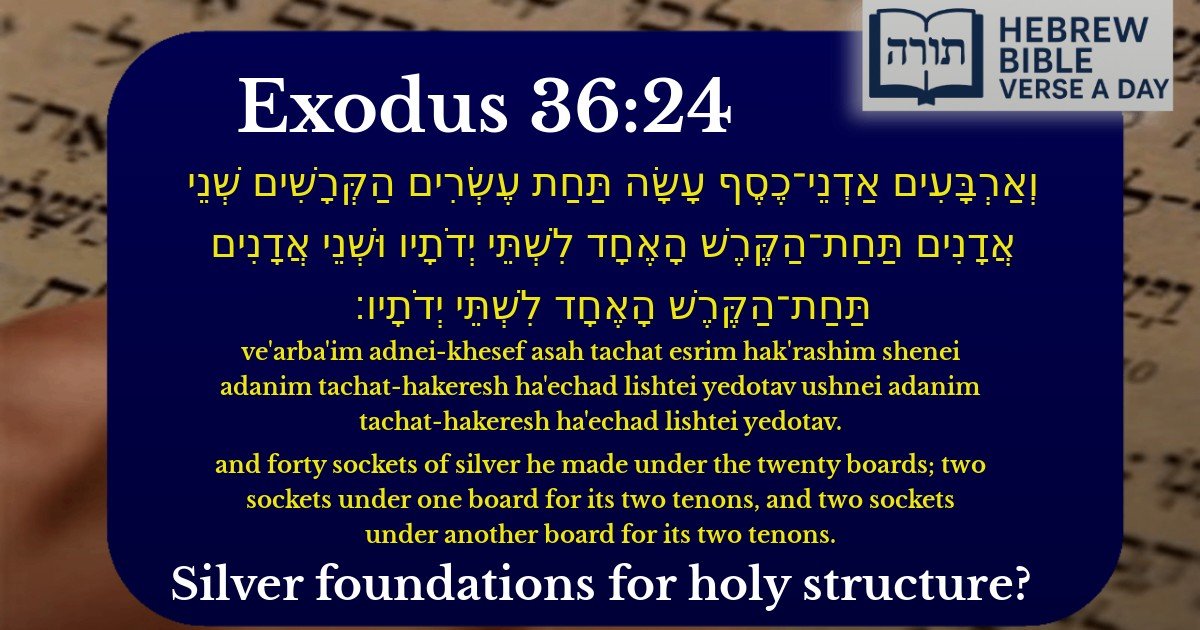
Q: What is the significance of the silver sockets (adnei kesef) in Exodus 36:24?
A: The silver sockets (adnei kesef) served as the foundation for the Mishkan (Tabernacle), holding up the wooden boards (kerashim). According to Rashi, these sockets symbolize stability and purity, as silver (kesef) represents refinement and atonement (based on Exodus 30:12-16, where silver was collected for the Mishkan). The sockets ensured the Mishkan remained sturdy, reflecting the importance of a strong spiritual foundation in serving Hashem.
Q: Why were there specifically forty silver sockets for twenty boards in the Mishkan?
A: The Torah specifies forty silver sockets for twenty boards—two sockets per board—to create a balanced and secure structure. The Talmud (Menachot 98a) explains that this arrangement ensured equal support for each board, teaching us the value of fairness and attention to detail in holy work. The number forty also recalls significant events like the forty days Moshe spent on Har Sinai, connecting the Mishkan’s construction to divine wisdom.
Q: What lesson can we learn from the two sockets under each board in the Mishkan?
A: The two sockets under each board teach that spiritual strength comes from dual foundations: Torah study and mitzvot (good deeds). The Midrash (Tanchuma, Terumah 11) compares the sockets to the two tablets of the Ten Commandments, emphasizing that a Jew’s life must be grounded in both learning and action. Just as the sockets supported the Mishkan, these twin pillars uphold a meaningful Jewish life.
Q: How does the detail about the Mishkan's construction apply to us today?
A: The meticulous details of the Mishkan’s construction, like the silver sockets, remind us that every aspect of avodat Hashem (service to G-d) matters. Rambam (Hilchot Beit HaBechirah 1:12) derives from this that holiness is built through precision and care. Today, this teaches us to approach mitzvot with dedication, whether in prayer, kindness, or building Jewish homes—each 'socket' (detail) contributes to a greater spiritual structure.


Explanation of the Verse
The verse describes the construction of the sockets (adnei-kesef) that supported the boards (kerashim) of the Mishkan (Tabernacle). According to Rashi (Exodus 26:19), these silver sockets served as the foundation for the boards, ensuring their stability. Each board had two tenons (yadot) that fit into two sockets, totaling forty sockets for twenty boards.
Symbolism of the Silver Sockets
The Midrash (Tanchuma, Terumah 11) explains that the silver used for the sockets symbolizes atonement, as silver (kesef) is linguistically connected to kisufin (yearning) and repentance. The Rambam (Hilchot Beit HaBechirah 1:12) further notes that the foundation of the Mishkan represents the foundation of divine service, emphasizing the importance of a strong spiritual base.
Structural Significance
Halachic Insights
The Talmud (Yoma 72a) derives from this verse that just as the Mishkan's boards required a firm foundation, so too must Torah study and mitzvot be built on solid principles. The Shulchan Aruch (Orach Chaim 1:1) applies this idea, teaching that one should strengthen their spiritual foundation before engaging in higher levels of divine service.