Frequently Asked Questions
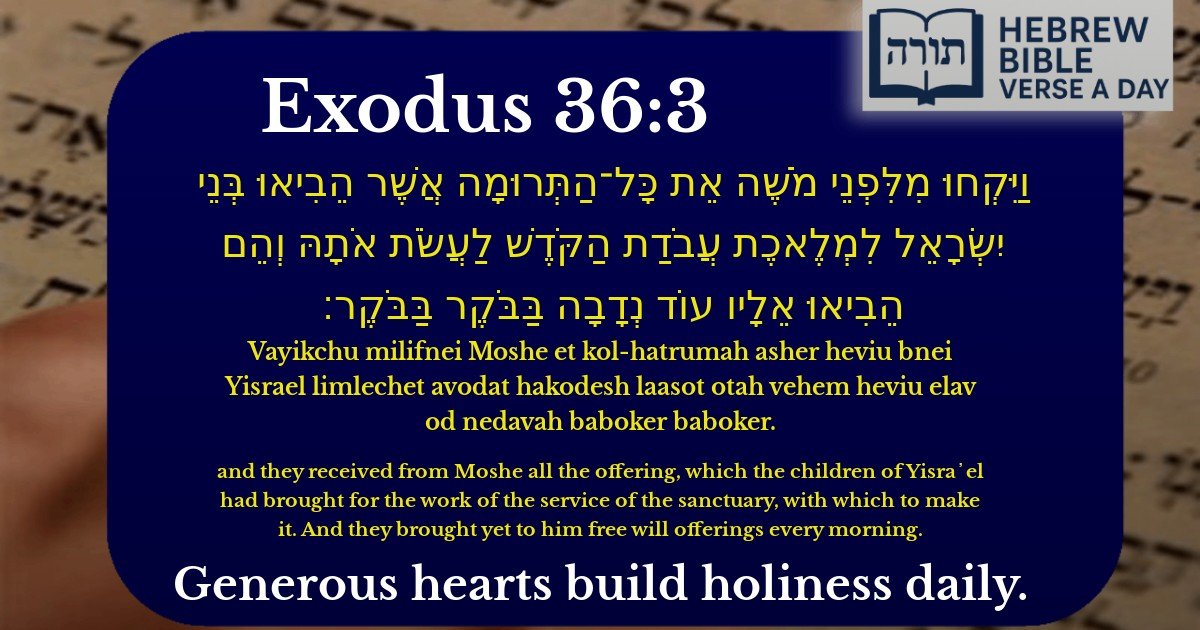
Q: What does Exodus 36:3 teach us about the Israelites' donations for the Mishkan (Tabernacle)?
A: Exodus 36:3 describes how the Israelites generously brought voluntary offerings ('nedavah') every morning for the construction of the Mishkan. According to Rashi, this shows their eagerness and enthusiasm to contribute to this holy project. The verse emphasizes that the donations were given willingly and consistently, demonstrating their deep commitment to serving Hashem.
Q: Why did the Israelites bring donations every morning for the Mishkan?
A: The Midrash explains that bringing donations 'every morning' (בַּבֹּקֶר בַּבֹּקֶר) shows the Israelites' consistent dedication. Morning represents renewal and freshness, indicating their pure intentions. The Rambam (Hilchot Matnot Aniyim 8:10) also teaches that giving tzedakah (charity) in the morning is especially meritorious, as it reflects prioritizing mitzvot at the start of the day.
Q: What is the significance of the 'free will offerings' (נְדָבָה) mentioned in Exodus 36:3?
A: The term 'nedavah' (free will offering) highlights that the Israelites gave voluntarily, beyond the required contributions. The Talmud (Yoma 75a) teaches that voluntary gifts for sacred purposes are especially beloved by Hashem. This teaches us the importance of going beyond the minimum in serving G-d and contributing to holy causes with a full heart.
Q: How does Exodus 36:3 apply to giving tzedakah (charity) today?
A: Just as the Israelites gave willingly and consistently for the Mishkan, we learn from this verse the importance of regular, heartfelt giving. The Shulchan Aruch (Yoreh De'ah 248:1) rules that one should give tzedakah according to one's ability, preferably daily. The verse reminds us that giving should be done with joy and consistency, as an expression of our devotion to Hashem.
Q: What does Exodus 36:3 teach about community participation in holy projects?
A: This verse shows how the entire community participated in building the Mishkan. The Ohr HaChaim explains that when everyone contributes according to their ability, it creates unity in serving Hashem. This principle applies today to communal mitzvot like building synagogues or supporting Torah institutions - everyone's participation, whether large or small, is valuable and necessary.


Context in the Construction of the Mishkan
This verse (Shemot 36:3) describes the process of collecting materials for the construction of the Mishkan (Tabernacle). The people of Israel had generously donated gold, silver, fabrics, and other materials for this sacred project. The verse emphasizes both the formal contributions ("the offering for the work of the service of the sanctuary") and the additional voluntary gifts ("free will offerings every morning").
Rashi's Explanation
Rashi comments that the phrase "they received from Moshe" indicates that the artisans (Bezalel, Oholiav, and their team) took the materials directly from Moshe's possession. This underscores Moshe's role as the trusted custodian of the donations, ensuring their proper allocation for the Mishkan's construction.
The Nature of the Donations
Spiritual Lessons from the Verse
The Rambam (Hilchot Matnot Aniyim 10:4) derives from this verse a principle about giving with a full heart: just as the Israelites contributed to the Mishkan joyfully and without hesitation, so too should one give tzedakah (charity) willingly and promptly. The Sforno adds that the repetition of "בַּבֹּקֶר בַּבֹּקֶר" (every morning) teaches that their generosity was not a one-time act but a sustained commitment.
The Role of the Artisans
The Talmud (Berachot 55a) notes that Bezalel and his team were Divinely inspired with wisdom to use the materials properly. This verse hints at their integrity—they did not misuse the donations but faithfully carried out their sacred task.