Frequently Asked Questions
Q: What is the meaning of Exodus 36:36?
A: This verse describes the construction of the Mishkan (Tabernacle), specifically the four pillars made of shittim (acacia) wood overlaid with gold that supported the partition between the Holy and Holy of Holies. Rashi explains these pillars represent the four matriarchs (Sarah, Rivka, Rachel, and Leah) who supported the Jewish people spiritually.
Q: Why were the pillars covered in gold?
A: The gold covering symbolizes both physical beauty and spiritual refinement. The Midrash teaches that gold represents the divine presence, showing that even the structural elements of the Mishkan were elevated to holiness. The wood core covered in gold also teaches that our physical actions should be infused with spiritual purpose.
Q: What is the significance of the silver sockets?
A: The silver sockets (adnei kesef) provided a stable foundation. The Talmud (Yoma 72a) compares this to Torah scholars whose wisdom provides stability to the world. Silver also represents kindness (chesed), showing that divine service must be built on a foundation of good deeds.
Q: Why specifically shittim (acacia) wood?
A: Rashi notes this was the same wood Avraham planted in Be'er Sheva (Genesis 21:33), showing continuity in Jewish tradition. The Rambam adds that acacia wood doesn't rot, symbolizing the eternal nature of the Mishkan's spiritual lessons. It was also readily available in the desert.
Q: How does this apply to our lives today?
A: Just as the Mishkan's structure combined physical materials with spiritual purpose, we're taught (based on the Rambam) to make our homes 'mini-sanctuaries' where every detail can reflect holiness. The gold-covered wood reminds us to elevate our physical world through mitzvot.

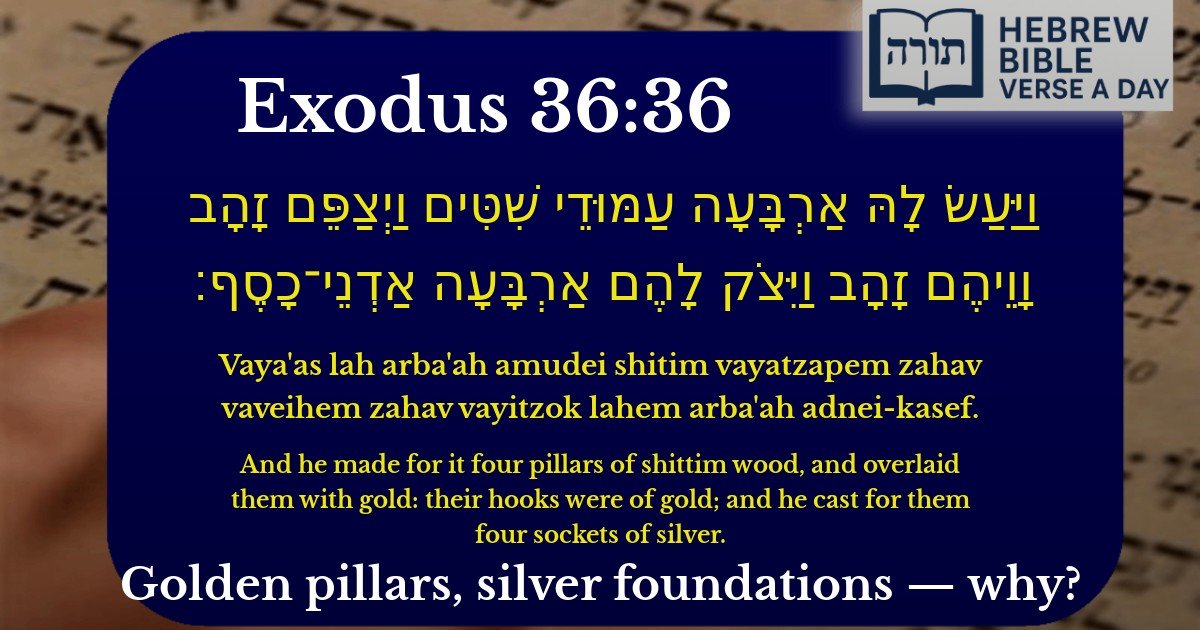

The Construction of the Mishkan's Curtain Pillars
The verse (Shemot 36:36) describes the making of four pillars for the parochet (the curtain separating the Holy of Holies from the rest of the Mishkan). These pillars were constructed from shittim wood (acacia), overlaid with gold, with golden hooks, and set into silver sockets. Rashi explains that these four pillars corresponded to the four directions (north, south, east, west), symbolizing the universal presence of the Divine in the Mishkan.
Symbolism of the Materials
The Number Four
The Talmud (Yoma 72a) associates the number four with the four foundational elements of creation (earth, water, air, fire), suggesting that the Mishkan was a microcosm of the universe. The Kli Yakar adds that the four pillars also parallel the four matriarchs (Sarah, Rivka, Rachel, Leah), whose merit supports the spiritual structure of Israel.
Function of the Pillars
According to the Ramban, the pillars served not only as structural supports but also as a boundary between the sacred and the most sacred, teaching the principle of kedushah (holiness) as a gradual ascent. The golden hooks (vaveihem) held the parochet in place, which the Sforno explains as a metaphor for how mitzvot "hook" and elevate the physical world to a higher spiritual plane.