Frequently Asked Questions
Q: What does the description of the Menorah's design in Exodus 37:19 represent?
A: The Menorah's design with almond-shaped cups, bulbs, and flowers symbolizes growth and divine light. Rashi explains that the almond (שָׁקֵד) motif reminds us of G-d's watchfulness (from the root ש.ק.ד, meaning 'to be diligent'), as the almond tree blossoms quickly. The intricate details teach us that every aspect of the Mishkan (Tabernacle) had spiritual significance.
Q: Why are almonds specifically mentioned in the Menorah's design?
A: Almonds (שְׁקֵדִים) are mentioned because they represent haste and divine providence. The Midrash (Bamidbar Rabbah 15:7) connects almonds to Aaron’s staff, which miraculously blossomed almonds overnight (Numbers 17:23), showing G-d’s swift judgment and blessing. The Menorah’s almond-shaped cups remind us of G-d’s constant presence and attention to our actions.
Q: How does the Menorah's structure apply to our lives today?
A: The Rambam (Hilchos Beis HaBechirah 3:12) explains that the Menorah’s light symbolizes wisdom and Torah study. Just as the Menorah’s branches all faced the center, we must direct our actions toward divine service. The almond design teaches us to be diligent in mitzvos, as the almond tree 'awakens' before other trees—a lesson in spiritual alertness.
Q: What is the significance of the 'bulb and flower' in the Menorah's design?
A: The כַּפְתֹּר (bulb) and פֶּרַח (flower) represent stages of growth. The Talmud (Menachos 28b) states that these details were hammered from a single piece of gold, showing unity in creation. The Sforno adds that they symbolize the potential for spiritual growth—just as a bulb blossoms into a flower, our mitzvos can blossom into greater holiness.
Q: Why does the Torah give such detailed instructions about the Menorah?
A: The details emphasize the importance of beauty and precision in serving G-d. The Ramban (Exodus 25:31) notes that the Menorah’s light represents the divine wisdom that illuminates the world. Every detail—like the almond cups—teaches deeper lessons about G-d’s presence, making the Menorah not just a physical object but a spiritual guide.

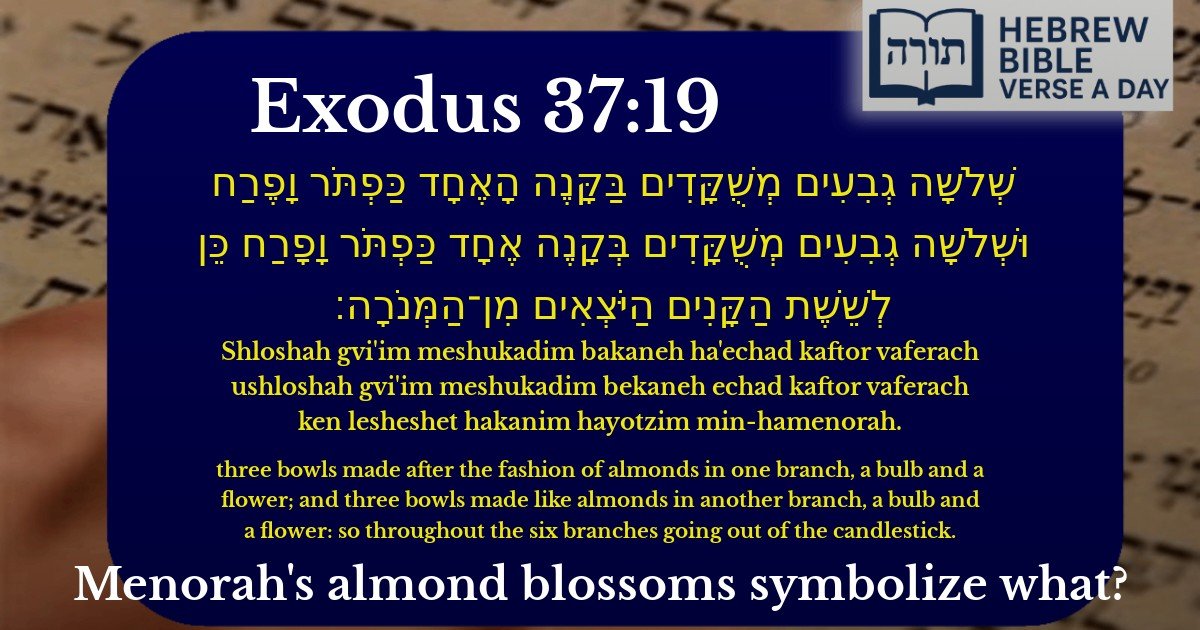

Context of the Verse
This verse (Shemot 25:33) describes the intricate design of the Menorah (candlestick) in the Mishkan (Tabernacle). The Menorah had a central shaft with six branches extending from it—three on each side—each adorned with decorative elements: gevi'im (bowls), kaftorim (bulbs), and perachim (flowers). The bowls were shaped like almonds (meshukadim), symbolizing divine providence and spiritual growth.
Symbolism of the Almond Design
Rashi explains that the term meshukadim (almond-shaped) alludes to the almond tree, which blossoms quickly. This symbolizes Hashem's swift judgment and reward, as referenced in Yirmiyahu 1:11-12, where the almond branch represents divine vigilance ("shoked ani al devari"—"I am hastening My word"). The Menorah's design thus reflects the immediacy of divine justice and the flourishing of spiritual light.
Structure of the Menorah's Branches
Harmony of the Six Branches
The symmetry of the six branches (three on each side) mirrors the balance in creation and the unity of Klal Yisrael. The Midrash (Bamidbar Rabbah 15:7) compares the Menorah to the Torah, whose light illuminates all directions. The almond motif reinforces the idea that Torah study and mitzvot must be pursued with urgency and diligence, like the swift blooming of the almond tree.
Practical Halachic Details
According to the Mishneh Torah (Hilchot Klei HaMikdash 3:2), the Menorah's design was a divine commandment with precise measurements. The almond-shaped bowls were not merely decorative but served as a reminder of the Shechinah's presence. The Ramban adds that the Menorah's light symbolizes the eternal flame of Torah, which must be kindled continuously in the hearts of Bnei Yisrael.