
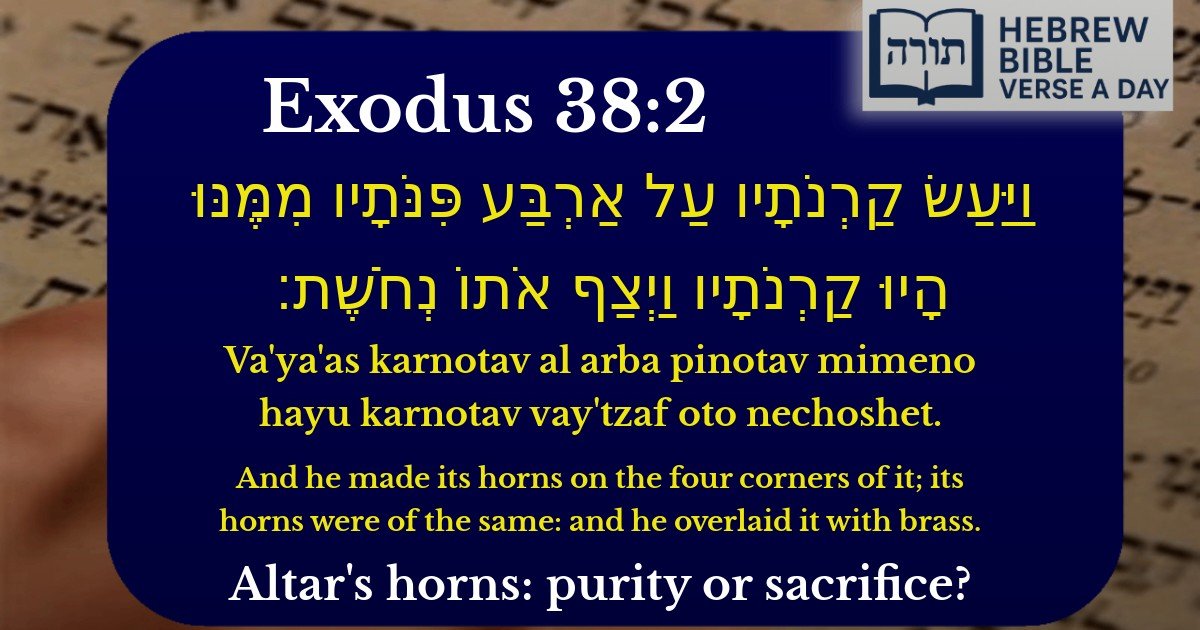

Exodus 38:2 - Altar's horns: purity or sacrifice?

Exodus 38:2 - שמות 38:2

Hebrew Text

וַיַּעַשׂ קַרְנֹתָיו עַל אַרְבַּע פִּנֹּתָיו מִמֶּנּוּ הָיוּ קַרְנֹתָיו וַיְצַף אֹתוֹ נְחֹשֶׁת׃

English Translation

And he made its horns on the four corners of it; its horns were of the same: and he overlaid it with brass.

Transliteration

Va'ya'as karnotav al arba pinotav mimeno hayu karnotav vay'tzaf oto nechoshet.

Hebrew Leining Text

וַיַּ֣עַשׂ קַרְנֹתָ֗יו עַ֚ל אַרְבַּ֣ע פִּנֹּתָ֔יו מִמֶּ֖נּוּ הָי֣וּ קַרְנֹתָ֑יו וַיְצַ֥ף אֹת֖וֹ נְחֹֽשֶׁת׃

🎵 Listen to leining

Parasha Commentary

The Horns of the Altar

The verse describes the construction of the mizbeach (altar) in the Mishkan, specifically its four horns. Rashi (Shemot 27:2) explains that these horns were protrusions at the four corners of the altar, rising upward like the horns of an ox. They were an integral part of the altar's structure, formed from the same material rather than being attached separately.

Symbolism of the Horns

According to the Midrash (Shemot Rabbah 34:11), the horns symbolize several spiritual concepts:

  • Strength and Power: Just as an animal's horns represent its strength, the altar's horns signify the power of atonement and divine service.
  • Protection: The Talmud (Zevachim 53b) teaches that one who grasped the horns of the altar could seek refuge, as seen in the case of Yoav (1 Melachim 2:28).
  • Connection to the Four Corners of the World: The four horns allude to the altar's universal role in drawing divine influence to all nations (Malbim, Shemot 27:2).

The Overlay of Brass

The verse states that the altar was overlaid with nechoshet (brass). Rambam (Hilchos Beis HaBechirah 2:3) notes that this coating served both a practical and symbolic purpose:

  • It protected the altar from the intense heat of the sacrifices.
  • Brass symbolizes judgment (din), reflecting the altar's role in atoning for sins (Kli Yakar, Shemot 27:2).

Halachic Significance

The horns were essential for certain sacrificial rites. The Torah (Vayikra 4:25) requires that the blood of some offerings be placed on the horns, emphasizing their role in the atonement process. The Mishnah (Zevachim 5:3) details the precise manner in which this was performed, highlighting their halachic importance.

📚 Talmud Citations

This verse is quoted in the Talmud.

📖 Zevachim 53b
The verse is referenced in a discussion about the construction of the altar and the significance of its horns.
📖 Menachot 97b
The verse is cited in a discussion about the materials used in the construction of the altar and their symbolic meanings.

Frequently Asked Questions

Q: What are the 'horns' mentioned in Exodus 38:2?
A: The 'horns' (קַרְנֹתָיו) refer to the four raised corners on the Mizbe'ach (Altar) in the Mishkan (Tabernacle). According to Rashi, these horns were hollow and protruded upward, symbolizing strength and elevation in serving Hashem. They were an integral part of the altar used for certain sacrificial procedures.
Q: Why was the altar overlaid with brass (נְחֹשֶׁת)?
A: The brass overlay served both a practical and symbolic purpose. Practically, brass is durable and could withstand the heat of the sacrifices. Symbolically, the Midrash teaches that brass represents judgment (din), reminding us that the altar was a place of atonement where sins were judged and forgiven through proper service to Hashem.
Q: Why did the altar have four corners with horns?
A: The four corners with horns correspond to the four directions of the world, as the Rambam explains, showing that the Mishkan's sanctity and the power of repentance (through the altar's service) extend universally. The Talmud (Zevachim 53b) also teaches that the horns were where special rituals like sprinkling blood were performed during certain sacrifices.
Q: What can we learn from the design of the altar today?
A: The design teaches us about the importance of structure and intentionality in serving Hashem. Just as every detail of the altar had meaning, our prayers and mitzvot today should be performed with focus and sincerity. The Malbim notes that the horns' upward direction reminds us to elevate our actions spiritually.