Frequently Asked Questions
Q: What are the vessels mentioned in Exodus 38:3 used for?
A: The vessels mentioned—pans, shovels, basins, forks, and firepans—were all essential tools for the service in the Mishkan (Tabernacle). According to Rashi, the pans were used to collect ashes, the shovels for removing ashes, the basins for holding blood of sacrifices, the forks for arranging the sacrifices on the altar, and the firepans for carrying coals.
Q: Why were all the altar vessels made of brass (copper)?
A: The Rambam (Maimonides) explains in the Mishneh Torah that brass was used because it withstands high heat well, making it practical for altar use. Additionally, the Midrash teaches that brass symbolizes strength and durability, reflecting the enduring nature of the service to Hashem.
Q: What can we learn from the detailed description of the Mishkan's vessels?
A: The Talmud (Yoma 72a) teaches that the precise details highlight the importance of every aspect of divine service. Just as each vessel had a specific purpose, every mitzvah and detail in Torah has significance. This teaches us to approach mitzvot with care and attention to detail.
Q: How does the making of the altar vessels apply to us today?
A: The Kli Yakar explains that just as the vessels were dedicated to holy service, we must sanctify our actions for a higher purpose. Even mundane objects (like pots or utensils) can be elevated when used for mitzvot, such as hospitality or tzedakah.
Q: Why does the Torah list each vessel separately instead of just saying 'all the vessels'?
A: Rashi notes that each vessel had a unique role, and listing them individually emphasizes their individual importance. The Midrash Tanchuma adds that this teaches us that every person, like every vessel, has a unique purpose in serving Hashem.


Overview of the Verse
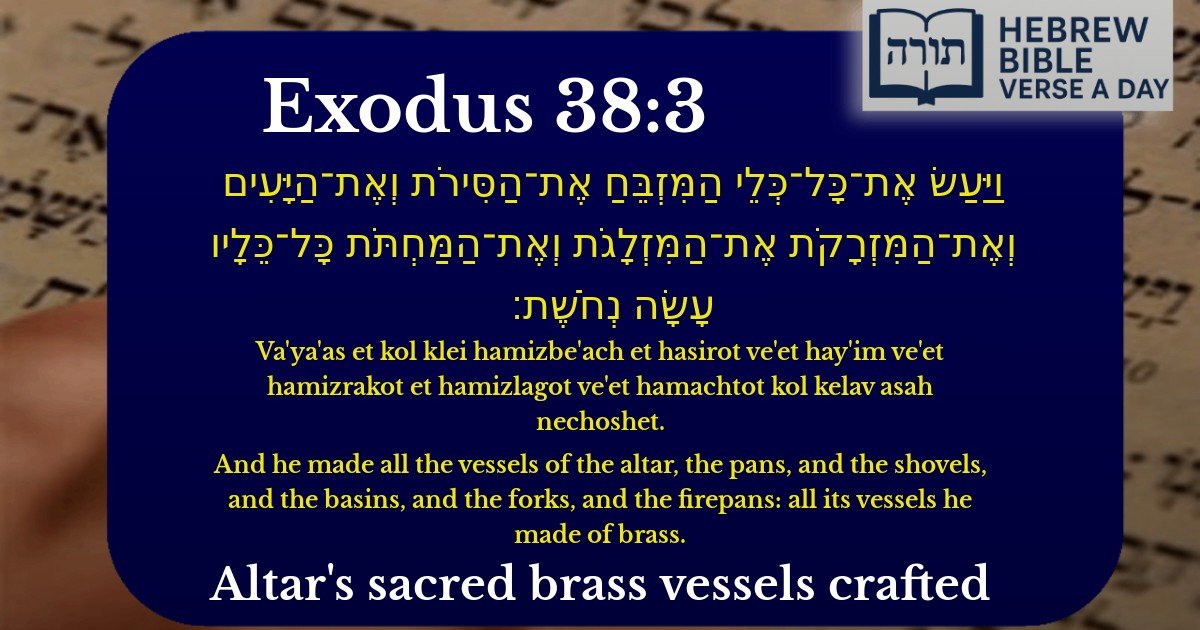
The verse describes the completion of the vessels used for the altar in the Mishkan (Tabernacle), specifying that they were all made of nechoshet (brass or copper). This follows the detailed instructions given earlier in the Torah regarding the construction of these sacred implements.
Rashi's Commentary
Rashi (Exodus 38:3) explains that the sirot (pans) were used to collect the ashes from the altar, while the yaim (shovels) were for removing ashes from the inner altar. The mizrakot (basins) were for sprinkling blood during sacrifices, and the mizlagot (forks) were used by the Kohanim to arrange the sacrificial pieces on the altar. The machtot (firepans) were for carrying coals.
Symbolism of Brass (Nechoshet)
The choice of brass for these vessels carries deep significance:
Purpose of the Vessels
Each vessel had a specific role in the sacrificial service:
Midrashic Insight
The Midrash Tanchuma (Pekudei 11) teaches that the meticulous crafting of these vessels reflects the importance of every detail in divine service. Just as each vessel had a unique purpose, every mitzvah contributes to the sanctity of the Mishkan—and by extension, the world.