Frequently Asked Questions
Q: What is the significance of the rod (מַטֶּה) in Exodus 4:17?
A: The rod (מַטֶּה) symbolizes authority and divine power. According to Rashi, it was the same staff used by Moses to perform miracles before Pharaoh, demonstrating Hashem's might. The Midrash (Shemot Rabbah) teaches that this staff was created during the six days of Creation and was passed down through righteous leaders like Adam, Noah, and Abraham.
Q: Why did Hashem command Moses to take the rod in his hand?
A: Hashem instructed Moses to take the rod to show that the miracles performed would come through divine power, not Moses' own abilities. The Rambam (Moreh Nevuchim) explains that using a physical object like the rod helps people recognize that the wonders are from Hashem, not human magic or trickery.
Q: What can we learn from Moses using the rod to perform signs?
A: We learn that true leadership and miracles come from Hashem's will, not human strength. The Talmud (Sanhedrin 93b) teaches that a leader must be like Moses—humble and dependent on Hashem’s guidance. The rod reminds us that even ordinary objects can become tools for holiness when used with faith.
Q: How does the concept of the rod apply to us today?
A: Just as the rod was a tool for divine miracles, we are taught (Avot 2:12) that all our actions should be for the sake of Heaven. Whether through simple objects or daily mitzvot, we can sanctify the physical world by using it for a higher purpose, as Moses did with the rod.
Q: What were the 'signs' (אוֹתוֹת) mentioned in this verse?
A: The 'signs' refer to the miracles Moses performed before Pharaoh, such as turning the rod into a snake (Exodus 4:3) and later bringing the plagues. Rashi explains that these signs were proofs of Hashem’s authority and Moses' divine mission to free the Jewish people from Egypt.

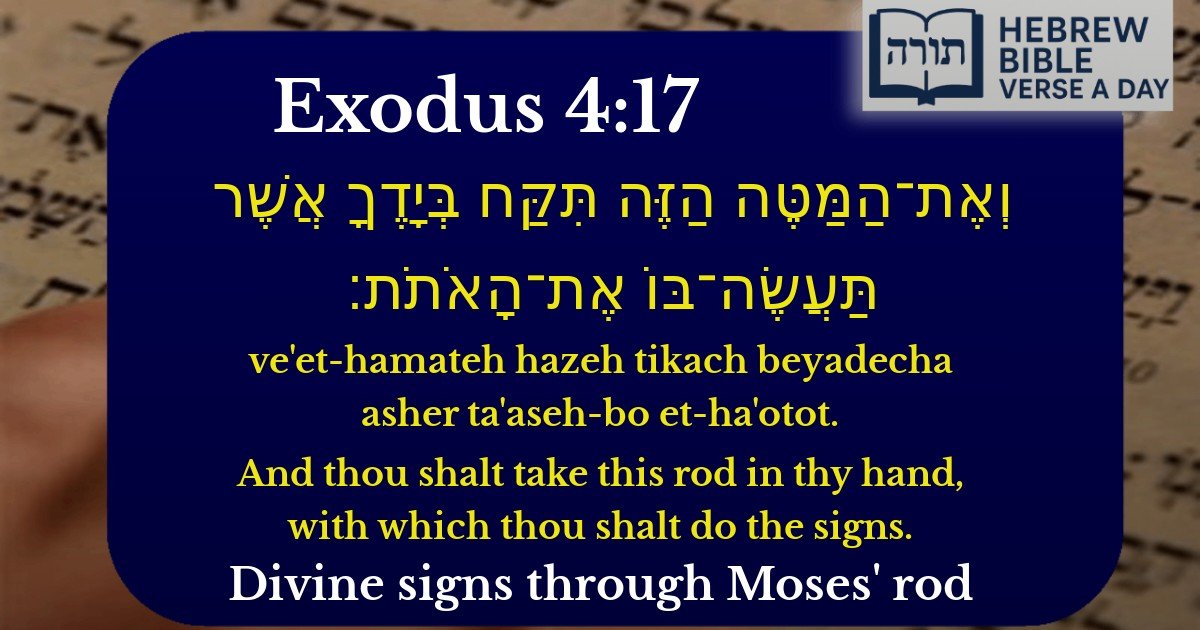

The Significance of the Rod in Moshe's Hand
The verse (Shemot 4:17) states, "And thou shalt take this rod in thy hand, with which thou shalt do the signs." Rashi explains that this rod was the same one Moshe used to shepherd Yitro's flock, symbolizing his leadership role. The Midrash (Shemot Rabbah 2:6) elaborates that this rod was created during the twilight of the sixth day of Creation, alongside other miraculous objects like the Luchos and the Shamir.
The Rod as a Tool for Divine Signs
Rambam (Moreh Nevuchim 2:45) teaches that the rod was not inherently magical but served as a conduit for Hashem's will, demonstrating His power over nature. The signs performed with it—such as turning into a snake (Shemot 4:3) or splitting the sea (Shemot 14:16)—were meant to affirm Moshe's divine mission to both Bnei Yisrael and Pharaoh.
Symbolism of the Rod
Practical Lessons
The Kli Yakar emphasizes that the rod's transformation into a snake and back (Shemot 4:4) taught Moshe that even apparent obstacles (symbolized by the snake) revert to their true purpose when guided by divine command. This reinforces the idea that all tools—physical or spiritual—are sanctified when used for Hashem's service.