Frequently Asked Questions
Q: What does it mean that Israel is called God's 'firstborn' in Exodus 4:22?
A: In Exodus 4:22, when Hashem calls Israel His 'firstborn,' it signifies the special, chosen relationship between G-d and the Jewish people. Rashi explains that this designation gives Israel precedence and a higher status among nations, like a firstborn son who receives a double portion of inheritance. This metaphor emphasizes Israel's unique role in serving G-d and receiving the Torah.
Q: Why did G-d tell Moshe to say this specifically to Pharaoh?
A: G-d instructed Moshe to tell Pharaoh that Israel is His firstborn to emphasize that enslaving the Jewish people was an offense against G-d Himself. The Midrash (Shemot Rabbah) explains that this message was a warning—just as a firstborn holds a special place in a father's heart, harming Israel would provoke G-d's direct intervention, leading to the Plagues and the Exodus.
Q: How does the idea of Israel being G-d's 'firstborn' apply to Jews today?
A: The title of 'firstborn' reminds Jews of their eternal covenant with G-d and their responsibility to live according to the Torah. The Rambam (Hilchot Yesodei HaTorah) teaches that this relationship comes with obligations—just as a firstborn serves in the Temple, Jews are called to be a 'kingdom of priests' (Exodus 19:6) by upholding mitzvot and being a moral example to the world.
Q: Does 'firstborn' mean other nations are also G-d's children?
A: While Israel is called the 'firstborn,' this doesn’t exclude other nations from having a relationship with G-d. The Talmud (Avodah Zarah 2b) teaches that all humanity are G-d’s creations, but Israel was chosen for a unique role—to receive and uphold the Torah. The term 'firstborn' highlights priority in service and responsibility, not exclusivity in divine care.
Q: What lesson can we learn from Israel being called G-d's 'son' in this verse?
A: Calling Israel G-d's 'son' teaches about divine love and discipline. Just as a father guides his child, G-d guides the Jewish people through challenges (like the Exodus) for their ultimate growth. The Sforno notes that this metaphor also implies accountability—a son must honor his father, just as Israel must follow G-d’s commandments with loyalty and devotion.

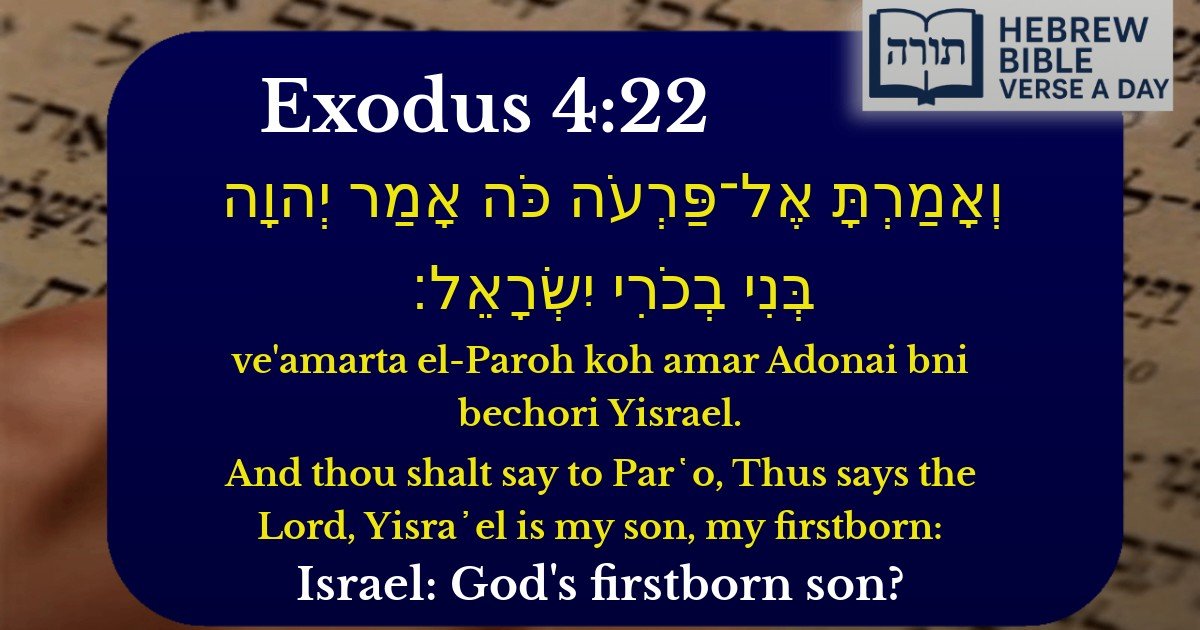

The Significance of "My Son, My Firstborn"
In this verse (Shemot 4:22), Hashem instructs Moshe to tell Pharaoh that Yisrael is His "son, firstborn." Rashi explains that this designation signifies the special relationship between Hashem and the Jewish people, akin to a father's bond with his firstborn son. The term "firstborn" conveys both privilege and responsibility, as the firstborn inherits a double portion and assumes leadership roles within the family.
Spiritual Primacy of Yisrael
The Ramban (Nachmanides) elaborates that calling Yisrael the "firstborn" emphasizes their chosen status among nations. Just as a firstborn holds a unique position in a household, Klal Yisrael is set apart to serve Hashem and uphold the Torah. The Midrash (Shemot Rabbah 5:7) compares this to a king who favors his firstborn above all other children, highlighting the intimacy of the bond.
Contrast with Pharaoh's Claim
Rabbi Samson Raphael Hirsch notes that this declaration directly challenges Pharaoh's arrogance. Pharaoh viewed himself as a divine ruler (as Egyptian tradition held), but Hashem asserts that true divine favor rests with Yisrael. The Ibn Ezra adds that this message was meant to humble Pharaoh by showing that his perceived power was subordinate to Hashem's will.
Implications for the Exodus