Frequently Asked Questions
Q: What does 'a bloody bridegroom' mean in Exodus 4:26?
A: The phrase 'a bloody bridegroom' (חֲתַן דָּמִים) refers to Moshe (Moses) being in danger because he had neglected the mitzvah of circumcision for his son. Tziporah (his wife) quickly performed the circumcision to save Moshe's life, showing the urgency of fulfilling this commandment. Rashi explains that an angel sought to kill Moshe for failing to circumcise his son, emphasizing the importance of brit milah (circumcision) in Jewish tradition.
Q: Why was Moshe in danger in Exodus 4:26?
A: Moshe was in danger because he had delayed circumcising his son, which is a fundamental mitzvah in Judaism. The Midrash teaches that an angel came to punish Moshe for this neglect. Tziporah understood the urgency and performed the circumcision herself, saving Moshe’s life. This teaches the importance of prioritizing mitzvot, especially brit milah, which is a covenant between Hashem and the Jewish people.
Q: What lesson can we learn from Exodus 4:26 about circumcision?
A: This verse teaches the vital importance of brit milah (circumcision) in Judaism. Even Moshe, the greatest prophet, was held accountable for delaying this mitzvah. The Rambam (Maimonides) writes that circumcision is one of the foundational commandments, symbolizing the eternal covenant between Hashem and the Jewish people. The incident reminds us to fulfill mitzvot promptly and not take them lightly.
Q: Why did Tziporah say 'a bloody bridegroom' after circumcising her son?
A: Tziporah called Moshe a 'bloody bridegroom' because she had just performed an emergency circumcision to save his life. Rashi explains that she recognized the danger Moshe was in due to neglecting this mitzvah. Her quick action demonstrated her wisdom and commitment to fulfilling Hashem’s commandments, even in difficult circumstances.
Q: How does Exodus 4:26 relate to Jewish practice today?
A: This verse reinforces the everlasting importance of brit milah (circumcision) in Jewish life. Today, Jewish boys are circumcised on the eighth day after birth, as commanded in the Torah (Genesis 17:12). The story reminds us that fulfilling mitzvot, especially foundational ones like brit milah, is essential to our covenant with Hashem and cannot be delayed without consequence.

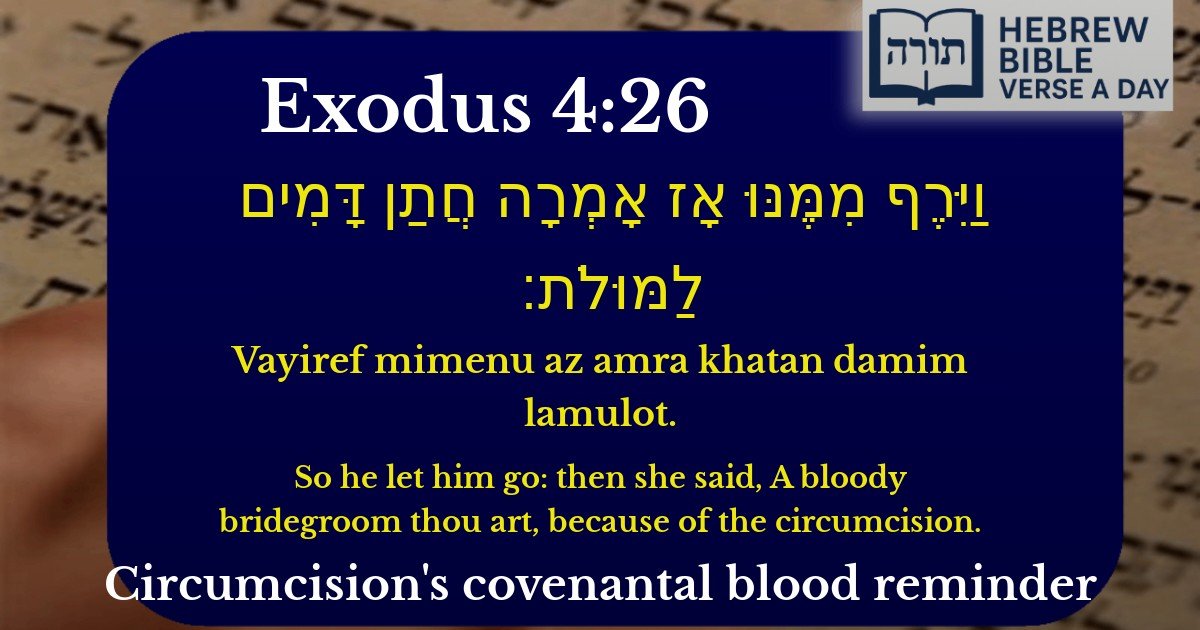

Context of the Verse
This verse (Shemot 4:26) appears in the narrative of Moshe's return to Egypt, where he is confronted by Hashem for failing to circumcise his son. Tziporah, Moshe's wife, performs the brit milah (circumcision) on their son and declares, "חֲתַן דָּמִים לַמּוּלֹת" ("A bloody bridegroom you are, because of the circumcision"). The situation is urgent, as Moshe's life is at risk due to this omission.
Rashi's Explanation
Rashi explains that the phrase "חֲתַן דָּמִים" refers to Moshe being saved from death due to the blood of the brit milah. Tziporah's declaration acknowledges that Moshe was spared only because she acted swiftly to fulfill the mitzvah. Rashi also notes that the term "חֲתַן" (bridegroom) is used because Moshe had recently been reunited with his wife and son, making him akin to a bridegroom in this context.
Midrashic Interpretations
The Midrash (Shemot Rabbah 5:8) elaborates that an angel sought to kill Moshe for neglecting the brit milah, emphasizing the severity of the mitzvah. Tziporah's quick action demonstrated her understanding of its critical importance. The Midrash also suggests that the term "דָּמִים" (blood) is plural to signify both the blood of circumcision and the blood of the Paschal sacrifice, linking this event to future redemptions.
Rambam's Perspective
Rambam (Hilchot Milah 1:1-2) underscores that brit milah is a foundational covenant for the Jewish people, binding in all generations. Moshe's near-death experience highlights that even the greatest leaders are not exempt from this obligation. Tziporah's intervention serves as a reminder that the mitzvah must be performed without delay.
Key Lessons