
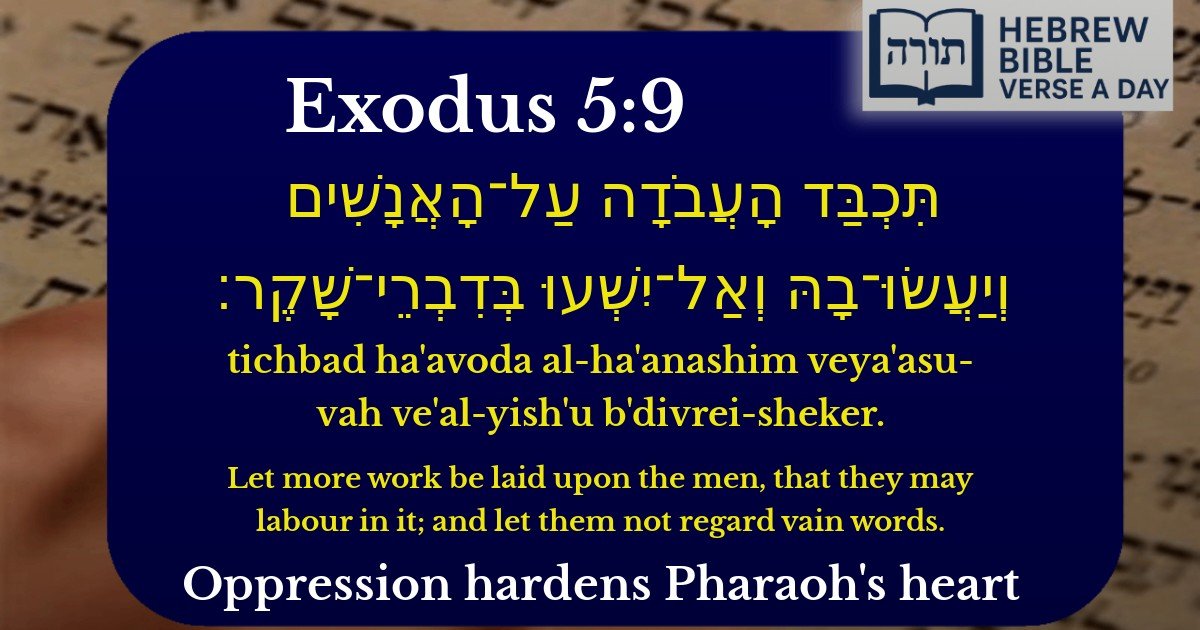

Exodus 5:9 - Oppression hardens Pharaoh's heart

Exodus 5:9 - שמות 5:9

Hebrew Text

תִּכְבַּד הָעֲבֹדָה עַל־הָאֲנָשִׁים וְיַעֲשׂוּ־בָהּ וְאַל־יִשְׁעוּ בְּדִבְרֵי־שָׁקֶר׃

English Translation

Let more work be laid upon the men, that they may labour in it; and let them not regard vain words.

Transliteration

Tichbad ha'avoda al-ha'anashim veya'asu-vah ve'al-yish'u b'divrei-sheker.

Hebrew Leining Text

תִּכְבַּ֧ד הָעֲבֹדָ֛ה עַל־הָאֲנָשִׁ֖ים וְיַעֲשׂוּ־בָ֑הּ וְאַל־יִשְׁע֖וּ בְּדִבְרֵי־שָֽׁקֶר׃

🎵 Listen to leining

Parasha Commentary

Context in Shemot (Exodus)

This verse (Shemot 5:9) records Pharaoh's response to Moshe and Aharon's request to allow Bnei Yisrael to observe a festival in the wilderness. Pharaoh, suspecting their motives, intensifies the labor to crush their spirits and prevent them from heeding Moshe's words.

Pharaoh's Strategy

Rashi explains that Pharaoh sought to burden Bnei Yisrael with excessive labor so they would be too exhausted to entertain thoughts of freedom or listen to Moshe's promises of redemption. The phrase "וְאַל־יִשְׁעוּ בְּדִבְרֵי־שָׁקֶר" ("let them not regard vain words") reflects Pharaoh's dismissal of Moshe's message as deceitful (Rashi on Shemot 5:9).

The Nature of the Oppression

  • Physical and Psychological Tactics: The Midrash (Shemot Rabbah 5:18) emphasizes that Pharaoh aimed not only to physically exhaust Bnei Yisrael but also to break their hope by labeling their aspirations as "vain words."
  • Distraction from Emunah: Ramban (Nachmanides) notes that Pharaoh understood idle time could lead to spiritual reflection, so he increased labor to prevent Bnei Yisrael from contemplating redemption or divine promises.

Halachic and Ethical Insights

The Talmud (Sotah 11b) derives from this verse that oppressive labor is a tool tyrants use to suppress dissent. The Gemara further connects this to the broader principle that suffering can either crush or refine a nation—a theme later realized in Yetziat Mitzrayim (the Exodus).

Modern Application

Orthodox commentaries, such as the Malbim, highlight how Pharaoh's tactic mirrors attempts throughout history to undermine Jewish faith through persecution or distraction. The verse serves as a reminder of the resilience of Bnei Yisrael in holding to truth despite oppression.

📚 Talmud Citations

This verse is not quoted in the Talmud.

Frequently Asked Questions

Q: What does Exodus 5:9 mean when it says 'let more work be laid upon the men'?
A: In Exodus 5:9, Pharaoh responds to Moshe (Moses) and Aharon's (Aaron) request to let the Israelites go by increasing their workload. According to Rashi, Pharaoh did this to keep the Israelites too busy to think about freedom or listen to Moshe's message from Hashem. This shows Pharaoh's cruelty and his attempt to break their spirit.
Q: Why does Pharaoh say 'let them not regard vain words' in Exodus 5:9?
A: Pharaoh calls Moshe and Aharon's request to worship Hashem 'vain words' (דִבְרֵי־שָׁקֶר) because he refuses to acknowledge Hashem's authority. The Midrash explains that Pharaoh saw himself as a god and dismissed the idea of the Israelites serving another power. This reflects his arrogance and denial of divine truth.
Q: What lesson can we learn from Exodus 5:9 about oppression?
A: Exodus 5:9 teaches that oppression often increases when people seek freedom. Pharaoh's response—adding more labor—shows how tyrants try to crush hope. The Rambam teaches that this foreshadows the eventual redemption, proving that Hashem's plan cannot be stopped by human cruelty. It reminds us to trust in Hashem even in difficult times.
Q: How does Exodus 5:9 relate to Jewish perseverance?
A: This verse highlights the Jewish people's resilience. Despite Pharaoh's harsh decree, the Israelites eventually gained their freedom. The Talmud (Sotah 11a) praises Jewish women for maintaining faith during this period, showing that oppression could not destroy their spirit. This teaches us the power of perseverance and emunah (faith).
Q: What does 'let them labor in it' teach about Pharaoh's strategy?
A: Pharaoh's command 'let them labor in it' (וְיַעֲשׂוּ־בָהּ) was a tactic to exhaust the Israelites physically and mentally. Rashi explains that he wanted to prevent them from organizing or protesting. This reflects a common tactic of oppressors—keeping people too busy to resist. Yet, as the Torah shows, this strategy ultimately failed against Hashem's will.