
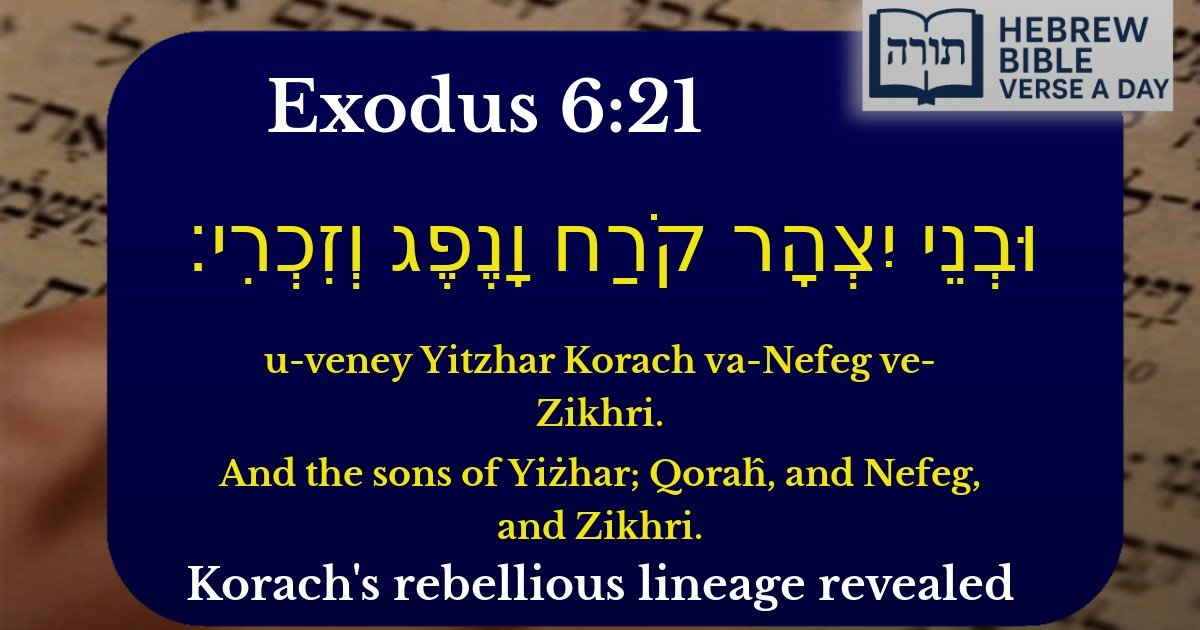

Exodus 6:21 - Korach's rebellious lineage revealed

Exodus 6:21 - שמות 6:21

Hebrew Text

וּבְנֵי יִצְהָר קֹרַח וָנֶפֶג וְזִכְרִי׃

English Translation

And the sons of Yiżhar; Qoraĥ, and Nefeg, and Zikhri.

Transliteration

U-veney Yitzhar Korach va-Nefeg ve-Zikhri.

Hebrew Leining Text

וּבְנֵ֖י יִצְהָ֑ר קֹ֥רַח וָנֶ֖פֶג וְזִכְרִֽי׃

🎵 Listen to leining

Parasha Commentary

The Lineage of Yiżhar

The verse lists the sons of Yiżhar: Qoraĥ (Korach), Nefeg, and Zikhri. Yiżhar was a son of Kehat, making him part of the prestigious Kehatite family within the tribe of Levi (Shemot 6:18). The Torah emphasizes lineage to highlight the importance of familial roles in the service of the Mishkan and later the Beit HaMikdash.

Korach's Notoriety

While the verse simply lists Korach as one of Yiżhar's sons, later narratives (Bamidbar 16) reveal his rebellion against Moshe and Aharon. Rashi (Bamidbar 16:1) notes that Korach's lineage is mentioned to show his distinguished background—he was a first cousin to Moshe and Aharon—yet he allowed his pride to lead him astray. The Midrash (Tanchuma Korach 1) elaborates that Korach, despite his wisdom and stature, was consumed by jealousy and a desire for honor.

The Significance of Nefeg and Zikhri

Nefeg and Zikhri are less prominent in later narratives, but their inclusion underscores the Torah's principle of recording all descendants, even those who did not achieve fame. The Talmud (Sanhedrin 109b) suggests that Korach's brothers did not join his rebellion, demonstrating that righteous choices are individual, even within the same family.

Lessons from the Verse

  • Lineage and Responsibility: Being born into a distinguished family (like the Kehatim) carries spiritual responsibilities (Rambam, Hilchot Klei HaMikdash 3:8).
  • The Danger of Ambition: Korach's story warns against allowing personal ambition to override divine authority (Midrash Rabbah Bamidbar 18:3).
  • Individual Accountability: Nefeg and Zikhri’s absence from Korach’s rebellion teaches that one must choose righteousness independently (Malbim on Bamidbar 16:1).

📚 Talmud Citations

This verse is not quoted in the Talmud.

Frequently Asked Questions

Q: Who was Korach in the Torah?
A: Korach was a descendant of Levi and a cousin of Moshe (Moses) and Aharon (Aaron). He is famously known for leading a rebellion against Moshe and Aharon, as described later in Bamidbar (Numbers) 16. Despite his prestigious lineage, his actions teach us about the dangers of arrogance and divisiveness.
Q: Why does the Torah list Korach's brothers Nefeg and Zikhri?
A: The Torah often lists family lineages to show the importance of each individual in Jewish history. While Nefeg and Zikhri are less prominent than Korach, their mention highlights that every person has significance. Rashi notes that even seemingly minor names in genealogies can carry deep meaning.
Q: What can we learn from Korach's story in the Torah?
A: Korach's rebellion teaches the importance of humility and respecting Torah leadership. The Talmud (Sanhedrin 110a) warns against disputes like Korach's, which were not for the sake of Heaven. His story reminds us to seek unity and follow the guidance of our sages.
Q: Why is Korach's lineage mentioned in Shemot (Exodus) before his rebellion in Bamidbar (Numbers)?
A: The Torah introduces Korach here to establish his family connection to Moshe and Aharon. This sets the stage for understanding his later rebellion, showing that even someone with a noble lineage can fall if they lack proper intentions. The Midrash emphasizes that lineage alone does not guarantee righteousness.