Frequently Asked Questions
Q: What does Exodus 6:29 mean?
A: Exodus 6:29 is where Hashem instructs Moshe to speak to Pharaoh, king of Egypt, exactly as Hashem commands him. This verse emphasizes Moshe's role as Hashem's messenger and reinforces that the words he delivers are divine, not his own. Rashi explains that this repetition (following earlier commands) was to strengthen Moshe's resolve, as speaking to Pharaoh was a daunting task.
Q: Why does Hashem say 'I am the Lord' in this verse?
A: When Hashem says 'I am the Lord' (אֲנִי יְהוָה), it serves as a reminder of His absolute authority and that Moshe is acting on His behalf. The Rambam teaches that this declaration reinforces that the mission to Pharaoh is divinely ordained and that Moshe must trust in Hashem's power, especially after his earlier doubts (Exodus 6:12).
Q: Why was Moshe told to speak to Pharaoh directly?
A: Moshe was chosen to speak to Pharaoh directly because he was the leader of Bnei Yisrael and Hashem's appointed prophet for the Exodus. The Midrash (Shemot Rabbah) explains that this confrontation demonstrated Hashem's supremacy over Pharaoh, who was considered a 'god' in Egyptian belief. By speaking boldly to Pharaoh, Moshe showed that true power comes only from Hashem.
Q: What lesson can we learn from Exodus 6:29 today?
A: This verse teaches us the importance of faithfully conveying Hashem's word without alteration, even when facing powerful opposition. Just as Moshe was instructed to speak 'all that I say to thee,' we learn from Chazal (our Sages) that Torah leaders must transmit teachings accurately and with courage, trusting in Hashem's guidance.
Q: Why is this verse important in the story of the Exodus?
A: This verse is crucial because it marks the beginning of Moshe's direct confrontation with Pharaoh, leading to the Ten Plagues and the eventual liberation of Bnei Yisrael. The Talmud (Sanhedrin 111a) highlights that Moshe's obedience in delivering Hashem's exact words set the stage for the miracles that proved Hashem's dominion over Egypt and the world.

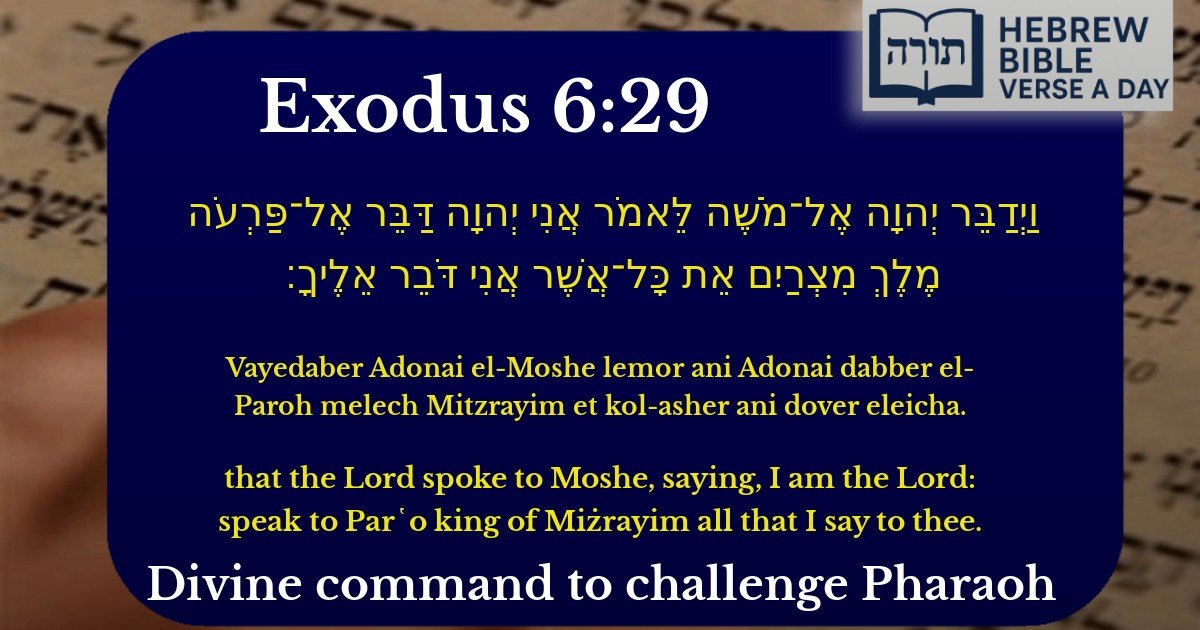

Divine Command to Speak to Pharaoh
The verse (Shemot 6:29) states: "וַיְדַבֵּר יְהוָה אֶל־מֹשֶׁה לֵּאמֹר אֲנִי יְהוָה דַּבֵּר אֶל־פַּרְעֹה מֶלֶךְ מִצְרַיִם אֵת כָּל־אֲשֶׁר אֲנִי דֹּבֵר אֵלֶיךָ" ("And the Lord spoke to Moshe, saying, 'I am the Lord: speak to Pharaoh king of Egypt all that I say to you'"). This directive follows Moshe's earlier hesitation to confront Pharaoh (Shemot 6:12), where he expressed doubt due to his speech impediment and the Israelites' reluctance to listen.
Rashi's Explanation
Rashi (Rabbi Shlomo Yitzchaki) comments that the phrase "אֲנִי יְהוָה" ("I am the Lord") serves as a reassurance to Moshe. It emphasizes that Hashem, in His omnipotence, is the One commanding him to speak to Pharaoh, despite any perceived obstacles. Rashi further notes that this repetition of Hashem's name underscores His authority and Moshe's role as His faithful messenger.
Rambam's Perspective
Rambam (Maimonides) in Moreh Nevuchim (Guide for the Perplexed) highlights the significance of prophecy in this verse. Moshe's mission is not based on personal initiative but on direct divine instruction. The phrase "אֵת כָּל־אֲשֶׁר אֲנִי דֹּבֵר אֵלֶיךָ" ("all that I say to you") reinforces the principle that a prophet must convey Hashem's words precisely, without alteration.
Midrashic Insights
The Midrash (Shemot Rabbah 7:3) elaborates that Hashem's command to Moshe was meant to strengthen his resolve. The Midrash compares this to a king who sends his servant on a mission, assuring him of royal backing. Similarly, Moshe is reminded that he acts with divine authority, and Pharaoh's resistance is ultimately futile against Hashem's will.