Frequently Asked Questions
Q: What does Exodus 7:6 mean when it says Moshe and Aharon did as Hashem commanded?
A: This verse teaches us that Moshe and Aharon followed Hashem's instructions precisely without adding or subtracting anything. Rashi explains that this emphasizes their complete obedience and trust in Hashem, setting an example for us to fulfill mitzvos exactly as commanded.
Q: Why is it important that Moshe and Aharon did exactly as commanded?
A: The Talmud (Eruvin 54b) teaches that meticulous fulfillment of mitzvos demonstrates our complete submission to Hashem's will. By doing exactly as commanded, Moshe and Aharon showed that even great leaders must follow Divine instructions without deviation, teaching us humility and precision in mitzvah observance.
Q: What lesson can we learn from Exodus 7:6 in our daily lives?
A: The Rambam (Mishneh Torah, Hilchos De'os) derives from this verse that we should perform mitzvos with the same care and completeness as Moshe and Aharon. Just as they didn't modify Hashem's commands based on their understanding, we too should follow halacha faithfully, even when we don't fully understand the reasons.
Q: How does this verse relate to the concept of emunas chachamim (faith in the sages)?
A: The Midrash (Shemos Rabbah 8:3) uses this verse to teach that just as Moshe and Aharon followed Hashem's word exactly, we must follow the teachings of our sages who transmit Torah law. Their precise obedience becomes the model for how we should relate to Torah authority throughout the generations.
Q: Why does the verse repeat 'so they did' at the end?
A: Rashi explains the repetition teaches that Moshe and Aharon not only intended to fulfill the commandment properly, but actually carried it out exactly as instructed. This teaches us the importance of both proper intention (kavanah) and proper action in performing mitzvos.


Literal Interpretation (Peshat)
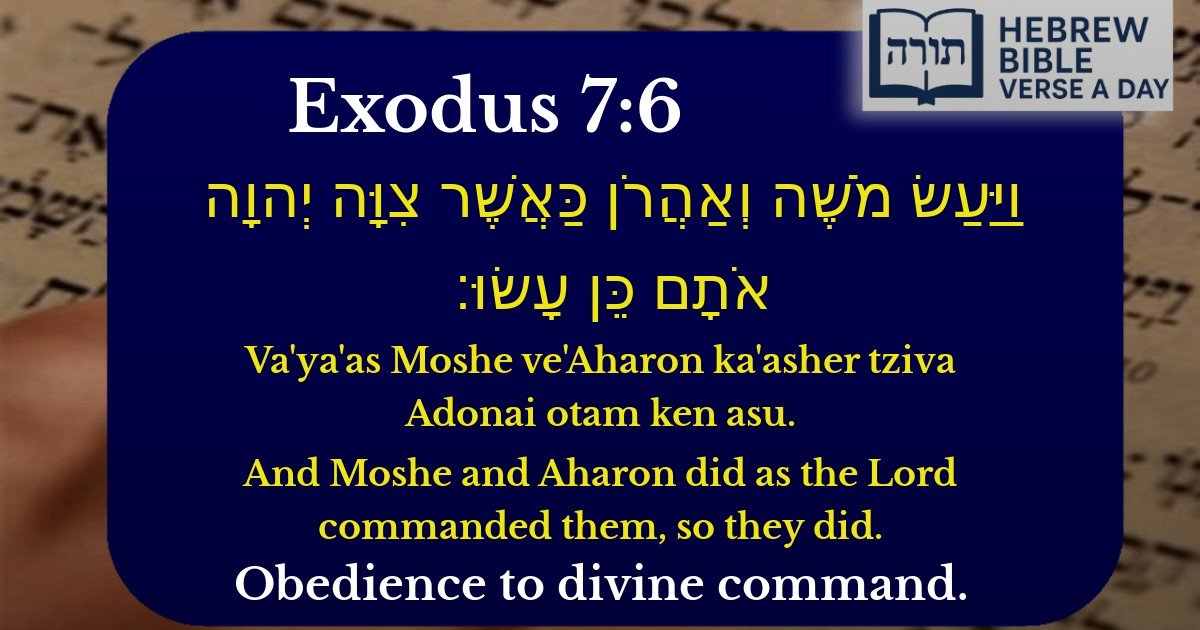
The verse (Shemot 7:6) states that Moshe and Aharon carried out Hashem's command precisely as instructed. Rashi emphasizes that this demonstrates their unwavering obedience and exact fulfillment of the divine will, without adding or omitting anything. The repetition of "כֵּן עָשׂוּ" ("so they did") underscores their complete adherence to the mitzvah.
Midrashic Insights (Derash)
The Midrash (Shemot Rabbah 9:5) highlights that Moshe and Aharon acted in perfect unity, despite their different roles. Their cooperation serves as a model for Jewish leadership, where individuals with distinct strengths work harmoniously to fulfill Hashem's will. The Midrash also notes that their actions were performed with simcha (joy) and zerizut (alacrity).
Halachic Perspective
Rambam (Hilchot Yesodei HaTorah 9:1) derives from this verse the principle that a navi (prophet) must carry out divine commands exactly as received. Any deviation would invalidate their prophetic status. This reinforces the Torah's insistence on precise adherence to mitzvot, a foundation of halachic practice.
Chassidic Interpretation
The Baal Shem Tov teaches that the double language ("וַיַּעַשׂ... כֵּן עָשׂוּ") reflects two dimensions of divine service:
True fulfillment requires both proper action and proper kavanah (intention).
Grammatical Observation
Ibn Ezra notes that the singular verb "וַיַּעַשׂ" (and he did) is used even though Moshe and Aharon are two individuals. This suggests that when fulfilling Hashem's will, they became like a single entity - a lesson in unity of purpose when serving the divine.