Frequently Asked Questions
Q: Why does the verse mention both Moshe and Aharon when speaking to Pharaoh?
A: According to Rashi, Moshe was the primary prophet, but Aharon was included because Moshe initially hesitated to speak due to his speech difficulties (Exodus 4:10). Aharon served as Moshe's spokesperson, especially when addressing Pharaoh.
Q: What is the significance of God speaking to both Moshe and Aharon together?
A: The Ramban explains that this shows unity in leadership. Both Moshe (representing Torah and prophecy) and Aharon (representing priesthood and service) were needed to convey God's message to Pharaoh, demonstrating that divine missions often require collaboration.
Q: Why does the Torah repeat 'saying' (לֵאמֹר) after God's command?
A: The Midrash teaches that 'saying' indicates Moshe and Aharon were to repeat God's words exactly to Pharaoh. This emphasizes the importance of accurately transmitting divine messages without alteration, a principle that applies to Torah teaching in all generations.
Q: How does this verse relate to leadership in Judaism today?
A: The Talmud (Sanhedrin 8a) derives from this verse that important communal matters should involve multiple leaders. Just as God addressed both Moshe and Aharon, Jewish communities today typically have rabbinic and lay leaders working together for important decisions.
Q: Why does the verse mention God speaking to them before the plagues begin?
A: Rashi explains this introduces the coming narrative of the plagues, showing that every action against Egypt was by direct divine command. This teaches that God controls nature and history, and nothing happens by chance - a foundational Jewish belief.

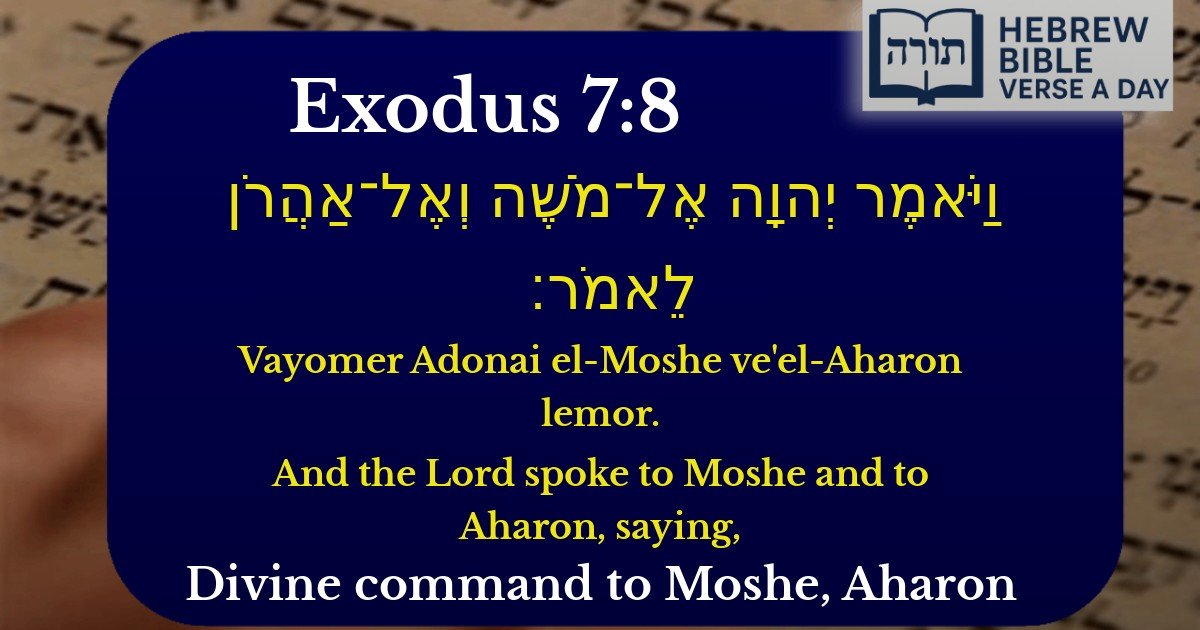

Divine Communication to Moshe and Aharon
The verse states, "And the Lord spoke to Moshe and to Aharon, saying" (Shemot 12:1). This phrasing appears frequently in the Torah, particularly in the context of mitzvot and divine instructions. Rashi notes that when Hashem addresses both Moshe and Aharon together, it often signifies a joint mission or a commandment that involves both leadership roles—Moshe as the primary prophet and Aharon as the Kohen Gadol.
The Significance of Addressing Both Leaders
Rambam (Hilchot Yesodei HaTorah 7:6) explains that Moshe was the primary conduit for prophecy, while Aharon served as his spokesperson to the people (as seen in Shemot 4:16). However, here, Hashem speaks to both directly, indicating their shared responsibility in transmitting the mitzvot related to the Exodus, particularly the laws of Pesach (as this verse introduces the commandments of the Korban Pesach). The Midrash (Shemot Rabbah 15:13) adds that Aharon was included to emphasize the importance of unity among leaders in fulfilling divine commandments.
Aharon's Elevated Role
The Talmud (Sanhedrin 99b) teaches that Aharon was not merely an assistant but an equal partner in certain aspects of leadership. The inclusion of Aharon in this verse highlights his unique role in:
The Language of "Leimor" (Saying)
The term "leimor" ("saying") is interpreted by the Baal HaTurim as an instruction for Moshe and Aharon to relay these commandments clearly to the people. The Ohr HaChaim adds that this emphasizes the obligation to teach Torah in a way that ensures its transmission to future generations, a principle foundational to Jewish tradition.