Frequently Asked Questions
Q: What does it mean that Pharaoh 'hardened his heart'?
A: When the Torah says Pharaoh 'hardened his heart,' it means he stubbornly refused to change his mind or listen to Moshe and Aharon, despite seeing the miracles and temporary relief from the plagues. According to Rashi, this was a punishment from Hashem because Pharaoh initially chose evil on his own—so later, Hashem prevented him from repenting (Shemos Rabbah 13:3).
Q: Why did Pharaoh change his mind after the plagues stopped?
A: The Midrash explains that Pharaoh only pretended to repent when suffering from the plagues, but his change wasn't sincere. Once the suffering stopped ('there was respite'), he returned to his stubborn ways (Shemos Rabbah 11:9). This teaches that true repentance requires lasting change, not just temporary reactions to hardship.
Q: What lesson can we learn from Pharaoh's hardened heart?
A: The Rambam (Hilchos Teshuvah 6:3) teaches that Pharaoh's story warns us not to delay repentance. If someone continuously ignores opportunities to improve, they risk becoming spiritually 'hardened' like Pharaoh, making it harder to change later. This verse reminds us to seize moments of clarity for self-improvement.
Q: How does this verse show Hashem's control over events?
A: The phrase 'as the Lord had said' proves that Pharaoh's actions fulfilled Hashem's plan. The Talmud (Berachos 7b) explains that Hashem sometimes allows free will to align with divine justice—Pharaoh's stubbornness led to more miracles, increasing awareness of Hashem's power (see Shemos 9:16).
Q: Why does the Torah repeat that Pharaoh didn't listen?
A: Repetition emphasizes Pharaoh's deliberate defiance. Ibn Ezra notes that each refusal compounded his guilt, showing progressive moral decline. This pattern appears in all ten plagues, teaching that ignoring truth repeatedly makes the heart less receptive—a warning about spiritual desensitization (based on Mishlei 29:1).

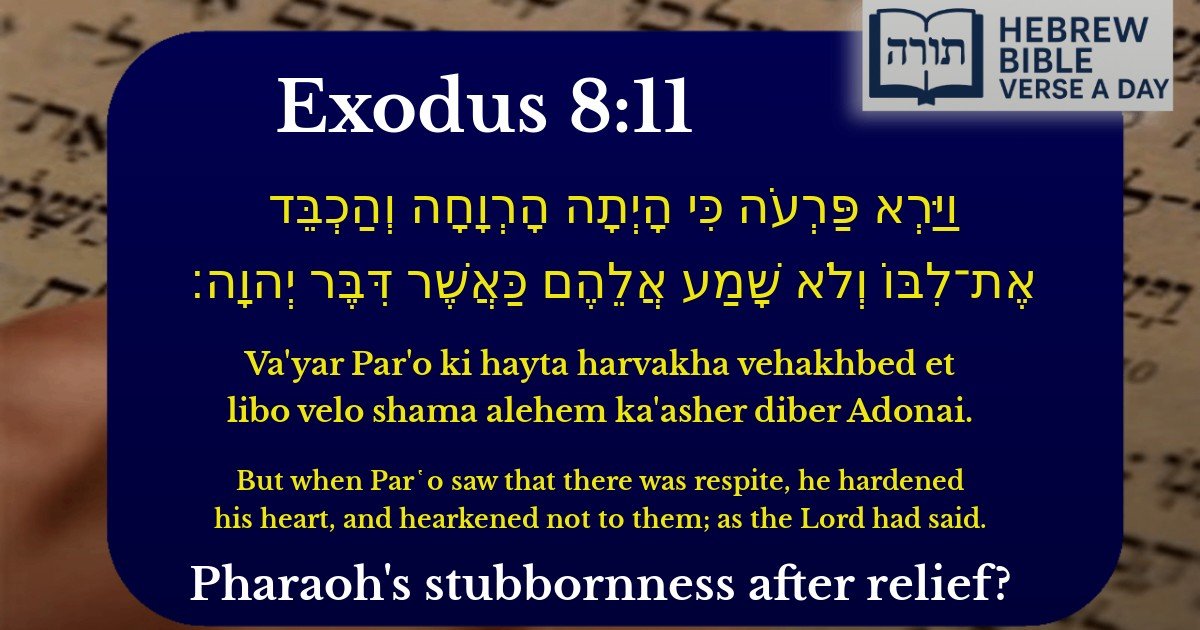

Understanding Pharaoh's Hardened Heart
The verse states: "But when Pharaoh saw that there was respite, he hardened his heart, and hearkened not to them; as the Lord had said." (Exodus 8:11). This describes Pharaoh's reaction after the plague of frogs was removed. The phrase "וַיַּרְא פַּרְעֹה כִּי הָיְתָה הָרְוָחָה" ("when Pharaoh saw that there was respite") is key to understanding his behavior.
Rashi's Explanation
Rashi (Exodus 8:11) explains that Pharaoh's heart was hardened precisely because the suffering ceased. When the plague ended, he reverted to his stubbornness, demonstrating that his temporary submission was not genuine repentance (teshuvah), but merely a reaction to distress. This aligns with the principle that true repentance requires a lasting change of heart, not just a response to suffering.
The Nature of Divine Hardening
The Rambam (Maimonides) in Hilchot Teshuvah (6:3) discusses how Pharaoh's free will was affected by G-d hardening his heart. The hardening was a consequence of Pharaoh's initial choices—after repeatedly rejecting repentance, G-d allowed his heart to remain obstinate as a form of divine justice. This ensured Pharaoh would face the full measure of consequences for his actions.
Midrashic Insights
Theological Implications
This verse underscores the principle that G-d's foreknowledge does not negate human free will. Pharaoh's stubbornness was his own choice, yet it fulfilled the divine plan. The Sforno notes that Pharaoh's repeated refusal to relent justified the escalation of plagues, ultimately revealing G-d's supremacy to both Egypt and Israel.