

Join Our Newsletter To Be Informed When New Videos Are Posted
Hebrew Text
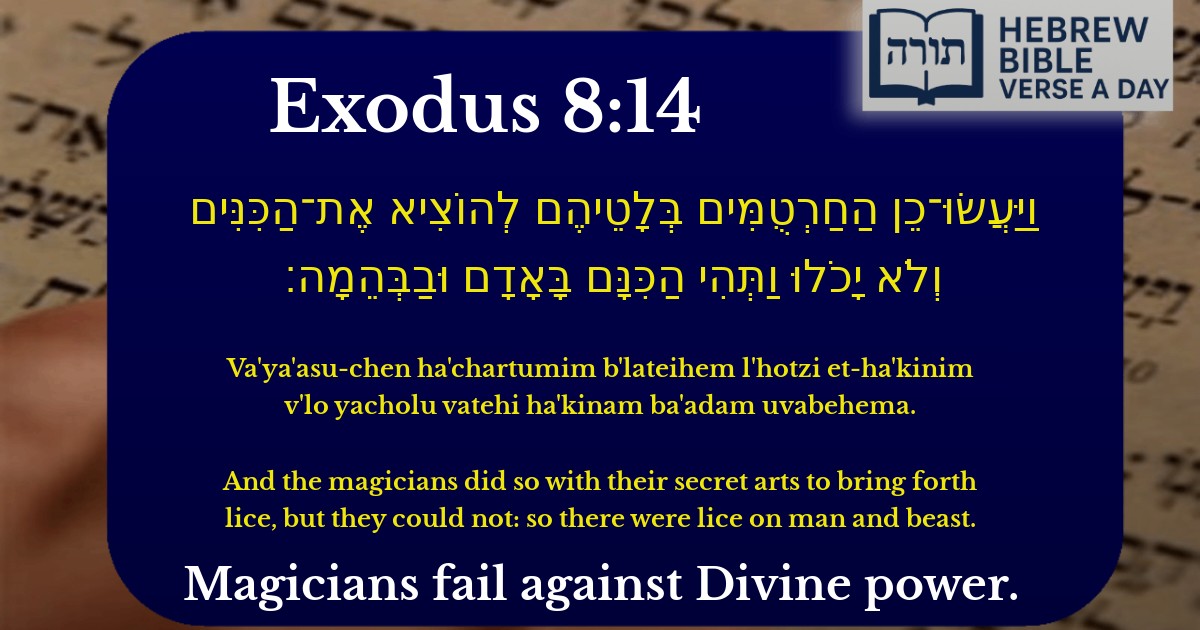
וַיַּעֲשׂוּ־כֵן הַחַרְטֻמִּים בְּלָטֵיהֶם לְהוֹצִיא אֶת־הַכִּנִּים וְלֹא יָכֹלוּ וַתְּהִי הַכִּנָּם בָּאָדָם וּבַבְּהֵמָה׃
English Translation
And the magicians did so with their secret arts to bring forth lice, but they could not: so there were lice on man and beast.
Transliteration
Va'ya'asu-chen ha'chartumim b'lateihem l'hotzi et-ha'kinim v'lo yacholu vatehi ha'kinam ba'adam uvabehema.
Hebrew Leining Text
וַיַּעֲשׂוּ־כֵ֨ן הַחַרְטֻמִּ֧ים בְּלָטֵיהֶ֛ם לְהוֹצִ֥יא אֶת־הַכִּנִּ֖ים וְלֹ֣א יָכֹ֑לוּ וַתְּהִי֙ הַכִּנָּ֔ם בָּאָדָ֖ם וּבַבְּהֵמָֽה׃
🎵 Listen to leining
Parasha Commentary
📚 Talmud Citations
This verse is not quoted in the Talmud.
Context of the Verse
This verse (Shemot 8:14) describes the third plague inflicted upon Egypt—the plague of kinim (lice)—and the failure of Pharaoh's magicians (chartumim) to replicate it through their occult practices. The inability of the magicians marks a turning point in the narrative, demonstrating the supremacy of Hashem's power over Egyptian sorcery.
Rashi's Commentary
Rashi explains that the magicians attempted to produce lice through their lataim (secret arts or incantations) but failed because demons and sorcery have no power over creatures as small as lice. He cites the Talmud (Sanhedrin 67b), which states that demons cannot manipulate anything smaller than a barley grain. Since lice are minuscule, the magicians were powerless to replicate this plague, proving that it was a divine act beyond human or demonic capability.
Rambam's Perspective
Rambam (Hilchot Avodat Kochavim 11:16) emphasizes that the magicians' failure exposed the limitations of their craft. Unlike the first two plagues (blood and frogs), which they could mimic to some extent, the plague of lice was beyond their reach. This distinction highlights that true miracles come only from Hashem, while sorcery is mere deception or manipulation of natural forces.
Midrashic Insights
Symbolism of the Plague
The kinim (lice) symbolize the degradation and futility of Egypt's idolatry. Unlike the previous plagues, which still allowed for some illusion of control, the lice demonstrated that even the smallest and most pervasive elements of creation are under Hashem's dominion. This plague also foreshadowed the complete dismantling of Egypt's false beliefs, as the magicians themselves were forced to concede defeat.
Halachic Implications
The Gemara (Chullin 67b) derives from this verse that lice do not reproduce sexually but are generated spontaneously from dust, based on the phrase "vatehi hakinam ba'adam uvabehema"—indicating their sudden, widespread appearance. This understanding is cited in halachic discussions regarding the permissibility of killing lice on Shabbat (Shulchan Aruch, Orach Chaim 316:9).