Frequently Asked Questions
Q: What is the 'grievous swarm of gnats' in Exodus 8:20?
A: The 'grievous swarm of gnats' (עָרֹב כָּבֵד) refers to one of the ten plagues Hashem brought upon Egypt. According to Rashi, these were not ordinary gnats but a mixture of wild animals and insects that caused great destruction and discomfort, demonstrating Hashem's power over nature.
Q: Why did Hashem send the plague of gnats (עָרֹב) specifically?
A: The plague of עָרֹב (gnats/wild animals) was a punishment for Egypt's cruelty to Bnei Yisrael. The Midrash explains that the Egyptians forced the Jews to clean their homes and stables, so Hashem brought these creatures into their own houses, showing that He protects His people and repays measure for measure.
Q: How did this plague affect the Egyptians differently from the previous plagues?
A: Unlike earlier plagues, the עָרֹב invaded Pharaoh's palace and his servants' homes, showing that no one—not even the elite—could escape Hashem's judgment. The Talmud (Sanhedrin 67b) notes that this plague also devastated the land itself, proving that Egypt's false gods had no power.
Q: What lesson can we learn from the plague of gnats today?
A: This plague teaches that Hashem controls all creatures and intervenes in history to uphold justice. The Rambam (Hilchot Teshuvah) emphasizes that recognizing Hashem's hand in such events strengthens our faith and reminds us to avoid cruelty, as wrongdoing ultimately brings consequences.
Q: Why does the verse say 'the land was devastated' by the gnats?
A: Rashi explains that the gnats ruined crops, livestock, and even the soil, making Egypt uninhabitable. This showed Pharaoh that Egypt's false 'gods' of nature (like the Nile or the earth) were powerless against Hashem’s will, as stated in Shemot Rabbah (10:7).

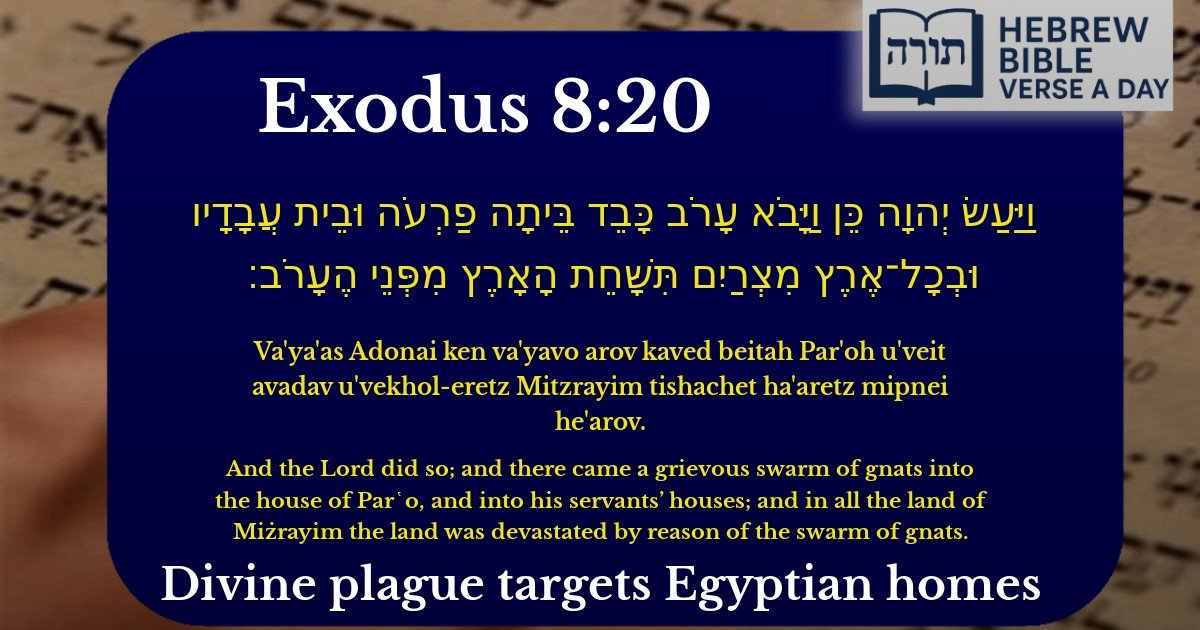

The Plague of Gnats (עָרֹב) in Egypt
The verse describes the third plague brought upon Egypt—a grievous swarm of gnats (עָרֹב). Rashi (Exodus 8:17) explains that this plague consisted of a mixture of wild animals and insects, causing widespread devastation. The term עָרֹב is derived from the root meaning "mixture," indicating that this was not a single species but a chaotic infestation of harmful creatures.
Divine Precision in the Plague
The verse emphasizes that the plague affected Pharaoh's house, his servants' houses, and all the land of Egypt, demonstrating Hashem's complete control over nature. The Rambam (Moreh Nevuchim 3:17) notes that each plague was meticulously designed to challenge Egyptian beliefs, particularly their deification of natural forces. The gnats, small yet uncontrollable, humiliated the Egyptians by showing their helplessness before the G-d of Israel.
The Land's Devastation
The phrase תִּשָּׁחֵת הָאָרֶץ ("the land was devastated") is interpreted by the Midrash (Shemot Rabbah 10:7) to mean that the gnats corrupted the land, making it uninhabitable. The Ibn Ezra adds that this plague disrupted daily life so severely that even basic activities like eating and sleeping became impossible due to the relentless swarm.
Spiritual Lessons