Frequently Asked Questions
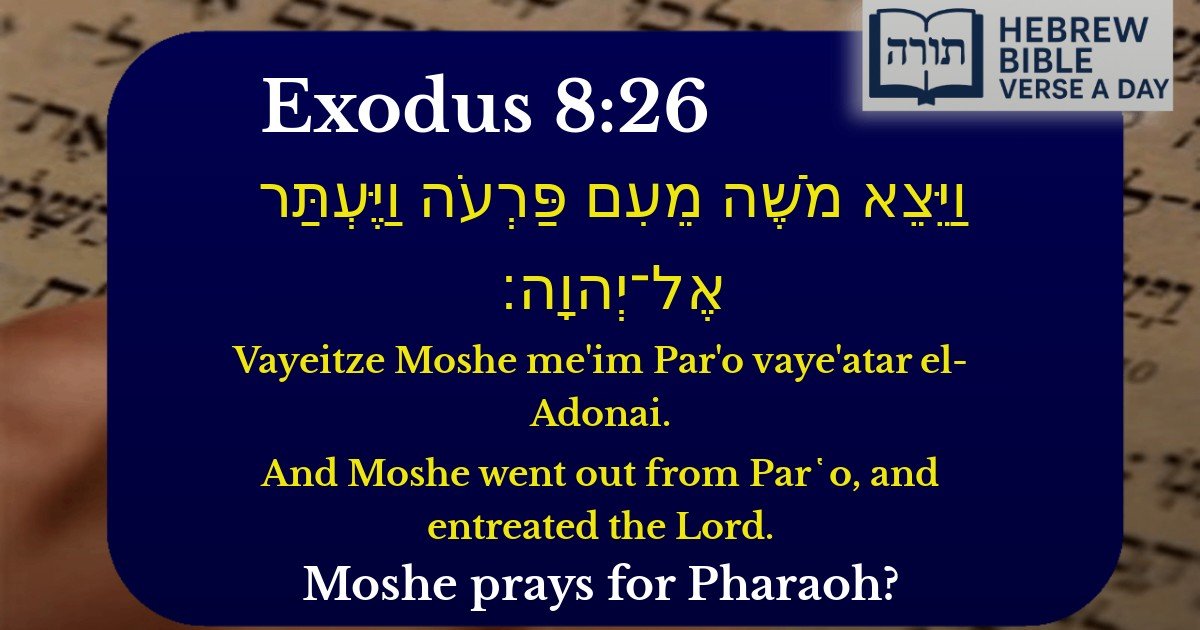
Q: What does it mean that Moshe 'entreated the Lord' in Exodus 8:26?
A: The phrase 'entreated the Lord' means that Moshe prayed intensely to Hashem after leaving Pharaoh's presence. Rashi explains that Moshe was pleading for the removal of the plague of wild animals (עָרוֹב), showing his compassion even for the Egyptians suffering from the plague.
Q: Why did Moshe leave Pharaoh before praying in Exodus 8:26?
A: According to the Midrash (Shemos Rabbah 11:4), Moshe left Pharaoh's presence to pray because it would be disrespectful to pray to Hashem in front of the wicked Pharaoh, who considered himself a god. This teaches us the importance of proper respect when speaking to Hashem.
Q: What can we learn from Moshe's prayer in this verse?
A: We learn two important lessons: 1) Even when executing justice (the plagues), we should have compassion (as Moshe did for the Egyptians). 2) The Rambam (Hilchos Tefillah 4:16) derives from here that one should pray in a dignified place - Moshe chose to pray separately rather than in Pharaoh's palace.
Q: How does this verse connect to the sequence of the plagues?
A: This verse occurs during the fourth plague (wild animals). The Talmud (Rosh Hashanah 17b) notes that Pharaoh only asked Moshe to pray for the removal of this plague (unlike earlier plagues), showing that the plagues were progressively breaking his resistance.
Q: Why is Moshe's prayer in this verse important for us today?
A: The Sforno teaches that Moshe's prayer demonstrates that leaders must care about all people, even their enemies. Today, this teaches us that while we stand firm in our principles (like Moshe did with Pharaoh), we must still have compassion and pray for others' welfare when they suffer.


Context of the Verse
The verse (Shemot 9:33) describes Moshe's actions after warning Pharaoh about the impending plague of hail. After delivering the warning, Moshe departs from Pharaoh's presence and turns to Hashem in prayer ("וַיֶּעְתַּר אֶל־יְהוָה"). This moment occurs during the seventh plague, demonstrating Moshe's role as both a messenger to Pharaoh and an intercessor for Bnei Yisrael.
Rashi's Explanation
Rashi (Shemot 9:33) explains that Moshe's prayer was an act of עתירה (entreaty), a term that implies intense and persistent supplication. Rashi notes that this word is used elsewhere in Tanach (e.g., Devarim 3:23) to describe Moshe's prayers, emphasizing his deep connection to Hashem and his role as a leader who seeks mercy for others.
Rambam on Prayer
Rambam (Hilchot Tefillah 1:1-2) teaches that prayer is a fundamental mitzvah, rooted in the actions of our forefathers and leaders like Moshe. Moshe's entreaty here exemplifies the principle that even when Divine judgment is decreed, righteous prayer can bring about mercy or mitigation of suffering.
Midrashic Insights
Halachic Implications
The Gemara (Berachot 34b) derives from this verse that a leader must distance themselves from conflict or impurity before engaging in prayer. Moshe's departure from Pharaoh's presence before praying reinforces the idea that one must prepare spiritually before approaching Hashem in supplication.
Chassidic Perspective
The Sfat Emet (Shemot 9:33) teaches that Moshe's act of leaving Pharaoh symbolizes the need to separate from negative influences before connecting with Hashem. His prayer was effective because he first removed himself from the environment of arrogance and oppression represented by Pharaoh.