Frequently Asked Questions
Q: What does Exodus 8:6 mean when it says 'there is none like the Lord our God'?
A: This verse emphasizes the uniqueness and supremacy of Hashem (God) over all other forces. It was said during the plague of frogs in Egypt to show Pharaoh that no other power—whether Egyptian gods or human rulers—can compare to Hashem's might. Rashi explains that this declaration was meant to demonstrate God's absolute control over nature and His ability to perform miracles beyond human comprehension.
Q: Why did Moshe (Moses) say the plague would happen 'tomorrow' and not immediately?
A: According to the Midrash (Shemot Rabbah 10:4), Moshe delayed the plague until the next day to give Pharaoh time to reconsider his stubbornness and repent. Additionally, Rambam teaches that Hashem often gives people opportunities to change before executing judgment, showing His mercy even during punishment.
Q: How does Exodus 8:6 apply to us today?
A: The verse reminds us that Hashem is uniquely all-powerful and in control of everything. In daily life, this teaches us to trust in Him during challenges, recognizing that no other force—whether hardships or human authority—can override His will. The Talmud (Berachot 10a) encourages us to acknowledge God's greatness in both big and small events.
Q: What lesson can we learn from Pharaoh's response in this verse?
A: Pharaoh's stubbornness ('And he said, Tomorrow') teaches the danger of delaying repentance. The Sages note that hardening one’s heart when given a chance to change leads to greater consequences. This idea is echoed in Pirkei Avot (2:10), which warns against pushing off mitzvot (commandments) or self-improvement for later.
Q: Why is the phrase 'none like the Lord our God' repeated often in Jewish prayers?
A: This declaration is central to Jewish faith, affirming monotheism and Hashem’s unmatched power. It appears in prayers like the Aleinu and the Haggadah to reinforce our belief in God’s uniqueness, as emphasized by the Rambam in his 13 Principles of Faith. The Talmud (Yoma 69b) also links this idea to the sanctification of God’s Name in the world.

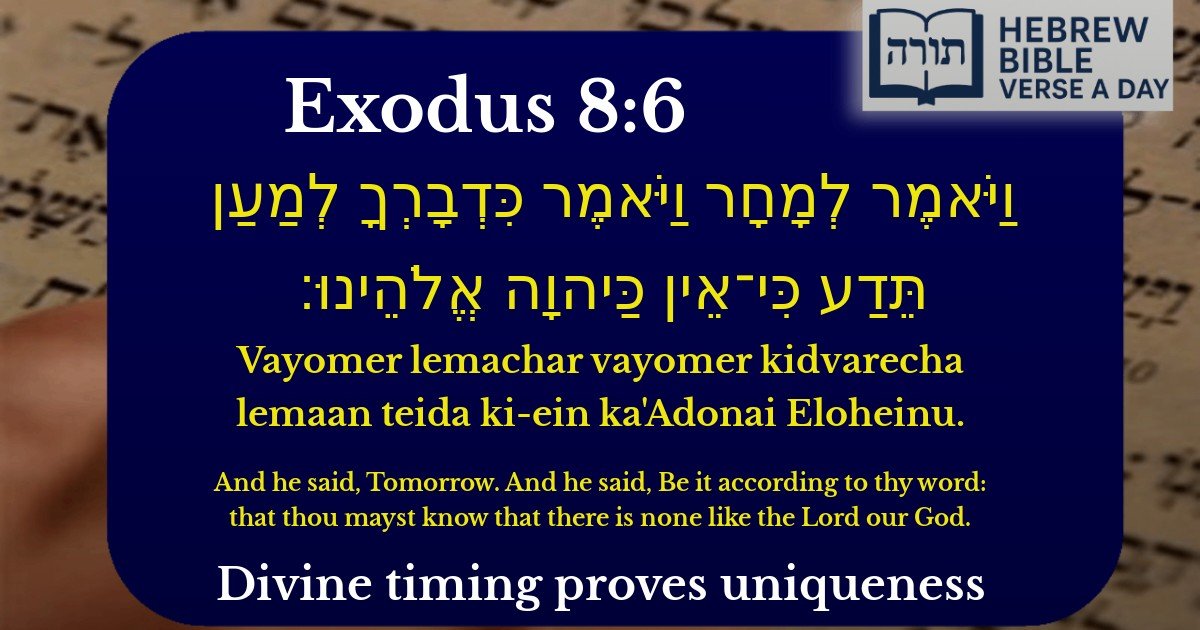

Context in Shemot (Exodus 8:6)
This verse appears during the second plague in Egypt—the plague of frogs (צְפַרְדֵּעַ). Pharaoh, distressed by the infestation, asks Moshe to pray for their removal. Moshe grants Pharaoh the choice of when the frogs should depart, and Pharaoh responds, "Tomorrow." Rashi (Shemot 8:6) explains that Pharaoh's request for delay reveals his stubbornness, as he could have asked for immediate relief but instead chose to prolong the suffering.
Pharaoh's Stubbornness and Free Will
The Rambam (Hilchot Teshuvah 5:1-3) discusses how Hashem grants humans free will, even to sinners like Pharaoh. By allowing Pharaoh to choose "Tomorrow," Hashem demonstrates that Pharaoh's obstinacy is his own doing, not divine coercion. The Midrash Tanchuma (Va'eira 14) adds that this delay gave Pharaoh time to reconsider his defiance, yet he remained hardened.
"That You May Know There Is None Like Hashem"
The phrase "לְמַעַן תֵּדַע כִּי־אֵין כַּיהוָה אֱלֹהֵינוּ" underscores the purpose of the plagues: to reveal Hashem's absolute uniqueness. The Ibn Ezra (Shemot 8:6) notes that this declaration contrasts Hashem’s power with the impotence of Egypt’s deities, who could neither bring nor remove the frogs. The Sforno emphasizes that this knowledge was not just for Pharaoh but for all nations, establishing Hashem’s supremacy in the world.
Lessons in Divine Providence