
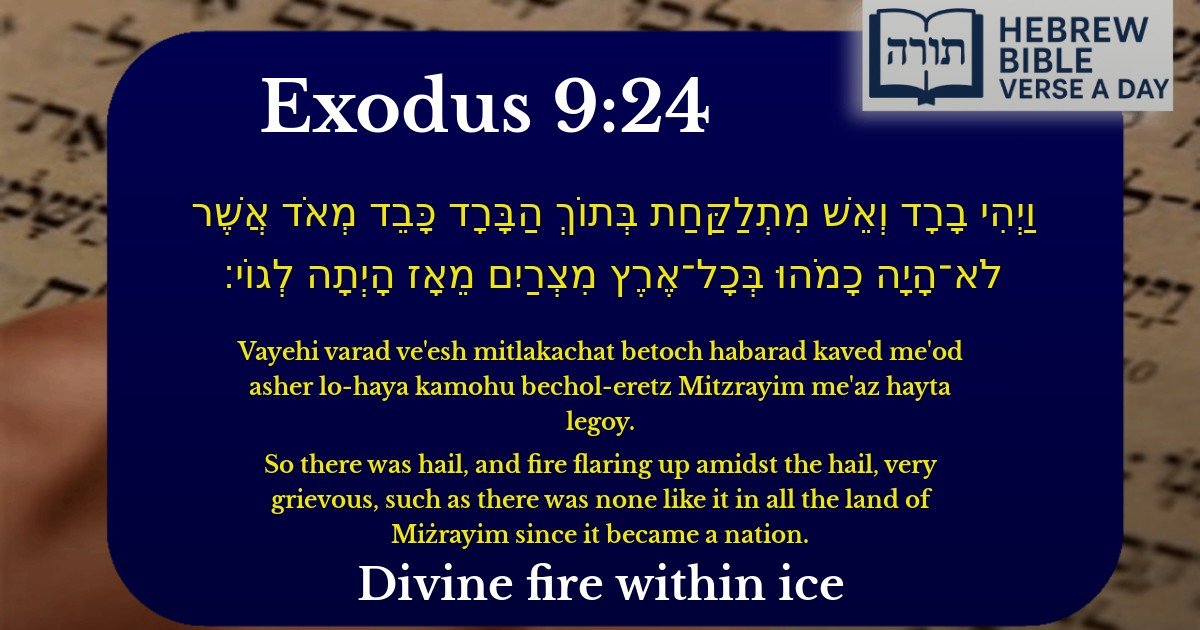

Exodus 9:24 - Divine fire within ice

Exodus 9:24 - שמות 9:24

Hebrew Text

וַיְהִי בָרָד וְאֵשׁ מִתְלַקַּחַת בְּתוֹךְ הַבָּרָד כָּבֵד מְאֹד אֲשֶׁר לֹא־הָיָה כָמֹהוּ בְּכָל־אֶרֶץ מִצְרַיִם מֵאָז הָיְתָה לְגוֹי׃

English Translation

So there was hail, and fire flaring up amidst the hail, very grievous, such as there was none like it in all the land of Miżrayim since it became a nation.

Transliteration

Vayehi varad ve'esh mitlakachat betoch habarad kaved me'od asher lo-haya kamohu bechol-eretz Mitzrayim me'az hayta legoy.

Hebrew Leining Text

וַיְהִ֣י בָרָ֔ד וְאֵ֕שׁ מִתְלַקַּ֖חַת בְּת֣וֹךְ הַבָּרָ֑ד כָּבֵ֣ד מְאֹ֔ד אֲ֠שֶׁ֠ר לֹֽא־הָיָ֤ה כָמֹ֙הוּ֙ בְּכׇל־אֶ֣רֶץ מִצְרַ֔יִם מֵאָ֖ז הָיְתָ֥ה לְגֽוֹי׃

🎵 Listen to leining

Parasha Commentary

The Plague of Hail and Fire

The verse describes the seventh plague inflicted upon Egypt—a miraculous combination of hail and fire. Rashi (Shemot 9:24) explains that this phenomenon was supernatural, as fire and water (hail) typically negate one another, yet here they coexisted to fulfill Hashem's will. This demonstrated His absolute power over nature.

Unprecedented Severity

The Torah emphasizes that this plague was unparalleled in Egypt's history ("which there was none like it"). The Midrash (Shemot Rabbah 12:3) elaborates that each hailstone contained a core of fire, causing simultaneous destruction by freezing and burning. The Ibn Ezra notes that the phrase "since it became a nation" refers to Egypt's establishment as a kingdom, implying no prior civilization had witnessed such a wonder.

Divine Precision in Judgment

Rambam (Hilchot Teshuvah 6:5) derives from this plague that Hashem's punishments are meticulously measured. The hail destroyed crops and livestock, but—as the next verse clarifies—spared those who heeded Moshe's warning (Shemot 9:20). This reflects the principle that Divine justice distinguishes between oppressors and those open to repentance.

Symbolism of Fire and Water

  • Fire (אש): Represents Egypt's cruelty, as Pharaoh decreed Jewish infants be cast into the Nile (Shemot 1:22).
  • Hail (ברד): Symbolizes the Nile's waters, which Egypt idolized and wherein Jewish children were drowned.

The Sforno teaches that their combination showed Hashem's mastery over both elements Egypt wrongly deified, dismantling their theological arrogance.

📚 Talmud Citations

This verse is quoted in the Talmud.

The verse is referenced in a discussion about the miracles performed in Egypt, particularly the plague of hail mixed with fire, as an example of God's power and the uniqueness of the plagues.
📖 Pesachim 118a
The verse is cited in the context of discussing the severity of the plagues in Egypt, emphasizing the extraordinary nature of the hail and fire as described in the verse.

Frequently Asked Questions

Q: What does the verse about hail and fire in Exodus 9:24 mean?
A: This verse describes the seventh plague in Egypt, where Hashem sent a miraculous combination of hail and fire together. According to Rashi, the fire was miraculously burning within the hailstones to show Hashem's absolute power over nature. The Midrash explains that this unusual phenomenon demonstrated that the elements obey Hashem's command, even when they normally contradict each other (fire and water).
Q: Why was this plague of hail and fire so severe compared to others?
A: The Torah emphasizes this plague was uniquely severe ('such as there was none like it') because it combined two opposite elements (fire and water) in a miraculous way. Rambam explains that each plague increased in intensity to give Pharaoh more opportunities to repent. This particular plague was exceptionally destructive to crops and livestock, hitting Egypt's economy hard while sparing the Israelites in Goshen.
Q: What lesson can we learn from the plague of hail and fire?
A: The Talmud (Berachot 54b) teaches that we recite blessings over natural phenomena (like thunder and lightning) to acknowledge Hashem's power - just as the Egyptians witnessed in this plague. The unusual combination of fire and hail teaches that Hashem can alter nature at will. This reminds us of divine providence and that nothing is beyond Hashem's control, a fundamental Jewish belief.
Q: How does this verse show the difference between Egyptians and Israelites during the plagues?
A: Rashi notes that while the hail and fire devastated Egypt, the Israelite region of Goshen was untouched (Exodus 9:26). This distinction showed that the plagues were targeted divine judgments. The Midrash adds that the fire within the hail symbolized how Hashem's justice (fire) and mercy (water) can operate simultaneously - punishing the wicked while protecting the righteous.
Q: Why does the verse mention this never happened since Egypt became a nation?
A: The emphasis on 'since it became a nation' serves two purposes according to traditional commentators: 1) It highlights the unprecedented nature of this miracle, showing this wasn't a natural weather event but divine intervention. 2) It humbled Egypt's pride as an ancient civilization by demonstrating that their long history contained nothing comparable to Hashem's power. The Ramban explains this phrasing stresses that Egypt's entire national experience couldn't explain away this supernatural event.