Frequently Asked Questions
Q: Who are the Pelishtim (Philistines) mentioned in Genesis 10:14?
A: The Pelishtim (Philistines) were a people descended from the Kasluchim, as mentioned in Genesis 10:14. According to Rashi, they later settled in the land of Canaan and became known as a significant nation that interacted with the Jewish people, particularly during the times of the Judges and King David. The Torah identifies their origins here to trace the lineage of nations.
Q: Why does the Torah list the origins of nations like the Pelishtim?
A: The Torah lists the origins of nations, including the Pelishtim, to provide a historical and genealogical record of humanity after the Flood. Ramban explains that these details help us understand the relationships between different peoples and their eventual roles in biblical history. The Pelishtim, for example, later became adversaries of Israel, and their origins are noted to clarify their identity.
Q: What is the significance of Kaftorim in Genesis 10:14?
A: The Kaftorim are another group mentioned in Genesis 10:14, associated with the descendants of Mitzrayim (Egypt). Rashi notes that Kaftor refers to the island of Crete, and the Kaftorim were likely a seafaring people. Their mention highlights the diversity of nations that emerged from Noach's descendants and their geographical spread.
Q: How does Genesis 10:14 connect to later events in the Torah?
A: Genesis 10:14 introduces the Pelishtim, who later play a major role in conflicts with the Jewish people, such as in the stories of Avraham, Yitzchak (Isaac), and Shimshon (Samson). The Midrash explains that tracing their origins here sets the stage for understanding their historical and adversarial relationship with Israel, as seen in later books like Shmuel (Samuel).
Q: What lesson can we learn from the listing of nations in Genesis 10:14?
A: The listing of nations, including the Pelishtim and Kaftorim, teaches that all peoples have a divine purpose in history. The Talmud (Sanhedrin 37a) emphasizes that every nation has a unique role, and the Torah records their origins to show Hashem's plan for humanity. Recognizing this helps us appreciate the interconnectedness of nations in the biblical narrative.

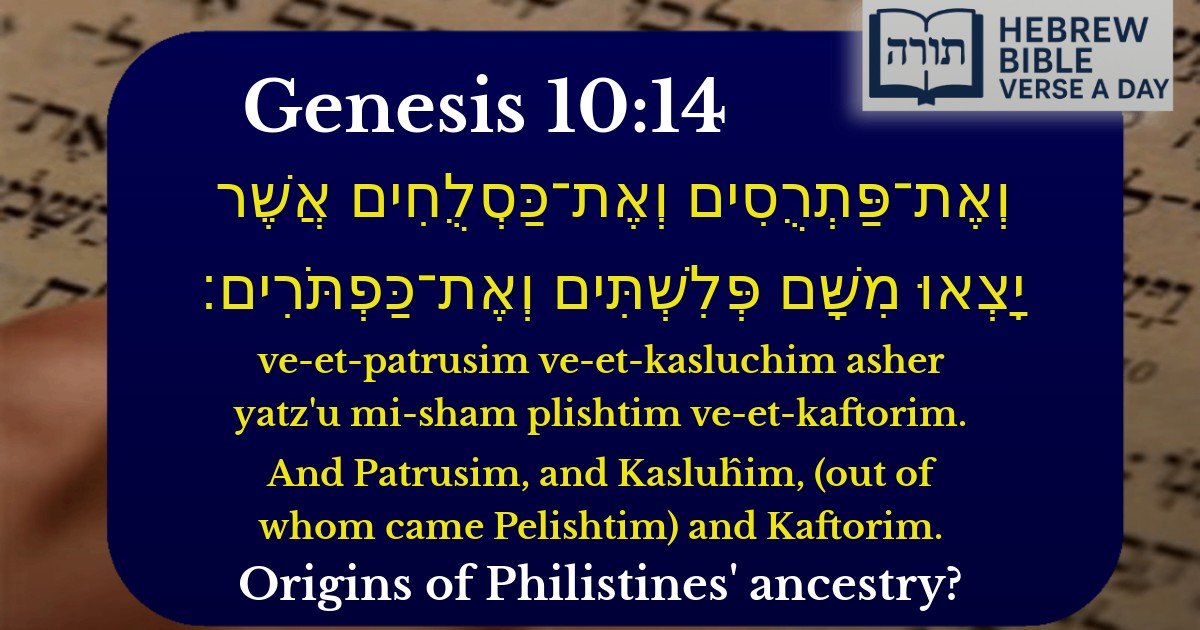

Patrusim and Kasluchim: Origins of the Plishtim
The verse lists the descendants of Mitzrayim (Egypt), including the Patrusim, Kasluchim, and Kaftorim. Rashi (on Bereishit 10:14) explains that the Patrusim were inhabitants of Upper Egypt (Patros), while the Kasluchim were the ancestors of the Plishtim (Philistines), who later settled in Eretz Yisrael. The Talmud (Chullin 60b) notes that the Plishtim originated from the Kasluchim, emphasizing their connection to Mitzrayim.
The Kaftorim and Their Identity
The Kaftorim are identified by Rashi and the Radak as originating from the island of Crete (Kaphtor in Hebrew). The Midrash (Bereishit Rabbah 37:1) links them to the Plishtim, suggesting that some of the Kaftorim migrated and merged with the Plishtim. Ramban (on Bereishit 10:14) adds that the Kaftorim were a distinct nation but shared geographical and cultural ties with the Plishtim.
Historical and Geographical Context
Halachic and Moral Implications
The inclusion of these nations in the genealogy of Mitzrayim underscores the Torah’s emphasis on tracing lineage and understanding the origins of nations that interacted with Am Yisrael. The Rambam (Hilchot Avodat Kochavim 1:3) notes that recognizing these historical connections helps clarify the boundaries between permissible and forbidden interactions with neighboring peoples.