

Join Our Newsletter To Be Informed When New Videos Are Posted
Hebrew Text
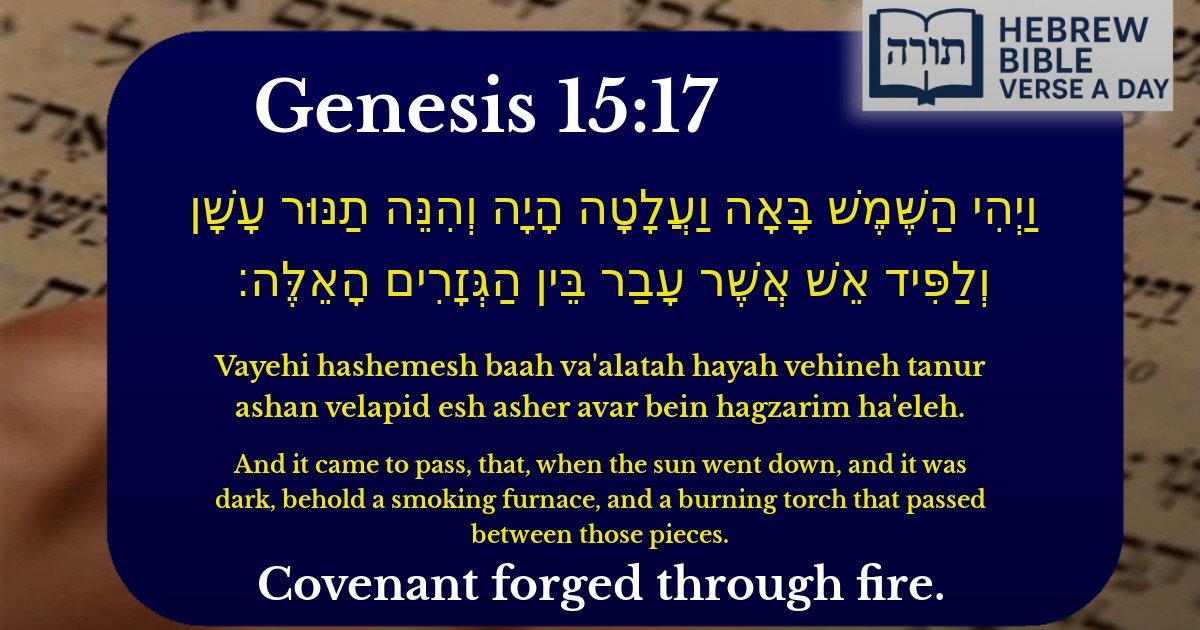
וַיְהִי הַשֶּׁמֶשׁ בָּאָה וַעֲלָטָה הָיָה וְהִנֵּה תַנּוּר עָשָׁן וְלַפִּיד אֵשׁ אֲשֶׁר עָבַר בֵּין הַגְּזָרִים הָאֵלֶּה׃
English Translation
And it came to pass, that, when the sun went down, and it was dark, behold a smoking furnace, and a burning torch that passed between those pieces.
Transliteration
Vayehi hashemesh baah va'alatah hayah vehineh tanur ashan velapid esh asher avar bein hagzarim ha'eleh.
Hebrew Leining Text
וַיְהִ֤י הַשֶּׁ֙מֶשׁ֙ בָּ֔אָה וַעֲלָטָ֖ה הָיָ֑ה וְהִנֵּ֨ה תַנּ֤וּר עָשָׁן֙ וְלַפִּ֣יד אֵ֔שׁ אֲשֶׁ֣ר עָבַ֔ר בֵּ֖ין הַגְּזָרִ֥ים הָאֵֽלֶּה׃
🎵 Listen to leining
Parasha Commentary
📚 Talmud Citations
This verse is quoted in the Talmud.
📖 Berakhot 26b
The verse is referenced in a discussion about the timing of the evening prayer, connecting the 'smoking furnace' and 'burning torch' to the transition between day and night.
📖 Nedarim 32a
The verse is cited in a discussion about the covenant between God and Abraham, emphasizing the significance of the 'smoking furnace' and 'burning torch' as symbols of divine presence and promise.
Context in Bereishit (Genesis 15:17)
This verse describes the covenant between Hashem and Avraham (the Brit Bein HaBetarim), where Hashem promises the Land of Israel to Avraham's descendants. The imagery of the smoking furnace and burning torch symbolizes divine presence and the future trials of the Jewish people.
Rashi's Explanation
Rashi (Rabbi Shlomo Yitzchaki) interprets the tanur ashan (smoking furnace) as a representation of the suffering of Israel in exile, particularly in Egypt ("ki tanur zeh mitzrayim"). The lapid eish (burning torch) symbolizes Hashem's deliverance, as seen in the Exodus (Shemot 19:18). The passing between the pieces signifies Hashem's unbreakable covenant with Avraham.
Rambam's Perspective
Rambam (Maimonides) in Moreh Nevuchim (Guide for the Perplexed 2:42) explains that the vision was a prophetic experience, where Avraham perceived divine messages through symbolic imagery. The fire and smoke represent divine revelation and the enduring bond between Hashem and the Jewish people.
Midrashic Interpretations
Symbolism in the Covenant
The act of passing between the split animals (mentioned earlier in the chapter) follows ancient covenant rituals, where parties would walk between pieces to signify commitment. Here, only Hashem passes through, indicating His unilateral promise to Avraham, as emphasized by the Mechilta and Sforno.
Halachic Implications
The Ramban (Nachmanides) notes that this covenant underscores the eternal Jewish claim to Eretz Yisrael, a principle codified in halachic discussions about settling the Land (e.g., Mishneh Torah, Hilchot Melachim).