

Join Our Newsletter To Be Informed When New Videos Are Posted
Hebrew Text
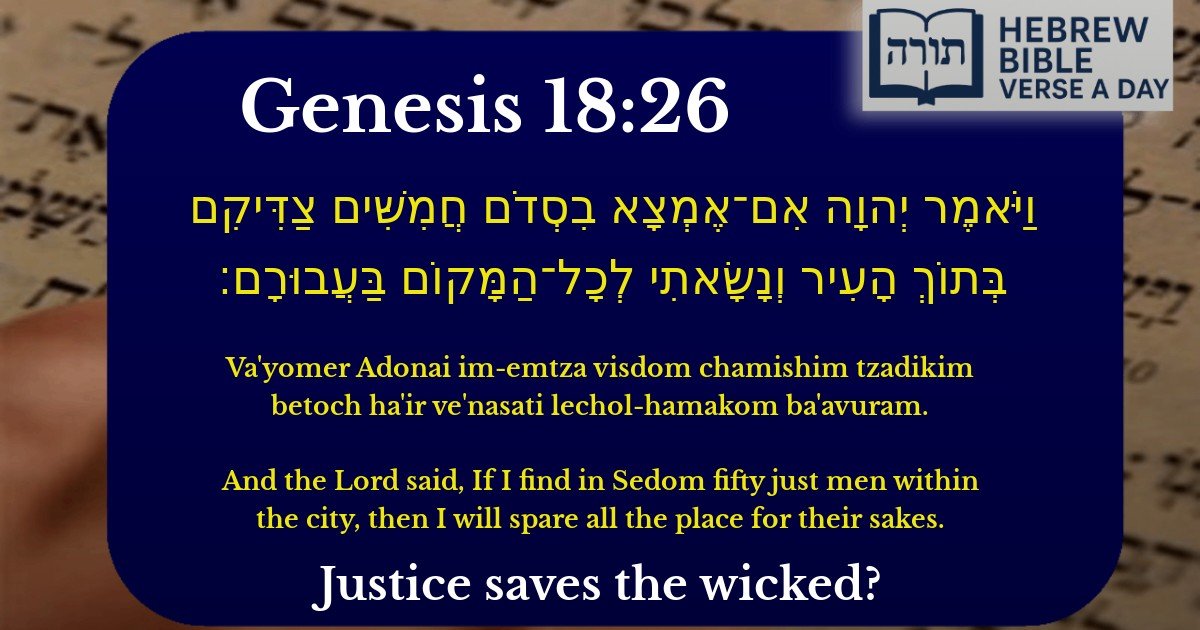
וַיֹּאמֶר יְהוָה אִם־אֶמְצָא בִסְדֹם חֲמִשִּׁים צַדִּיקִם בְּתוֹךְ הָעִיר וְנָשָׂאתִי לְכָל־הַמָּקוֹם בַּעֲבוּרָם׃
English Translation
And the Lord said, If I find in Sedom fifty just men within the city, then I will spare all the place for their sakes.
Transliteration
Va'yomer Adonai im-emtza visdom chamishim tzadikim betoch ha'ir ve'nasati lechol-hamakom ba'avuram.
Hebrew Leining Text
וַיֹּ֣אמֶר יְהֹוָ֔ה אִם־אֶמְצָ֥א בִסְדֹ֛ם חֲמִשִּׁ֥ים צַדִּיקִ֖ם בְּת֣וֹךְ הָעִ֑יר וְנָשָׂ֥אתִי לְכׇל־הַמָּק֖וֹם בַּעֲבוּרָֽם׃
🎵 Listen to leining
Parasha Commentary
📚 Talmud Citations
This verse is quoted in the Talmud.
📖 Sanhedrin 99b
The verse is referenced in a discussion about the merit of righteous individuals and how they can bring salvation to others.
📖 Berakhot 7a
The verse is cited in a discussion about divine justice and the concept of intercession by the righteous.
Context in the Torah
The verse (Bereishit 18:26) appears during Avraham Avinu's dialogue with Hashem regarding the impending destruction of Sedom. Avraham pleads for mercy, questioning whether the righteous should perish with the wicked. Hashem responds that if fifty righteous individuals are found, the entire city will be spared.
Rashi's Explanation
Rashi (Rabbi Shlomo Yitzchaki) explains that the number fifty represents a minyan (quorum) of righteous people sufficient to influence the entire city. He cites the Talmud (Sanhedrin 19b), which teaches that a city's merit depends on its righteous inhabitants. If Sedom had even fifty righteous individuals, their collective merit could protect the city from destruction.
Rambam's Perspective
Rambam (Maimonides) in Moreh Nevuchim (3:18) discusses Divine justice, emphasizing that Hashem's decree against Sedom was based on their extreme wickedness. The dialogue with Avraham demonstrates that Hashem does not punish indiscriminately—He would spare the city if a critical mass of righteous people existed to justify its preservation.
Midrashic Insights
Halachic Implications
The Maharal (Gur Aryeh) connects this concept to the halachic principle of tzibur (community). A city's fate depends on its collective spiritual state. If a significant number of righteous individuals exist, their merit sustains the entire community, as seen in later generations with the concept of the lamed-vav tzadikim (36 hidden righteous).
Avraham's Negotiation
Kli Yakar (Rabbi Shlomo Ephraim Luntschitz) notes that Avraham begins with fifty righteous people—a substantial number—to establish the principle that the righteous can save the wicked. Only afterward does he gradually reduce the number (to 45, 40, etc.), teaching that even a smaller group can invoke Divine compassion.