Frequently Asked Questions
Q: Why did Avraham serve butter, milk, and meat together in Genesis 18:8? Isn't that against kosher laws?
A: According to Rashi and the Talmud (Chullin 103a), Avraham lived before the Torah was given at Mount Sinai, so the kosher laws (including not mixing milk and meat) did not yet apply. Avraham followed a higher standard of righteousness even before the commandments were formally given.
Q: What is the significance of Avraham standing under the tree while his guests ate in Genesis 18:8?
A: The Midrash (Bereishit Rabbah 48:10) explains that Avraham stood to show honor to his guests (who were actually angels in disguise). This teaches us the importance of hachnasat orchim (hospitality) in Judaism - we should personally attend to our guests' needs with respect.
Q: Why does the Torah mention specifically what food Avraham served in Genesis 18:8?
A: Rashi notes that the verse emphasizes three things: 1) The butter and milk showed Avraham's haste to serve (easy to prepare quickly), 2) The calf demonstrated his generosity (a valuable animal), and 3) The phrase 'which he had prepared' shows he personally participated in serving, not just delegating to others.
Q: How can we apply the lesson of Avraham's hospitality from Genesis 18:8 today?
A: The Rambam (Hilchot Avel 14:1-2) derives from this verse that welcoming guests is even greater than receiving the Divine Presence (since Avraham interrupted his divine vision to host visitors). Today, we should emulate Avraham by being attentive hosts, serving our best food, and personally attending to guests.
Q: What does Genesis 18:8 teach us about serving G-d through physical actions?
A: The verse shows that serving guests (a physical act) was considered by Avraham as important as his spiritual connection. This reflects the Jewish view that we serve G-d through both ritual and interpersonal mitzvot. As the Talmud says (Shabbat 127a), hospitality is greater than receiving the Divine Presence.

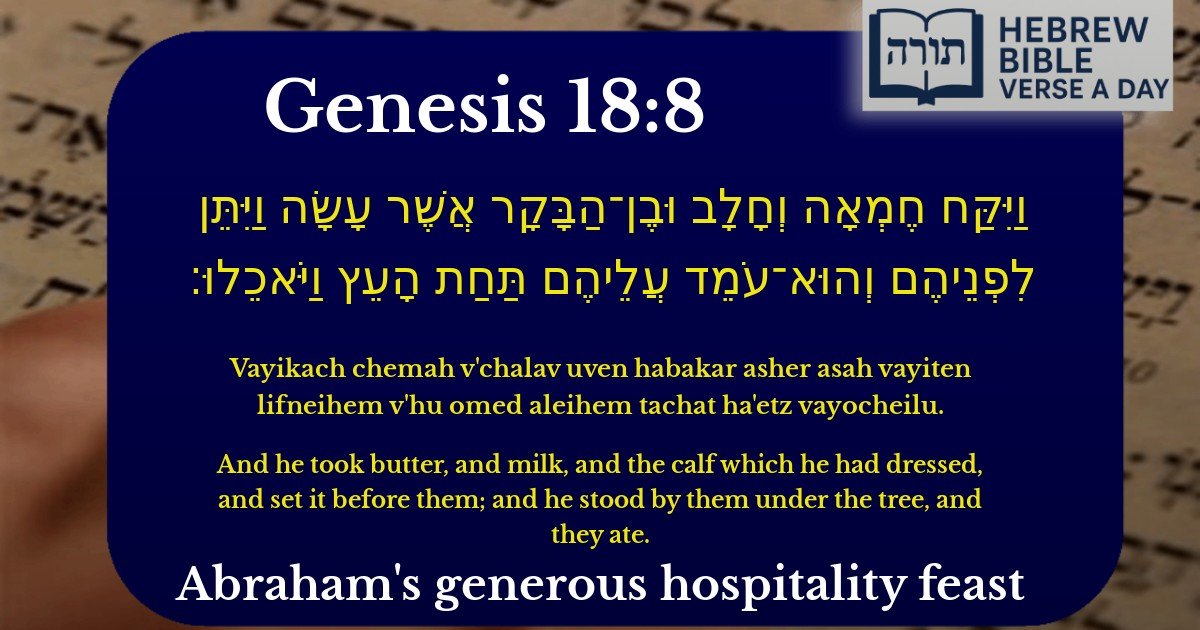

Avraham's Hospitality (Hachnasat Orchim)
The verse (Bereishit 18:8) describes Avraham Avinu's exemplary act of hospitality toward his angelic guests. Rashi explains that Avraham served them butter, milk, and the calf he had prepared to demonstrate his eagerness to fulfill the mitzvah of hachnasat orchim (welcoming guests). The order of the foods—first dairy, then meat—reflects Avraham's meticulousness in observing halachic principles, as the Sages later derived the prohibition of mixing milk and meat from this passage (Chullin 113a).
Standing Over Them
The phrase "וְהוּא־עֹמֵד עֲלֵיהֶם" ("and he stood by them") is interpreted by the Midrash (Bereishit Rabbah 48:14) as Avraham personally attending to his guests rather than delegating to servants, despite his high status and recent circumcision. The Rambam (Hilchot Avel 14:2) cites this as a model for how one should serve guests with one's own hands to honor them.
The Significance of the Tree
The mention of "תַּחַת הָעֵץ" ("under the tree") connects to Avraham's earlier planting of an eshel (Bereishit 21:33). The Talmud (Sotah 10a) teaches that this tree symbolized Avraham's establishment of an inn for travelers, providing physical and spiritual nourishment—food, drink, and teachings about Hashem.
Angels Eating
Though angels do not physically eat (as stated in Bereishit Rabbah 48:14), the Midrash explains they appeared to eat to avoid arousing suspicion of being supernatural beings, thereby preserving Avraham's unawareness of their true nature until later. This demonstrates the principle of darkhei noam (pleasant conduct) even in heavenly interactions.