

Join Our Newsletter To Be Informed When New Videos Are Posted
Hebrew Text
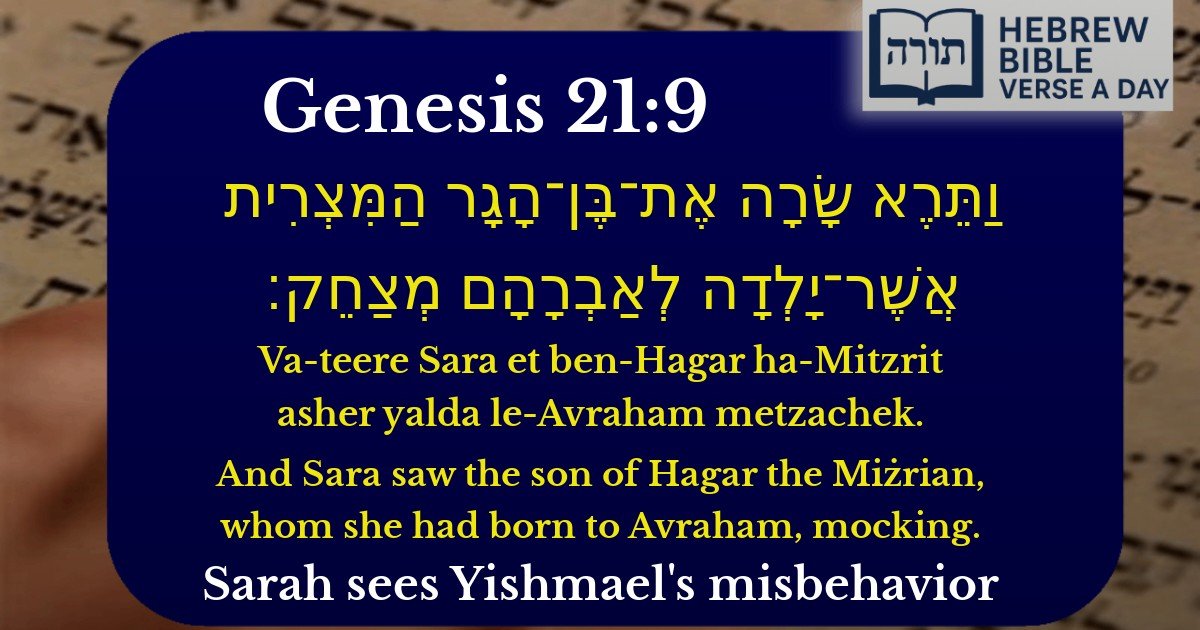
וַתֵּרֶא שָׂרָה אֶת־בֶּן־הָגָר הַמִּצְרִית אֲשֶׁר־יָלְדָה לְאַבְרָהָם מְצַחֵק׃
English Translation
And Sara saw the son of Hagar the Miżrian, whom she had born to Avraham, mocking.
Transliteration
Va-teere Sara et ben-Hagar ha-Mitzrit asher yalda le-Avraham metzachek.
Hebrew Leining Text
וַתֵּ֨רֶא שָׂרָ֜ה אֶֽת־בֶּן־הָגָ֧ר הַמִּצְרִ֛ית אֲשֶׁר־יָלְדָ֥ה לְאַבְרָהָ֖ם מְצַחֵֽק׃
🎵 Listen to leining
Parasha Commentary
📚 Talmud Citations
This verse is quoted in the Talmud.
📖 Sanhedrin 29b
The verse is discussed in the context of Sarah's observation of Ishmael's behavior, which leads to his and Hagar's expulsion from Abraham's household.
📖 Sotah 6b
The verse is referenced in a discussion about the implications of Ishmael's actions and Sarah's response.
Understanding the Verse
The verse (Bereshit 21:9) describes Sarah observing Yishmael, the son of Hagar, engaging in behavior described as "מְצַחֵק" (metsachek), which is often translated as "mocking." However, the term carries deeper implications in traditional Jewish sources.
Rashi's Interpretation
Rashi explains that the word "מְצַחֵק" here refers to idolatry, based on the connection to the same root used in Shemot 32:6 regarding the Golden Calf ("וַיָּקֻמוּ לְצַחֵק"). Rashi cites the Midrash (Bereshit Rabbah 53:11), which states that Sarah saw Yishmael bowing to idols, prompting her concern for Yitzchak's spiritual well-being.
Ramban's Perspective
Ramban offers an alternative view, suggesting that "מְצַחֵק" refers to Yishmael claiming inheritance rights over Avraham's estate, thereby threatening Yitzchak's position as the rightful heir. This interpretation aligns with the subsequent verses where Sarah insists on Hagar and Yishmael's expulsion.
Midrashic Insights
Halachic Implications
The Rambam (Hilchot Melachim 10:7) references this episode to establish that descendants of Yishmael are not entitled to a share in Eretz Yisrael, as the inheritance was explicitly granted to Yitzchak's line (Bereshit 21:12). This underscores the Torah's emphasis on Yitzchak as Avraham's spiritual successor.
Literary Context
The term "מְצַחֵק" appears earlier in Bereshit (19:14) regarding Lot's sons-in-law dismissing his warnings as "jesting." This parallel suggests a thematic connection—trivializing divine matters leads to severe consequences, as seen in Yishmael's expulsion.