
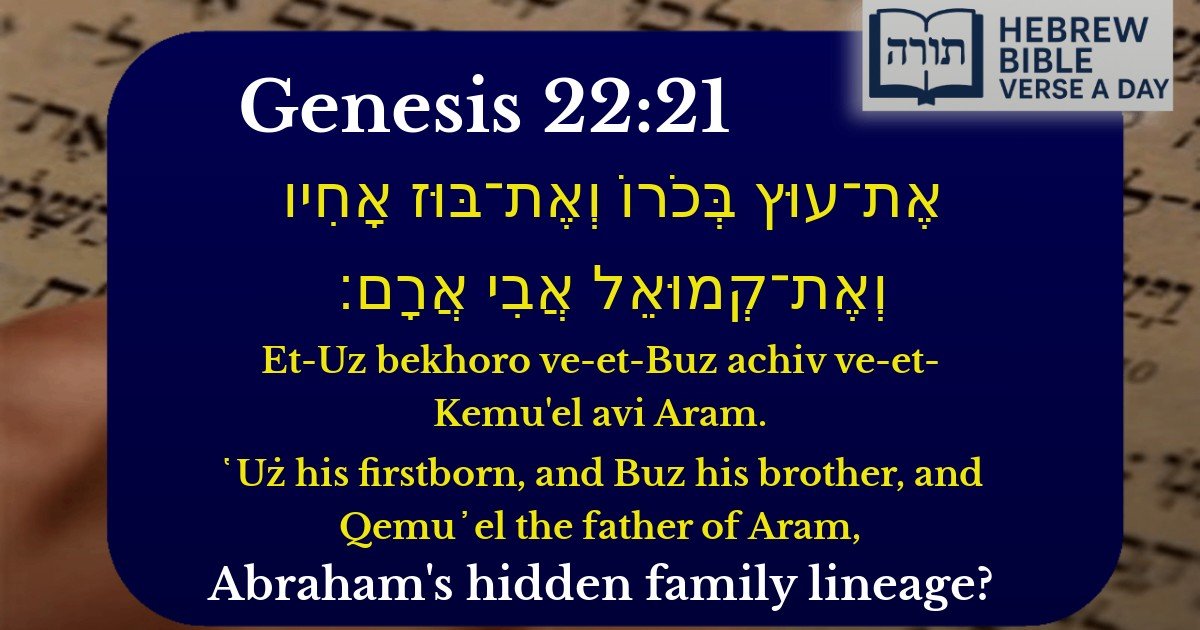

Genesis 22:21 - Abraham's hidden family lineage?

Genesis 22:21 - בראשית 22:21

Hebrew Text

אֶת־עוּץ בְּכֹרוֹ וְאֶת־בּוּז אָחִיו וְאֶת־קְמוּאֵל אֲבִי אֲרָם׃

English Translation

῾Uż his firstborn, and Buz his brother, and Qemu᾽el the father of Aram,

Transliteration

Et-Uz bekhoro ve-et-Buz achiv ve-et-Kemu'el avi Aram.

Hebrew Leining Text

אֶת־ע֥וּץ בְּכֹר֖וֹ וְאֶת־בּ֣וּז אָחִ֑יו וְאֶת־קְמוּאֵ֖ל אֲבִ֥י אֲרָֽם׃

🎵 Listen to leining

Parasha Commentary

Context in Sefer Bereishit

The verse (Bereishit 22:21) lists the descendants of Nachor, Avraham's brother. These names appear in the narrative following the Akeidah (Binding of Yitzchak), suggesting a thematic connection to Avraham's legacy and the future of his lineage.

Rashi's Commentary

Rashi explains that "Uz" (עוּץ) was the firstborn of Nachor, and "Buz" (בּוּז) was his brother. "Qemu'el" (קְמוּאֵל) is identified as the father of Aram, linking this lineage to the Aramean people. Rashi notes that these names are mentioned to highlight Rivka's ancestry, as she later becomes Yitzchak's wife (Bereishit 24:15).

Midrashic Interpretations

  • Uz and Buz: The Midrash (Bereishit Rabbah 57:4) connects these names to future nations. Uz is linked to the land of Edom (Iyov 1:1), while Buz is associated with the descendants of Elihu (Iyov 32:2), suggesting a prophetic hint to future interactions between these peoples and Klal Yisrael.
  • Qemu'el: The name means "God has risen" or "assembly of God," possibly alluding to the divine providence in Rivka's lineage, as she emerges from this family to continue the covenant.

Rambam's Perspective

While Rambam does not comment directly on this verse, his principles of hashgachah (divine providence) in Moreh Nevuchim (3:18) suggest that the listing of these names underscores Hashem's orchestration of history, ensuring Avraham's descendants would marry into a family with spiritual potential.

Significance in Jewish Tradition

This verse is foundational for understanding Rivka's yichus (lineage), which is critical in Jewish thought. The Torah emphasizes her ancestry to demonstrate that she was worthy of joining Avraham's family, as her roots were in a line connected to monotheistic values (see Ramban on Bereishit 24:15).

📚 Talmud Citations

This verse is not quoted in the Talmud.

Frequently Asked Questions

Q: Who are Uz, Buz, and Qemuel mentioned in Genesis 22:21?
A: According to Rashi and other traditional Jewish sources, Uz, Buz, and Qemuel were the sons of Nahor, Abraham's brother. Uz was the firstborn, Buz was his brother, and Qemuel was the ancestor of Aram (Syria). This verse highlights the lineage of Abraham's extended family.
Q: Why is the genealogy of Nahor's sons important in Genesis 22:21?
A: The genealogy is significant because it connects to later biblical narratives. For example, Rashi notes that Uz became the ancestor of Job (Iyov), and Buz is linked to Elihu (a figure in the Book of Job). Understanding these family ties helps trace the relationships between key figures in Tanakh.
Q: What can we learn from the mention of Qemuel as 'the father of Aram' in Genesis 22:21?
A: Qemuel being called 'the father of Aram' teaches us about the origins of nations neighboring Israel. The Midrash and commentators explain that these genealogies show how different peoples descended from Abraham's extended family, emphasizing the interconnectedness of nations in biblical history.
Q: How does Genesis 22:21 relate to the broader story of Abraham?
A: This verse appears after the Akeidah (Binding of Isaac) and reminds us that Abraham's legacy extended beyond his immediate family. While Isaac was chosen to continue the covenant, Abraham's brother Nahor also had descendants who played roles in later biblical events, showing Divine providence in all family lines.