Frequently Asked Questions
Q: Why did Avraham bury Sarah in the Cave of Machpelah?
A: Avraham buried Sarah in the Cave of Machpelah because it was a sacred burial site that would become the resting place for the patriarchs and matriarchs of the Jewish people. According to Rashi (Genesis 23:9), this cave was chosen because it was near the place where Adam and Chava (Eve) were buried, making it especially holy. Additionally, the Midrash (Pirkei DeRabbi Eliezer 36) teaches that Avraham specifically sought this location to fulfill the divine promise that his descendants would inherit the land of Canaan.
Q: Where is the Cave of Machpelah located?
A: The Cave of Machpelah is located in Hebron (Chevron), in the land of Canaan, as stated in the verse (Genesis 23:19). Today, it is known as the Tomb of the Patriarchs (Me'arat HaMachpelah) and is a significant holy site in Judaism. The Talmud (Eruvin 53a) and Rambam (Hilchot Beit HaBechirah 7:14) discuss its sanctity as the burial place of Avraham, Sarah, Yitzchak, Rivka, Yaakov, and Leah.
Q: Why is Hebron called 'Chevron' in Hebrew?
A: Hebron is called 'Chevron' (חֶבְרוֹן) in Hebrew, which comes from the root 'chavar' (חבר), meaning 'to connect' or 'to unite.' Rashi (Genesis 23:2) explains that Chevron was named so because it was a place where people gathered and connected. The Midrash (Bereishit Rabbah 58:4) also associates the name with Avraham's deep connection to this land, as it was where he established his legacy and where the patriarchs and matriarchs were buried.
Q: What is the significance of Avraham burying Sarah in the land of Canaan?
A: Avraham burying Sarah in the land of Canaan (Genesis 23:19) was a fulfillment of Hashem's promise that this land would belong to his descendants (Genesis 12:7). By purchasing the Cave of Machpelah as a burial site, Avraham legally acquired a portion of the land, as explained by Rashi and the Talmud (Bava Metzia 87a). This act demonstrated his faith in the divine promise and established a permanent Jewish connection to the land.
Q: Why is the Cave of Machpelah important in Judaism today?
A: The Cave of Machpelah remains one of the holiest sites in Judaism because it is the burial place of the patriarchs and matriarchs (Avraham, Sarah, Yitzchak, Rivka, Yaakov, and Leah). The Rambam (Mishneh Torah, Hilchot Beit HaBechirah 7:14) emphasizes its sanctity, and Jewish tradition teaches that prayers offered there are especially powerful. It is a place of pilgrimage and a symbol of the eternal bond between the Jewish people and the land of Israel.

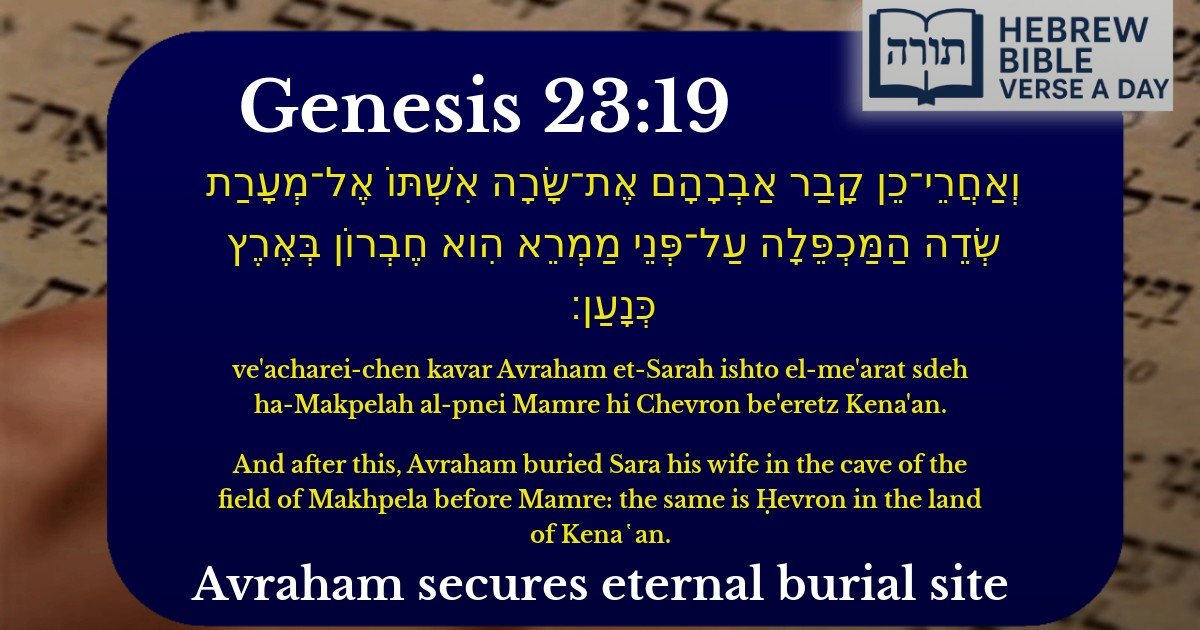

The Burial of Sarah in the Cave of Machpelah
The verse describes Avraham's burial of his wife Sarah in the Cave of Machpelah, marking the first Jewish acquisition of land in Eretz Canaan. This event holds profound significance in Jewish tradition, as it establishes a permanent connection between the Jewish people and the Land of Israel.
Location and Meaning of Machpelah
Rashi (Bereshit 23:9) explains that the name "Machpelah" comes from the root כפל (double), referring to either:
The Midrash (Bereshit Rabbah 58:8) states that this cave was the entrance to Gan Eden, making it especially holy ground.
Avraham's Purchase of the Burial Site
The Talmud (Bava Metzia 87a) emphasizes that Avraham insisted on paying full price for the land rather than accepting it as a gift, to establish clear ownership according to halacha. Rambam (Hilchot Mechira 1:15) later codifies this as a principle in Jewish property law.
Significance of Hebron
The verse notes that Mamre is Hebron. Rashi explains that Mamre was the name of Avraham's ally (Bereshit 14:13), and the area was called by his name. Hebron's importance is underscored by the Midrash (Pirkei D'Rabbi Eliezer 36) which states it is one of the three places where the nations cannot claim the Jews stole the land, as it was properly purchased.
Spiritual Dimensions of the Burial
The Zohar (1:127b) teaches that Sarah's burial in Machpelah represents the connection between the physical and spiritual worlds. Just as the cave was the gateway between this world and Gan Eden, Sarah's righteousness created a channel for divine blessing to enter the world.