
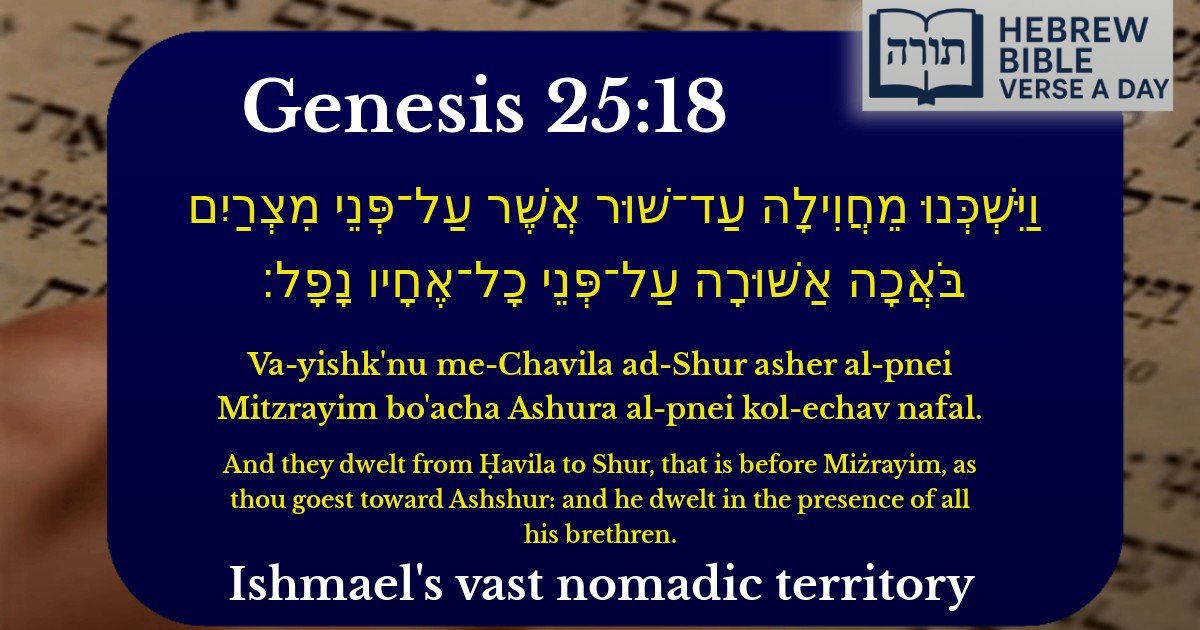

Genesis 25:18 - Ishmael's vast nomadic territory

Genesis 25:18 - בראשית 25:18

Hebrew Text

וַיִּשְׁכְּנוּ מֵחֲוִילָה עַד־שׁוּר אֲשֶׁר עַל־פְּנֵי מִצְרַיִם בֹּאֲכָה אַשּׁוּרָה עַל־פְּנֵי כָל־אֶחָיו נָפָל׃

English Translation

And they dwelt from Ḥavila to Shur, that is before Miżrayim, as thou goest toward Ashshur: and he dwelt in the presence of all his brethren.

Transliteration

Va-yishk'nu me-Chavila ad-Shur asher al-pnei Mitzrayim bo'acha Ashura al-pnei kol-echav nafal.

Hebrew Leining Text

וַיִּשְׁכְּנ֨וּ מֵֽחֲוִילָ֜ה עַד־שׁ֗וּר אֲשֶׁר֙ עַל־פְּנֵ֣י מִצְרַ֔יִם בֹּאֲכָ֖ה אַשּׁ֑וּרָה עַל־פְּנֵ֥י כׇל־אֶחָ֖יו נָפָֽל׃ {פ}

🎵 Listen to leining

Parasha Commentary

Geographical Context

The verse describes the dwelling places of Yishmael's descendants, spanning from Chavila to Shur, near Egypt, extending toward Ashur. Rashi (Bereshit 25:18) explains that Chavila refers to the same region mentioned earlier (Bereshit 2:11), known for its precious resources, while Shur is identified as the wilderness near Egypt (see Shemot 15:22). The phrase "as thou goest toward Ashur" indicates a northern expansion toward Assyria, reflecting the vast territory inhabited by Yishmael's progeny.

Interpretation of "He Dwelt in the Presence of All His Brethren"

The concluding phrase, "and he dwelt in the presence of all his brethren", is interpreted in multiple ways:

  • Rashi (Bereshit 25:18) suggests that Yishmael's descendants lived in a manner that provoked conflict, as they were "fallen" (נָפָל)—meaning they were hostile toward their brethren, particularly the descendants of Yitzchak.
  • Ramban (Bereshit 25:18) offers an alternative reading, proposing that Yishmael's descendants were scattered (נָפַל in the sense of dispersal) among other nations, living as nomads rather than establishing a permanent settlement.
  • The Midrash (Bereshit Rabbah 62:5) connects this verse to future events, hinting at the enduring tension between Yishmael's offspring and Bnei Yisrael.

Spiritual and Historical Implications

The verse underscores the fulfillment of Hashem’s promise to Hagar (Bereshit 16:12) that Yishmael would be a "wild donkey of a man," dwelling in opposition to others. The Ibn Ezra (Bereshit 25:18) notes that this prophecy manifests in the nomadic and often adversarial nature of Yishmael’s descendants throughout history. The delineation of their territory also serves as a reminder of the divine plan for the separation between the lineages of Yitzchak and Yishmael.

📚 Talmud Citations

This verse is not quoted in the Talmud.

Frequently Asked Questions

Q: What does Genesis 25:18 mean when it says Ishmael's descendants 'dwelt from Havilah to Shur'?
A: This verse describes the territory where Ishmael's descendants settled. According to Rashi, Havilah refers to a region near India, while Shur was near Egypt's border. This shows they inhabited a large area in the wilderness regions, fulfilling G-d's promise to Abraham that Ishmael would become a great nation (Genesis 17:20).
Q: Why is it important that Ishmael's descendants lived 'in the presence of all his brethren'?
A: The Talmud (Sanhedrin 91a) explains this phrase teaches that Ishmael's descendants maintained peaceful relations with Isaac's descendants at that time, despite their later conflicts. Rambam notes this shows temporary fulfillment of G-d's will for family harmony, though their paths ultimately diverged.
Q: What lesson can we learn from Ishmael's descendants dwelling near Egypt?
A: The Midrash (Bereishit Rabbah 62:5) teaches that their settlement near Egypt shows how G-d provides for all His creations. Though Ishmael wasn't the chosen heir like Isaac, G-d still gave his descendants a proper inheritance, teaching us Divine providence extends to all people.
Q: How does the description of Ishmael's territory apply to Jewish geography today?
A: Traditional Jewish sources (like Radak) identify these locations as covering parts of the Arabian Peninsula and Sinai. This helps us understand the biblical landscape and the regions surrounding the Land of Israel, showing how the Jewish people were situated among neighboring nations.
Q: Why does the Torah mention Ishmael's dwelling places after discussing his death?
A: Rashi explains the Torah first completes Ishmael's personal story (his age at death in verse 17), then describes his legacy - where his descendants lived. This teaches that a person's true impact is measured both by their personal life and by what they leave behind for future generations.