Frequently Asked Questions
Q: Who is the 'she' mentioned in Genesis 25:2?
A: The 'she' refers to Keturah, Avraham's wife after Sarah passed away. Rashi explains that Keturah was actually Hagar, Sarah's maidservant, whom Avraham remarried after Sarah's death (Bereishit Rabbah 61:4).
Q: Why does the Torah list Avraham's children with Keturah?
A: The Torah lists these children to show Avraham's complete lineage. While Yitzchak (Isaac) was the main heir (Genesis 25:5), these sons became ancestors of various nations. Ramban notes that this demonstrates how Avraham fulfilled God's promise of becoming 'the father of many nations' (Genesis 17:5).
Q: What happened to Avraham's sons with Keturah?
A: The Midrash (Bereishit Rabbah 61:5) explains that Avraham sent these sons eastward with gifts to distance them from Yitzchak, ensuring Yitzchak would be the clear inheritor of Avraham's spiritual legacy. They became ancestors of various eastern nations.
Q: Why is Midyan (Midian) mentioned among Keturah's children?
A: Midyan is listed because he became the ancestor of the Midianite nation, who later appear in the Torah. Rashi notes (on Exodus 2:15) that the Midianites were descendants of Avraham, which is why Yisro (Jethro), a Midianite priest, recognized Hashem's greatness.
Q: What lesson can we learn from Avraham having children with Keturah?
A: The Sforno teaches that this shows Avraham's commitment to spreading monotheism even in his later years. By having more children, he increased his influence in the world. This teaches us the importance of continually working to spread goodness, regardless of age.

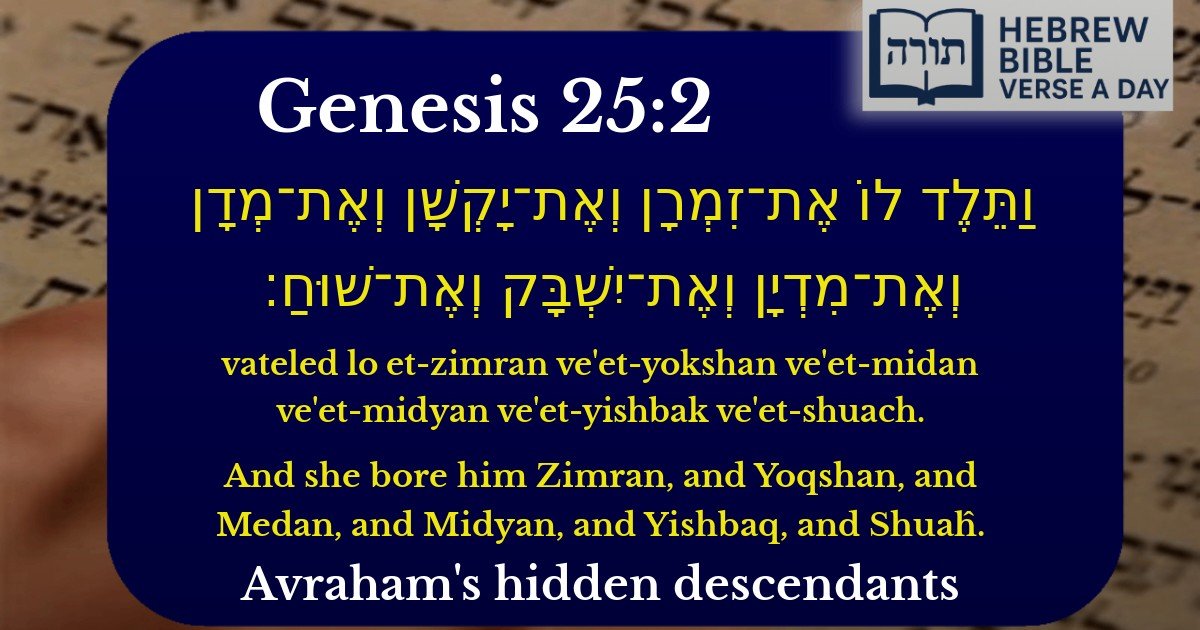

Commentary on Genesis 25:2 – The Sons of Keturah
The verse lists the six sons born to Avraham and Keturah: Zimran, Yoqshan, Medan, Midyan, Yishbaq, and Shuaĥ. These descendants play a significant role in understanding Avraham's legacy beyond Yitzchak.
Rashi's Explanation
Rashi (on Genesis 25:2) notes that Keturah was actually Hagar, as the name "Keturah" (from the root ketoret, incense) alludes to her righteous deeds, which were as pleasing as incense. This aligns with the Midrash (Bereishit Rabbah 61:4), which states that Avraham remarried Hagar after Sarah's passing, elevating her status.
Significance of the Names
Rambam's Perspective
In Moreh Nevuchim (3:50), Rambam explains that Avraham ensured these sons were spiritually separated from Yitzchak by sending them eastward (Genesis 25:6). This preserved Yitzchak's unique role as the bearer of the covenant, while still providing for his other children materially.
Midrashic Insights
The Midrash (Bereishit Rabbah 61:5) emphasizes that these sons were not part of the chosen line but were still blessed due to Avraham's merit. Midyan, in particular, is noted for his descendants' complex relationship with Klal Yisrael—both positive (Yitro, Moshe's father-in-law) and negative (the incident at Baal Peor).