Frequently Asked Questions
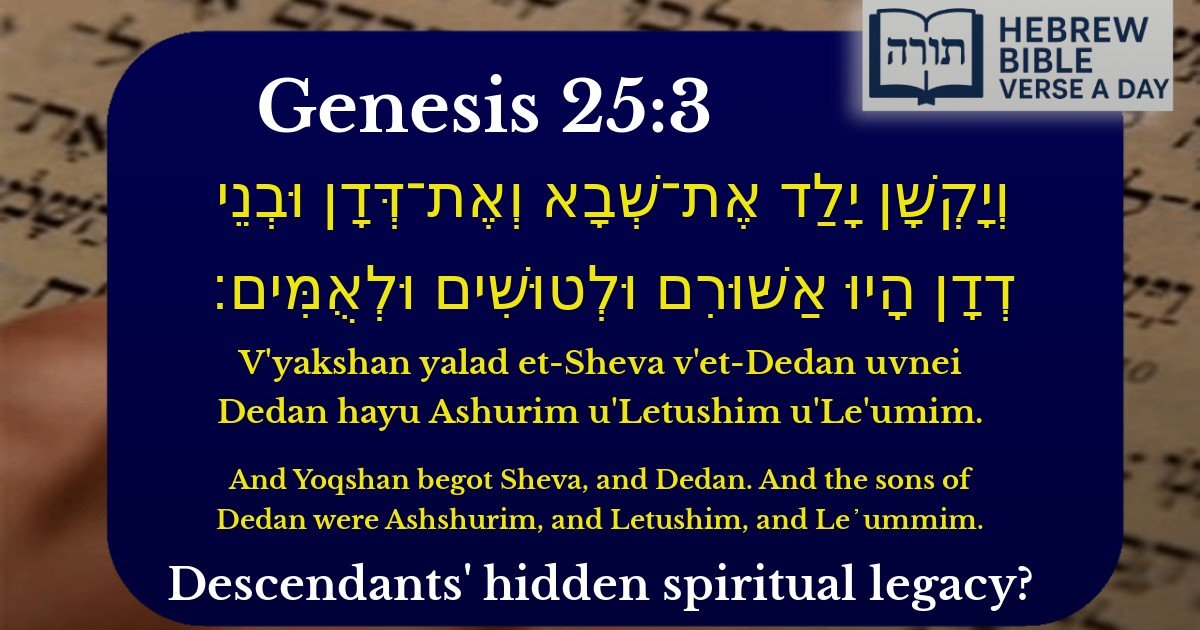
Q: Who were the descendants of Yoqshan mentioned in Genesis 25:3?
A: According to the verse, Yoqshan had two sons: Sheva and Dedan. Dedan, in turn, had three sons: the Ashshurim, Letushim, and Le'ummim. These names represent different tribes or nations that descended from Avraham through his son Midyan (Rashi on Genesis 25:3).
Q: Why does the Torah list these names in Genesis 25:3?
A: The Torah lists these descendants to show the fulfillment of Hashem's promise to Avraham that he would become the father of many nations (Genesis 17:4-5). Even though these were not part of the chosen line (which continued through Yitzchak), they were still part of Avraham's legacy (Ramban on Genesis 25:3).
Q: What is the significance of the names Ashshurim, Letushim, and Le'ummim?
A: These names represent different tribes that descended from Dedan. The Ashshurim may refer to a trading people (based on the root 'ashar' meaning to trade), the Letushim may refer to craftsmen or smiths (from 'latash' meaning to hammer), and Le'ummim means 'peoples' or 'nations' (Rashi on Genesis 25:3). Each name reflects their characteristics or occupations.
Q: How does Genesis 25:3 connect to the larger narrative of the Torah?
A: This verse continues the Torah's pattern of tracing family lineages, showing how Avraham's descendants branched into many nations. While the main narrative follows Yitzchak's line (the future Jewish people), the Torah also documents other descendants to show the complete fulfillment of Hashem's blessings (Sforno on Genesis 25:3).
Q: What lesson can we learn from Genesis 25:3 about family relationships?
A: This verse teaches that all of Avraham's descendants had value, even those not part of the chosen line. It reminds us that every family produces different branches with different paths, and all contribute to the larger picture of humanity (based on Rambam's approach to understanding biblical genealogies).


Context in the Torah
The verse (Bereishit 25:3) appears in the genealogy of Avraham Avinu's descendants through Keturah, his wife after Sarah's passing. It traces the lineage of Yoqshan (also spelled Yaktan), one of the sons of Avraham and Keturah, and his descendants, including Sheva, Dedan, and Dedan's sons: Ashshurim, Letushim, and Le'ummim.
Rashi's Commentary
Rashi (Bereishit 25:3) explains that the names Ashshurim, Letushim, and Le'ummim refer to nations or tribes descended from Dedan. He notes that these names are plural forms, indicating groups of people rather than individuals. Rashi also connects the name Ashshurim to the Hebrew root אשר (to go straight or prosper), suggesting they were a prosperous or well-established nation.
Ibn Ezra's Insight
Ibn Ezra (Bereishit 25:3) adds that these tribes were known in his time (medieval period) as inhabitants of distant lands, possibly in Arabia or Africa. He emphasizes that the Torah records these genealogies to distinguish the lineage of Yitzchak (the chosen heir of Avraham) from the other descendants of Avraham.
Midrashic Interpretations
Rambam's Perspective
In Moreh Nevuchim (Guide for the Perplexed 3:50), Rambam explains that the Torah details these genealogies to clarify Avraham's legacy and the uniqueness of the Jewish people through Yitzchak and Yaakov. The other descendants, though numerous, were not part of the covenantal lineage.
Halachic and Historical Significance
The Sforno (Bereishit 25:3) notes that these nations, though descended from Avraham, did not inherit his spiritual mission. Their inclusion in the Torah serves as a contrast to the chosen line of Yitzchak and Yaakov, highlighting the distinction between the Jewish people and other nations.