Frequently Asked Questions
Q: Why was Rachel buried on the way to Bethlehem instead of with the other matriarchs in Hebron?
A: According to Rashi and Midrash (Genesis Rabbah 82:10), Rachel was buried on the roadside so that in the future, when the Jewish people would be exiled and pass by her grave, she could pray for them. This shows her enduring love and concern for her descendants.
Q: What is the significance of the verse mentioning both 'Ephrath' and 'Bethlehem'?
A: Rashi explains that 'Ephrath' was the ancient name of the place, while 'Bethlehem' was its later name. The Torah uses both names to connect this location to future events, as Bethlehem would become the birthplace of King David (Ruth 4:11).
Q: Why does the Torah tell us about Rachel's death and burial in such detail?
A: The Talmud (Moed Katan 16b) teaches that Rachel's burial place became a significant landmark and place of prayer. The Torah emphasizes this location because of its future importance to the Jewish people, as Jeremiah 31:14 describes Rachel weeping for her children in exile.
Q: What lesson can we learn from Rachel being buried alone on the roadside?
A: The Midrash teaches that Rachel's solitary burial demonstrates self-sacrifice. Though she could have been buried with honor in Hebron, she chose (through Divine providence) a place where she could comfort her descendants. This teaches us about putting the needs of the Jewish people above personal honor.
Q: Is Rachel's tomb still standing today?
A: Yes, Kever Rachel (Rachel's Tomb) near Bethlehem has been a recognized holy site for thousands of years. The Rambam (Maimonides) mentions visiting it in his travels (Iggeret Teiman), and it remains an important place of prayer according to Jewish tradition.

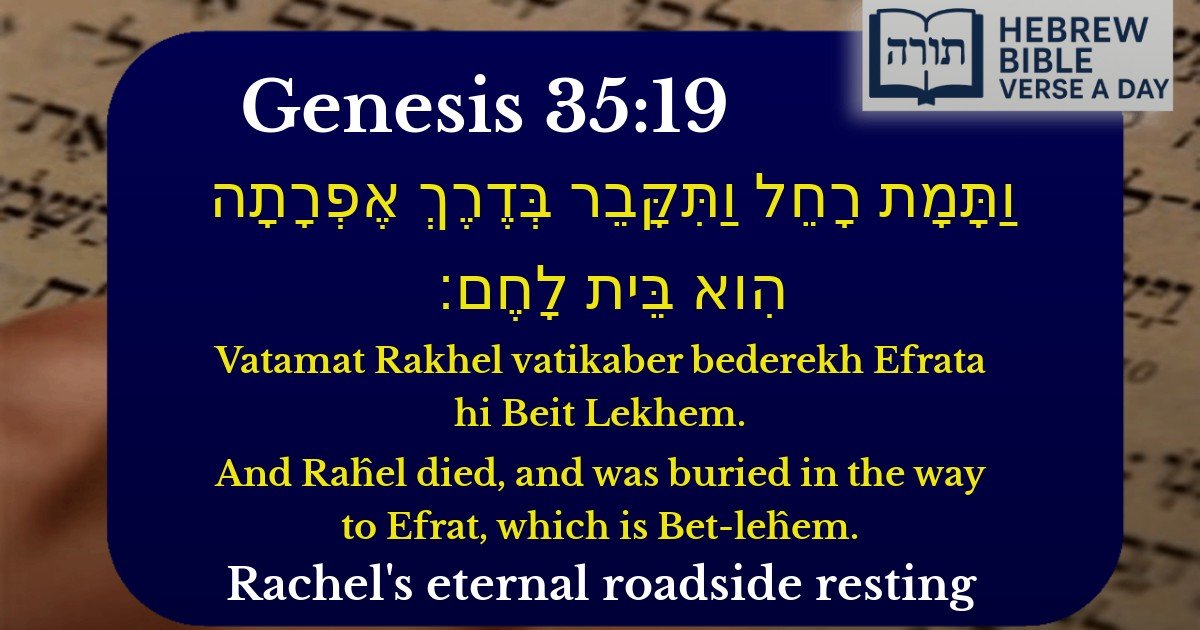

The Passing and Burial of Rachel
The verse states: "And Rachel died, and was buried in the way to Efrat, which is Bet-leḥem" (Genesis 35:19). This event marks a tragic moment in the life of Yaakov (Jacob) and holds deep significance in Jewish tradition.
Rashi's Explanation
Rashi comments that Rachel died during childbirth with Binyamin (Benjamin) and was buried on the road to Efrat (Bethlehem) rather than in the family burial cave of Machpelah in Chevron. He explains that Yaakov intentionally buried her there because he foresaw that her descendants—the Jewish people—would pass by her grave during the Babylonian exile (Jeremiah 31:14-16). Her burial place would serve as a source of comfort, as she would pray for her children's return.
Midrashic Insights
Halachic Perspective (Rambam)
The Rambam (Mishneh Torah, Hilchot Aveilut 4:11) discusses the laws of mourning and burial, emphasizing the importance of proper burial. Rachel's burial on the roadside was an exception due to Yaakov's prophetic insight, but generally, Jewish law requires burial in a designated cemetery.
Symbolism of Bethlehem (Beit Leḥem)
The verse specifies that Efrat is Beit Leḥem, linking Rachel's burial place to the future Davidic dynasty (since David haMelech was from Beit Leḥem). This hints at Rachel's role as a mother of kings—through her son Binyamin (ancestor of Shaul) and through Yehudah (ancestor of David), who was spiritually connected to her.