
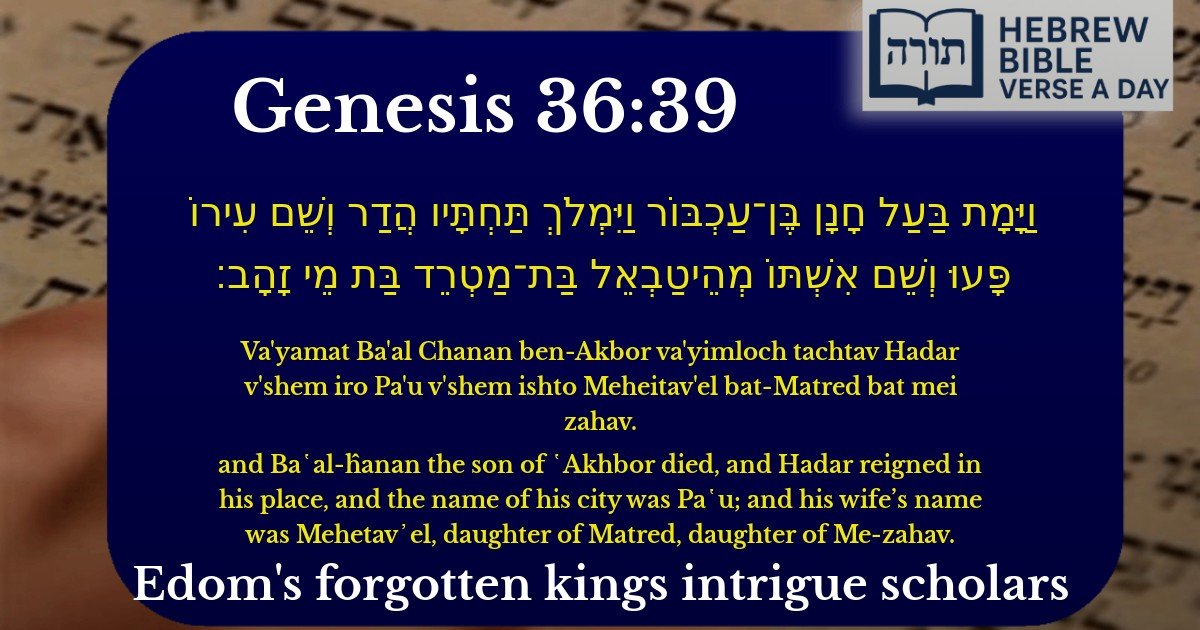

Genesis 36:39 - Edom's forgotten kings intrigue scholars

Genesis 36:39 - בראשית 36:39

Hebrew Text

וַיָּמָת בַּעַל חָנָן בֶּן־עַכְבּוֹר וַיִּמְלֹךְ תַּחְתָּיו הֲדַר וְשֵׁם עִירוֹ פָּעוּ וְשֵׁם אִשְׁתּוֹ מְהֵיטַבְאֵל בַּת־מַטְרֵד בַּת מֵי זָהָב׃

English Translation

and Ba῾al-ĥanan the son of ῾Akhbor died, and Hadar reigned in his place, and the name of his city was Pa῾u; and his wife’s name was Mehetav᾽el, daughter of Matred, daughter of Me-zahav.

Transliteration

Va'yamat Ba'al Chanan ben-Akbor va'yimloch tachtav Hadar v'shem iro Pa'u v'shem ishto Meheitav'el bat-Matred bat mei zahav.

Hebrew Leining Text

וַיָּ֘מׇת֮ בַּ֣עַל חָנָ֣ן בֶּן־עַכְבּוֹר֒ וַיִּמְלֹ֤ךְ תַּחְתָּיו֙ הֲדַ֔ר וְשֵׁ֥ם עִיר֖וֹ פָּ֑עוּ וְשֵׁ֨ם אִשְׁתּ֤וֹ מְהֵֽיטַבְאֵל֙ בַּת־מַטְרֵ֔ד בַּ֖ת מֵ֥י זָהָֽב׃

🎵 Listen to leining

Parasha Commentary

Context in Sefer Bereishit

This verse appears in Bereishit 36:39 as part of the genealogy of the kings of Edom, descendants of Esav. The Torah lists these kings to contrast the transient nature of Edomite kingship with the enduring legacy of the Jewish people, who would later be led by the divinely appointed kings of Israel.

Names and Their Meanings

  • Ba'al Chanan ben Achbor: Rashi explains that "Ba'al Chanan" means "master of grace," possibly indicating a ruler who was generous or favored. "Achbor" means "mouse," which some commentaries (like Ibn Ezra) suggest may symbolize cunning or humility.
  • Hadar: His name means "splendor" or "majesty," reflecting his royal stature. The Midrash (Bereishit Rabbah) notes that Edomite kings often bore names denoting power and grandeur.
  • Pa'u: The city's name is interpreted by Radak as possibly meaning "shout" or "cry," perhaps alluding to its prominence or the manner of its founding.
  • Mehetav'el bat Matred bat Mei Zahav: "Mehetav'el" means "God benefits," "Matred" may derive from "pursuit" or "persistence," and "Mei Zahav" means "waters of gold." The Malbim suggests these names hint at the wealth and influence of Hadar's lineage.

Symbolism and Lessons

The Kli Yakar emphasizes that the detailed genealogy of Edom's kings serves to highlight the impermanence of their rule—each king's reign ends with death, unlike the eternal covenant of the Jewish people. The mention of wives and cities underscores the transient nature of worldly power, as opposed to the spiritual legacy of Yaakov's descendants.

Historical Perspective

Ramban notes that these records were preserved to fulfill the prophecy that Edom would produce kings before Israel (Bereishit 36:31). The Sforno adds that this foreshadows the eventual rise of Jewish kingship, which would be established under divine guidance through the Davidic dynasty.

📚 Talmud Citations

This verse is not quoted in the Talmud.

Frequently Asked Questions

Q: Who was Ba'al-ĥanan in Genesis 36:39?
A: Ba'al-ĥanan was one of the kings of Edom mentioned in the genealogy of Esau's descendants (Genesis 36). According to Rashi, these were local rulers before the Israelites had kings. His name means 'lord of grace,' indicating his role as a leader.
Q: Why does the Torah list the names of Edomite kings like Hadar in Genesis 36:39?
A: The Torah lists these kings to show the fulfillment of G-d's promise that Esau (Edom) would become a nation with kings (Genesis 36:31). Ramban explains that this also contrasts with Israel, who did not yet have kings, emphasizing that Edom's monarchy came first.
Q: What is the significance of mentioning Hadar's wife Mehetav'el in Genesis 36:39?
A: The Torah often includes names of women in genealogies when they play an important role. Midrash suggests that Mehetav'el (meaning 'G-d benefits') and her lineage ('daughter of Matred, daughter of Me-zahav') indicate noble or influential families in Edomite society.
Q: What does the name of Hadar's city, 'Pa'u,' mean in Genesis 36:39?
A: The name 'Pa'u' (פָּעוּ) is unclear, but some commentaries like Ibn Ezra suggest it may relate to a place of shouting or calling, possibly referring to a center of governance. The Torah includes such details to document Edom's historical development.
Q: How does Genesis 36:39 connect to the broader Torah narrative?
A: This verse is part of the genealogy of Esau (Edom), showing the fulfillment of blessings given to him (Genesis 27:39-40). The Talmud (Pesachim 54a) notes that recording these kings reminds us of Edom's power, which later becomes a rival to Israel (e.g., in the time of King David).