Frequently Asked Questions
Q: Why does the verse specify that the pit was empty with no water?
A: Rashi explains that the Torah mentions 'no water' to teach us that while there was no water, there were other things in the pit—specifically snakes and scorpions. This highlights the additional danger Yosef (Joseph) faced when his brothers threw him in.
Q: What is the significance of Yosef being thrown into a pit?
A: The Midrash (Bereshit Rabbah) teaches that the pit symbolizes the challenges and suffering Yosef endured before rising to greatness. This event sets in motion the chain of events that ultimately leads to Yosef saving his family and the Jewish people during the famine in Egypt.
Q: How do Yosef's brothers justify throwing him into the pit?
A: The brothers initially planned to kill Yosef (Genesis 37:20), but Reuven suggested throwing him into the pit instead, hoping to save him later (Rashi on Genesis 37:22). Their actions were driven by jealousy over Yosef's dreams and their father Yaakov's favoritism.
Q: What lesson can we learn from Yosef being cast into the pit?
A: The Rambam (Hilchot De'ot) teaches that this story reminds us of the dangers of jealousy and hatred between brothers. Additionally, it shows how Hashem's plan unfolds even through difficult circumstances, as Yosef's suffering ultimately led to the Jewish people's survival in Egypt.
Q: Why didn't the brothers just leave Yosef in the pit?
A: According to the Talmud (Shabbat 22a), the brothers didn't intend for Yosef to die in the pit. When they saw a caravan passing by, Yehuda suggested selling him instead (Genesis 37:26-27), showing that their anger cooled, and they sought a less severe punishment.


Context in the Torah
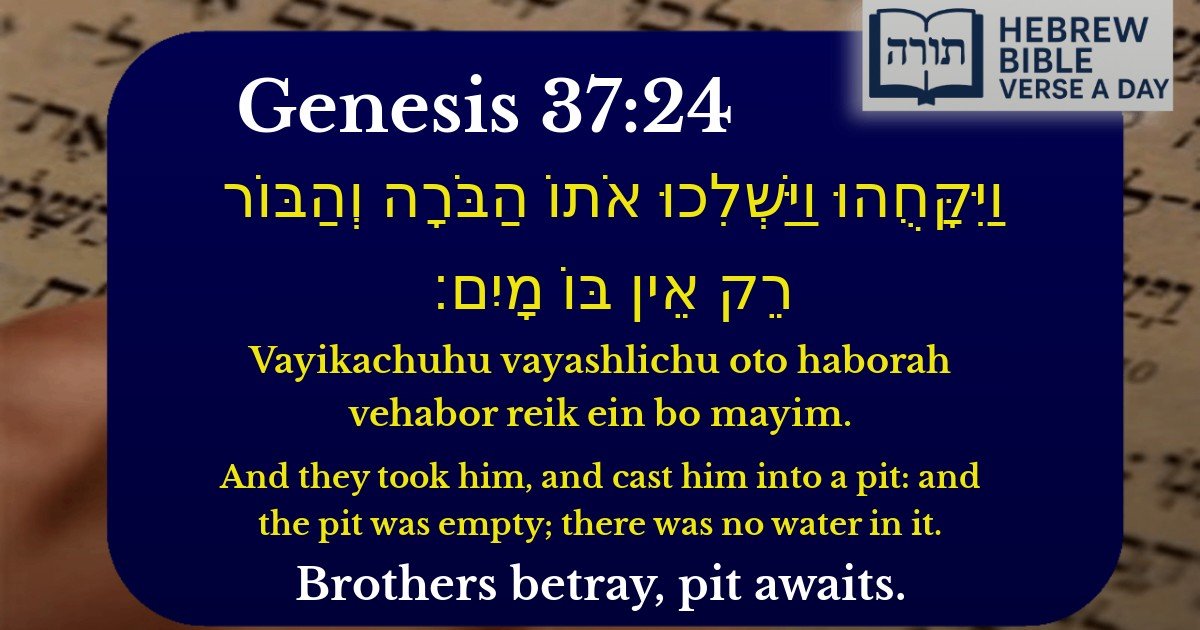
The verse (Bereshit 37:24) describes the brothers of Yosef casting him into a pit after stripping him of his coat of many colors. This event marks a pivotal moment in the narrative of Yosef and his brothers, leading to his eventual descent to Egypt.
Rashi's Explanation
Rashi comments on the phrase "וְהַבּוֹר רֵק אֵין בּוֹ מָיִם" ("the pit was empty; there was no water in it") by noting the apparent redundancy. He explains that the Torah specifies "no water" to teach that while there was no water, there were other things in the pit—specifically snakes and scorpions (as derived from a Midrashic interpretation). This emphasizes the danger Yosef faced, yet he was miraculously protected.
Midrashic Insights
The Midrash (Bereshit Rabbah 84:16) elaborates on the pit's emptiness, stating that the brothers initially intended for Yosef to die from thirst, but Hashem intervened by ensuring the pit had no water—only later dangers like snakes and scorpions. This demonstrates divine providence in Yosef's survival, as he was destined for greatness in Egypt.
Rambam's Perspective
Rambam (in his philosophical works) might view this event as an example of hashgachah pratit (divine providence), where even the brothers' harmful actions ultimately served a greater divine plan—leading to Yosef's rise to power and the eventual sustenance of Bnei Yisrael during famine.
Symbolism in the Pit
Halachic Implications
The Gemara (Sanhedrin 6b) discusses the brothers' culpability in this act, analyzing whether their judgment of Yosef as a "rodef" (pursuer) was halachically justified. This remains a complex ethical discussion in Jewish thought about the limits of human judgment.