Frequently Asked Questions
Q: What does 'Peace be to you, fear not' mean in Genesis 43:23?
A: In Genesis 43:23, Yosef (Joseph) reassures his brothers with the words 'Peace be to you, fear not.' According to Rashi, this was meant to calm their fears after they were accused of stealing the money that was returned in their sacks. Yosef wanted to show them that he bore no ill will and that everything was part of Hashem's plan.
Q: Why did Yosef mention 'your God and the God of your father' in this verse?
A: Yosef mentions 'your God and the God of your father' to remind his brothers that their divine protection and blessings come from the same God who guided Avraham, Yitzchak, and Yaakov. The Ramban explains that this was also a subtle hint that Yosef still upheld the faith of their fathers, despite his high position in Egypt.
Q: What is the significance of the 'treasure in your sacks' in Genesis 43:23?
A: The 'treasure in your sacks' refers to the money that Yosef had secretly returned to his brothers when they first came to buy food. According to the Midrash, this was a test to see if they would return the money honestly, demonstrating their moral growth since selling Yosef into slavery. It also showed Hashem's hidden kindness in providing for them.
Q: Why did Yosef bring out Shimon to his brothers in this verse?
A: Yosef had previously held Shimon as collateral to ensure his brothers would return with Binyamin (Genesis 42:24). By releasing Shimon now, he was showing goodwill and fulfilling his promise, reinforcing his message of peace. The Talmud (Chullin 91a) notes that Yosef treated his brothers with fairness despite their past actions.
Q: How can we apply the lesson of 'fear not' from this verse today?
A: The message 'fear not' teaches us to trust in Hashem's plan even in difficult or confusing situations. Just as Yosef's brothers were afraid but later saw divine providence at work, we too should remember that challenges may be part of a greater good. The Baal Shem Tov taught that recognizing Hashem's hand in events helps overcome fear and strengthens emunah (faith).


Context of the Verse
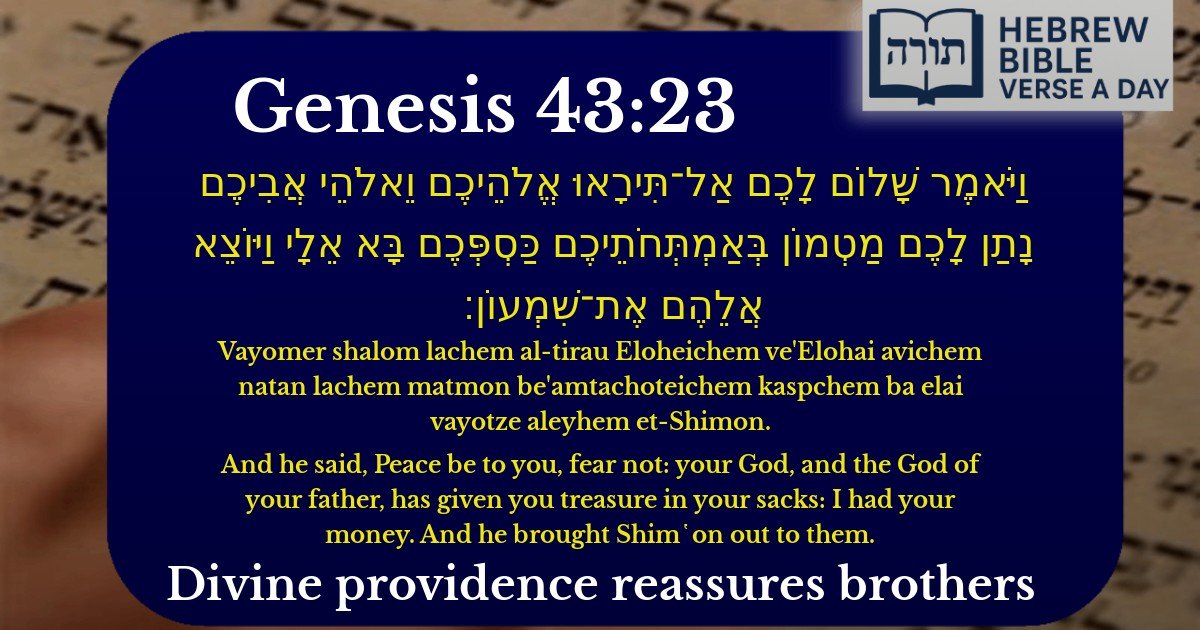
This verse (Bereshit 43:23) occurs during Yosef's interactions with his brothers in Egypt. The brothers had previously found their money returned in their sacks after purchasing grain, causing them distress. Here, Yosef reassures them that their money was not stolen but was a divine gift.
Yosef's Reassurance: "Peace be to you, fear not"
Rashi explains that Yosef begins with "שָׁלוֹם לָכֶם" ("Peace be to you") to calm their fears, as they were terrified of being accused of theft. The phrase "אַל־תִּירָאוּ" ("fear not") emphasizes that their concern about the money was unnecessary, as it was part of Hashem's plan.
The Divine Gift: "Your God... has given you treasure"
The phrase "נָתַן לָכֶם מַטְמוֹן" ("has given you treasure") is interpreted by the Midrash (Bereshit Rabbah 91:10) as hinting at the hidden kindness of Hashem. The Sforno adds that this was a sign of divine providence—Yosef wanted his brothers to recognize that their situation was orchestrated by Hashem, not by chance.
Yosef's Claim: "I had your money"
Ibn Ezra notes that Yosef's statement "כַּסְפְּכֶם בָּא אֵלָי" ("your money came to me") means he had already received payment for the grain, implying the returned money was an intentional act of kindness. The Malbim explains that Yosef was demonstrating his honesty to build trust with his brothers.
The Return of Shimon
Rashi highlights that Yosef's release of Shimon was another gesture of goodwill, proving his benevolent intentions. The Ramban suggests this was part of Yosef's strategy to test his brothers' unity and repentance for selling him into slavery.
Key Lessons from the Verse