Frequently Asked Questions
Q: What is the context of Genesis 44:19?
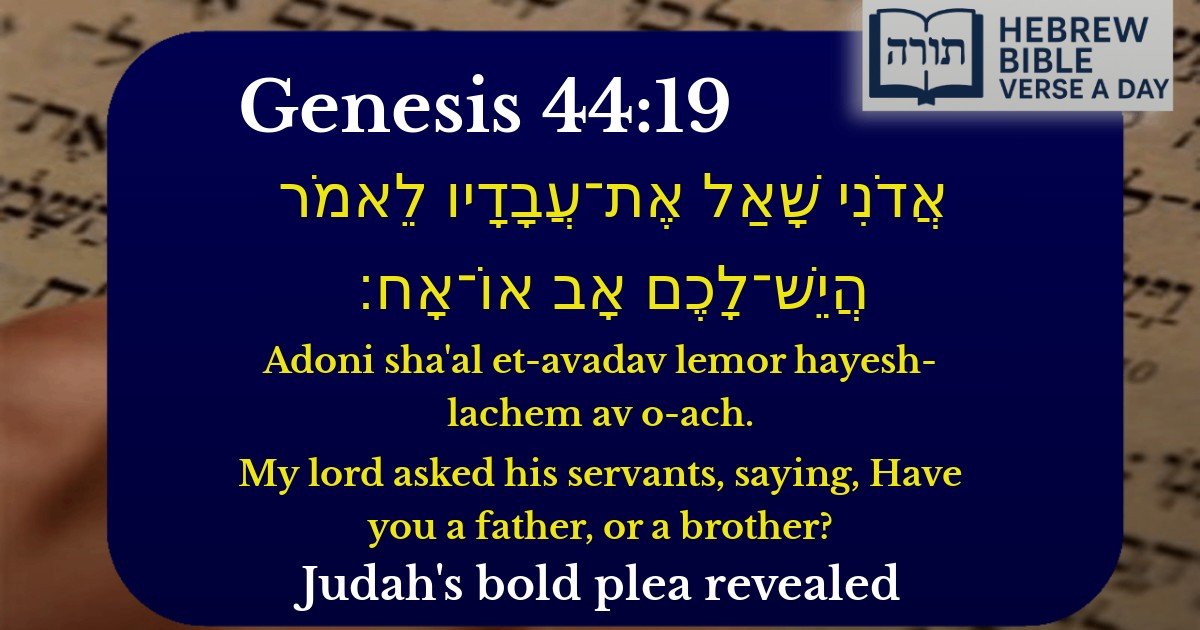
A: Genesis 44:19 is part of the story where Yehuda (Judah) speaks to Yosef (Joseph), who is disguised as an Egyptian ruler. Yehuda recounts how Yosef had questioned his brothers about their family, asking if they had a father or brother. This leads to Yehuda pleading for Binyamin's (Benjamin's) release, showing his growth and responsibility.
Q: Why did Yosef ask his brothers if they had a father or brother?
A: According to Rashi and other commentaries, Yosef asked this question to test his brothers' honesty and to see if they would mention Binyamin (Benjamin), their youngest brother. This was part of Yosef's plan to determine whether his brothers had changed since they sold him into slavery.
Q: What lesson can we learn from Yehuda's words in this verse?
A: Yehuda's words demonstrate his courage and willingness to take responsibility for his brother Binyamin. The Midrash highlights this as a turning point for Yehuda, showing repentance (teshuvah) and leadership. It teaches us the importance of standing up for family and correcting past mistakes.
Q: How does this verse relate to Jewish values?
A: This verse emphasizes key Jewish values such as family responsibility (areivut), honesty, and repentance. Yehuda's plea for his brother reflects the Torah's teachings on protecting one's family and the power of personal growth, as discussed in Talmudic and Midrashic sources.
Q: Why is Yehuda speaking in this verse instead of the other brothers?
A: The Talmud (Sotah 7b) explains that Yehuda took the lead because he had personally guaranteed Binyamin's safety to their father, Yaakov (Jacob). His leadership here shows his commitment to keeping his word, a trait praised in Jewish tradition as a sign of true integrity.


Context in the Torah
This verse (Genesis 44:19) is part of Yehuda's impassioned plea to Yosef (still unrecognized as their brother) on behalf of Binyamin. Yehuda recounts how Yosef had inquired about their family, specifically asking whether they had a father or brother.
Rashi's Explanation
Rashi explains that Yosef's questioning was strategic. By asking about their father and brother, Yosef was:
Ibn Ezra's Insight
Ibn Ezra notes that Yosef's questions were carefully crafted to elicit information without revealing his own identity. The phrasing "Have you a father or brother" rather than asking about each separately was intentionally vague to observe their reactions.
Midrashic Interpretation
The Midrash (Bereishit Rabbah 93:7) suggests that Yosef's questioning had deeper significance:
Rambam's Perspective
In his philosophical approach, Rambam would view this interaction as demonstrating:
Halachic Dimension
The Talmud (Chullin 94b) derives from this verse principles about: