Frequently Asked Questions
Q: Who were the sons of Yissakhar mentioned in Genesis 46:13?
A: The sons of Yissakhar listed in Genesis 46:13 are Tola, Puvva, Yov, and Shimron. These were the four sons born to Yissakhar, the ninth son of Yaakov (Jacob), as recorded in the Torah. According to Rashi, these names signify the tribes that would later descend from Yissakhar.
Q: Why is the lineage of Yissakhar important in the Torah?
A: The lineage of Yissakhar is important because his descendants became one of the twelve tribes of Israel. The tribe of Yissakhar was known for their dedication to Torah study and wisdom, as mentioned in Divrei Hayamim (Chronicles) and the Midrash. They were often associated with scholars and those who supported Torah learning.
Q: What can we learn from the names of Yissakhar's sons?
A: The names of Yissakhar's sons—Tola, Puvva, Yov, and Shimron—carry symbolic meanings. For example, Rashi explains that 'Tola' (meaning 'worm') refers to humility, teaching us the value of modesty. The names collectively remind us of the traits that the tribe of Yissakhar would embody, such as wisdom and devotion to Torah.
Q: How does the mention of Yissakhar's sons apply to us today?
A: The mention of Yissakhar's sons reminds us of the importance of family lineage and spiritual legacy in Judaism. Just as Yissakhar's descendants upheld Torah values, we are encouraged to cultivate Torah study and righteousness in our own lives. The tribe of Yissakhar serves as a model for dedicating oneself to wisdom and communal Torah support.

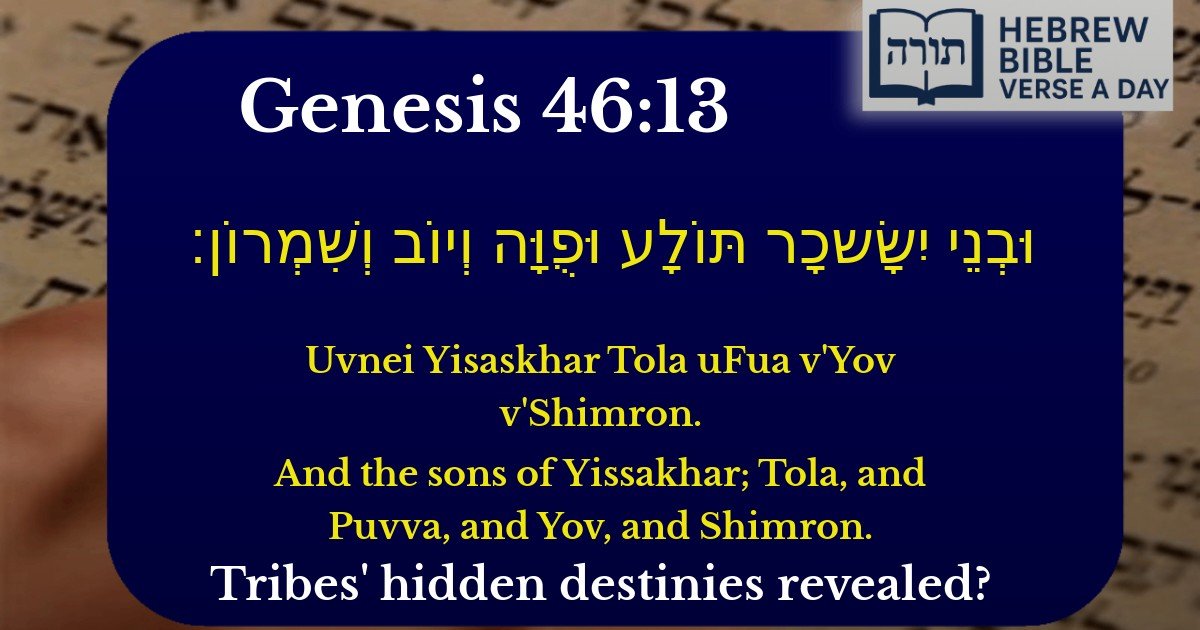

The Sons of Yissakhar: Names and Significance
The verse lists the four sons of Yissakhar: Tola, Puvva, Yov, and Shimron. According to Rashi (Bereshit 46:13), these names are also recorded in Divrei HaYamim I (7:1), though with slight variations (e.g., "Puvva" is called "Puvah" and "Yov" is called "Yashuv"). The differences in spelling do not indicate separate individuals but rather reflect linguistic variations in pronunciation or scribal traditions.
Symbolism of the Names
The names of Yissakhar's sons carry deeper meanings, as noted by the Midrash and commentators:
Yissakhar's Legacy of Torah Scholarship
The tribe of Yissakhar is renowned in Jewish tradition for its dedication to Torah study. The Talmud (Berachot 17a) describes them as "those who know understanding of the times," referring to their expertise in calculating the calendar and halachic rulings. Rashi (Devarim 33:18) notes that Yissakhar's descendants were the scholars who advised the Sanhedrin and the kings of Israel.
Historical Role in the Tribes
According to Midrash Tanchuma (Vayechi 11), Yissakhar and Zevulun formed a partnership: Zevulun engaged in commerce to support Yissakhar's Torah study, demonstrating the interdependence of material and spiritual pursuits in Klal Yisrael.