

Join Our Newsletter To Be Informed When New Videos Are Posted
Hebrew Text
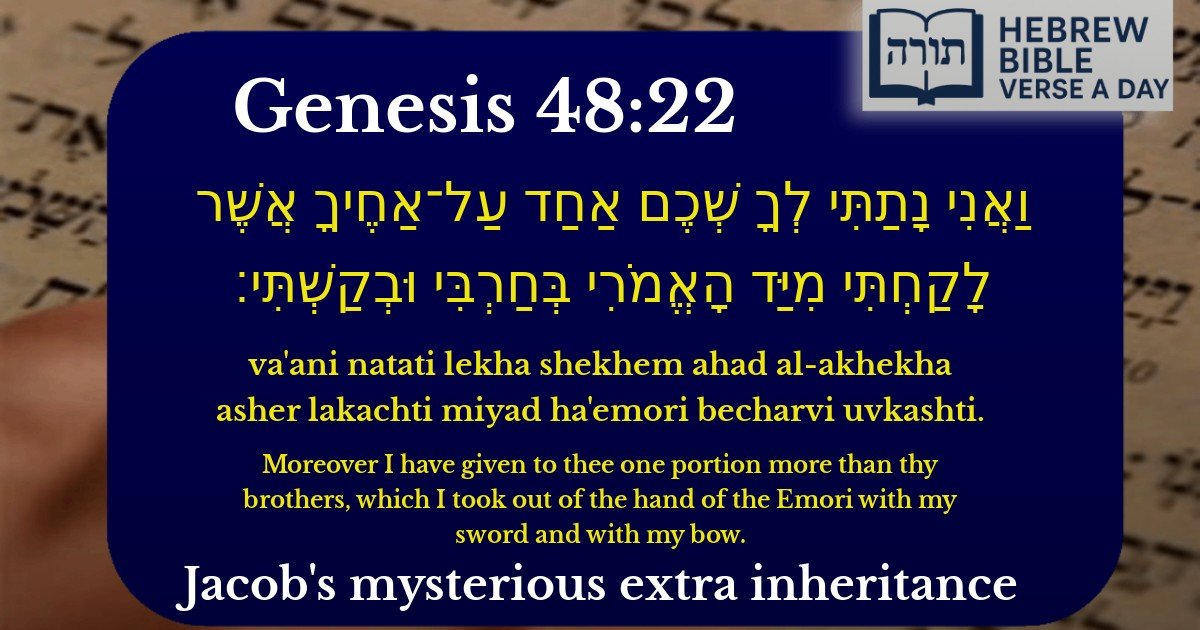
וַאֲנִי נָתַתִּי לְךָ שְׁכֶם אַחַד עַל־אַחֶיךָ אֲשֶׁר לָקַחְתִּי מִיַּד הָאֱמֹרִי בְּחַרְבִּי וּבְקַשְׁתִּי׃
English Translation
Moreover I have given to thee one portion more than thy brothers, which I took out of the hand of the Emori with my sword and with my bow.
Transliteration
Va'ani natati lekha shekhem ahad al-akhekha asher lakachti miyad ha'emori becharvi uvkashti.
Hebrew Leining Text
וַאֲנִ֞י נָתַ֧תִּֽי לְךָ֛ שְׁכֶ֥ם אַחַ֖ד עַל־אַחֶ֑יךָ אֲשֶׁ֤ר לָקַ֙חְתִּי֙ מִיַּ֣ד הָֽאֱמֹרִ֔י בְּחַרְבִּ֖י וּבְקַשְׁתִּֽי׃ {פ}
🎵 Listen to leining
Parasha Commentary
📚 Talmud Citations
This verse is quoted in the Talmud.
📖 Chullin 60b
The verse is discussed in the context of Jacob's blessings to his sons, particularly regarding the portion given to Joseph. The Talmud explores the meaning of 'with my sword and with my bow' and whether it refers to literal weapons or spiritual means.
📖 Berakhot 4a
The verse is referenced in a discussion about the merits of the patriarchs and the inheritance of the land of Israel, highlighting Jacob's role in securing the portion for his descendants.
Context of the Verse
The verse (Genesis 48:22) is part of Yaakov Avinu's blessing to Yosef before his passing. Yaakov grants Yosef an additional portion ("Shechem echad") beyond what his brothers receive. This refers to the city of Shechem, which Yaakov acquired through his efforts.
Rashi's Explanation
Rashi explains that "Shechem echad" refers to the city of Shechem, which Yaakov acquired through his "sword and bow"—meaning his wisdom and prayers (as the sword and bow are metaphors for Torah study and tefillah). Rashi also notes that this portion was taken from the Emori (Amorites) when Yaakov fought to protect his family after the incident with Dinah (Genesis 34).
Ibn Ezra's Interpretation
Ibn Ezra suggests that "Shechem echad" refers not only to the physical city but also to an extra portion of inheritance in the Land of Israel. He emphasizes that Yaakov's acquisition was legitimate, as it was obtained through battle ("with my sword and bow").
Midrashic Insights
Halachic Implications
The Rambam (Hilchot Nachalot 2:14) discusses how Yaakov's granting of an extra portion to Yosef establishes a precedent that a father may distribute his estate unequally among his sons if he chooses, provided it is done with clear intent.
Symbolism of Shechem
Shechem holds significance as the place where Yosef was later buried (Joshua 24:32) and where the tribes of Israel gathered to renew their covenant with Hashem. This reinforces the idea that Yosef's descendants held a special connection to this land.