Frequently Asked Questions
Q: What does Genesis 9:3 mean when it says 'Every moving thing that lives shall be food for you'?
A: This verse marks a major change in human diet after the Flood. Before this, humans were only permitted to eat plants (Genesis 1:29). Now Hashem permits Noah and his descendants to eat meat, with certain limitations that would later be fully explained in the Torah's kosher laws (Rashi on Genesis 9:3).
Q: Why is Genesis 9:3 important in Judaism?
A: This verse is important because it establishes the basic permission for humans to eat meat, which was not allowed before the Flood. However, it's not a blanket permission - the Torah later gives specific kosher laws (in Leviticus 11 and Deuteronomy 14) that limit which animals may be eaten and how they must be prepared (Rambam, Mishneh Torah, Laws of Forbidden Foods).
Q: Does Genesis 9:3 mean Jews can eat any animal?
A: No. While this verse gives general permission to eat meat, the Torah later specifies which animals are kosher (permitted) and which are not. Only animals that both chew their cud and have split hooves (like cows and sheep), certain birds, and fish with fins and scales may be eaten according to Jewish law (Chullin 59a).
Q: What can we learn from Genesis 9:3 about how Hashem relates to humanity?
A: We learn that Hashem adapts His commandments to humanity's needs and circumstances. After the Flood, when plant life was scarce, Hashem showed compassion by permitting meat consumption (Radak on Genesis 9:3). This teaches us about Divine mercy and the gradual development of Torah law.
Q: How does Genesis 9:3 apply to kosher laws today?
A: This verse is the foundation for the concept that meat may be eaten, but the detailed kosher laws that follow in the Torah (shechita - ritual slaughter, separating meat and milk, etc.) show that this permission comes with important restrictions and spiritual guidelines (Sefer Hachinuch, Mitzvah 73).

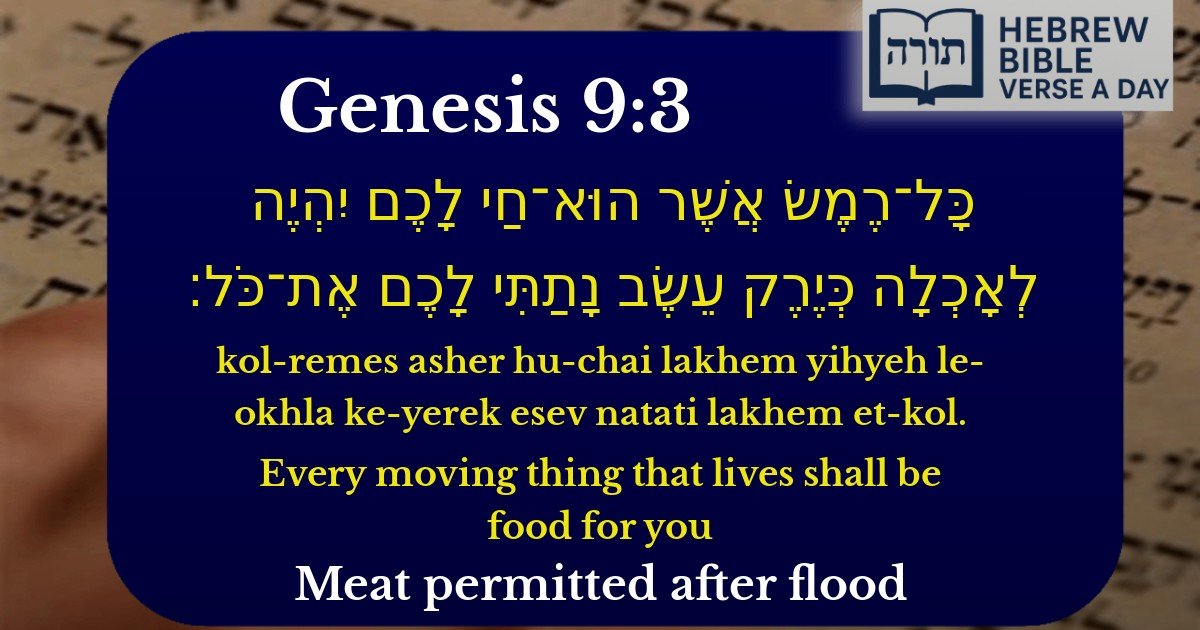

Permission to Eat Meat After the Flood
The verse (Bereishit 9:3) marks a significant shift in human dietary laws following the Flood. Prior to this, humanity was only permitted to consume plant-based foods (Bereishit 1:29). Rashi explains that this new permission was granted because the world had become corrupted, and humanity needed additional sustenance to rebuild civilization.
Limitations and Conditions
While this verse grants permission to eat meat, the Rambam (Hilchot Ma'achalot Asurot 1:1) notes that this was not an unrestricted license. The Torah later introduces specific limitations through:
Comparison to Vegetation
The phrase "כְּיֶרֶק עֵשֶׂב" ("like the green herb") suggests that meat consumption should be approached with the same attitude as eating plants. The Kli Yakar explains this means:
Ethical Considerations
The Talmud (Chullin 84a) derives from this verse that while meat consumption is permitted, there is an ethical dimension to how we treat animals. The permission comes with responsibilities: