
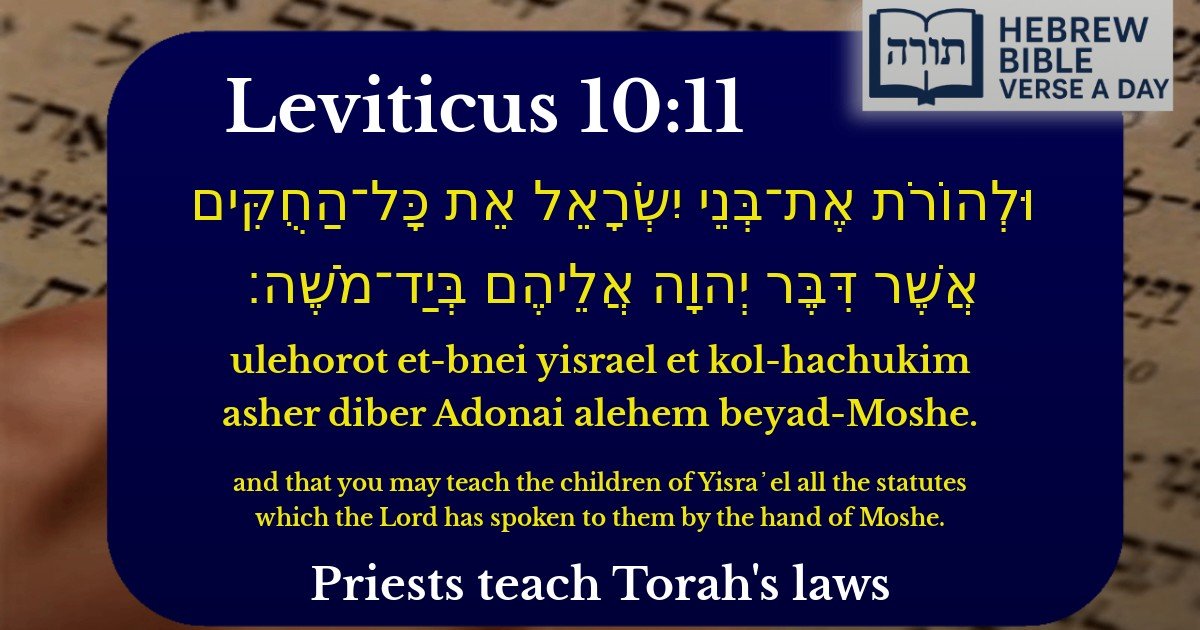

Leviticus 10:11 - Priests teach Torah's laws

Leviticus 10:11 - ויקרא 10:11

Hebrew Text

וּלְהוֹרֹת אֶת־בְּנֵי יִשְׂרָאֵל אֵת כָּל־הַחֻקִּים אֲשֶׁר דִּבֶּר יְהוָה אֲלֵיהֶם בְּיַד־מֹשֶׁה׃

English Translation

and that you may teach the children of Yisra᾽el all the statutes which the Lord has spoken to them by the hand of Moshe.

Transliteration

Ulehorot et-bnei yisrael et kol-hachukim asher diber Adonai alehem beyad-Moshe.

Hebrew Leining Text

וּלְהוֹרֹ֖ת אֶת־בְּנֵ֣י יִשְׂרָאֵ֑ל אֵ֚ת כׇּל־הַ֣חֻקִּ֔ים אֲשֶׁ֨ר דִּבֶּ֧ר יְהֹוָ֛ה אֲלֵיהֶ֖ם בְּיַד־מֹשֶֽׁה׃ {פ}

🎵 Listen to leining

Parasha Commentary

Explanation of the Verse

The verse states: "וּלְהוֹרֹת אֶת־בְּנֵי יִשְׂרָאֵל אֵת כָּל־הַחֻקִּים אֲשֶׁר דִּבֶּר יְהוָה אֲלֵיהֶם בְּיַד־מֹשֶׁה" ("and that you may teach the children of Yisra᾽el all the statutes which the Lord has spoken to them by the hand of Moshe"). This emphasizes the divine transmission of Torah law through Moshe Rabbeinu and the obligation to teach these laws to Bnei Yisrael.

Key Themes and Interpretations

  • Transmission of Torah: Rashi (Shemot 35:34) explains that the phrase "בְּיַד־מֹשֶׁה" ("by the hand of Moshe") underscores that Moshe was the faithful conduit through which Hashem delivered the mitzvot. The Torah was not of Moshe's own making but was given directly from Hashem.
  • Obligation to Teach: The Rambam (Hilchot Talmud Torah 1:1) derives from this verse the mitzvah of לִלְמֹד וּלְלַמֵּד ("to learn and to teach"). Every Jew is responsible not only to observe the mitzvot but also to transmit them accurately to future generations.
  • Role of the Sanhedrin and Rabbis: The Talmud (Sanhedrin 17a) teaches that the phrase "וּלְהוֹרֹת" ("and that you may teach") refers to the authority of the Sanhedrin and later rabbinic courts to interpret and apply Torah law. This establishes the chain of mesorah (tradition) from Moshe to the present day.

Midrashic Insights

The Midrash (Sifra, Kedoshim 1:1) connects this verse to the broader concept of קְדוֹשִׁים תִּהְיוּ ("You shall be holy"), teaching that proper instruction in mitzvot leads to kedushah (holiness). The transmission of Torah is not merely informational but transformative, shaping Bnei Yisrael into a holy nation.

Practical Implications

  • Torah Education: The verse underscores the centrality of Torah study and teaching in Jewish life, as codified in the Mishnah (Avot 1:1): "הֱווּ מְתוּנִים בַּדִּין, וְהַעֲמִידוּ תַלְמִידִים הַרְבֵּה" ("Be deliberate in judgment, and raise many students").
  • Preservation of Halacha: The phrase "כָּל־הַחֻקִּים" ("all the statutes") teaches that no mitzvah may be neglected, and all must be transmitted in their entirety (Devarim 4:2).

📚 Talmud Citations

This verse is quoted in the Talmud.

📖 Yoma 4a
The verse is referenced in the discussion about the role of the priests in teaching the laws to the children of Israel.
📖 Sanhedrin 17a
Cited in the context of the responsibilities of the Sanhedrin and the transmission of Torah laws.

Frequently Asked Questions

Q: What does Leviticus 10:11 mean?
A: Leviticus 10:11 emphasizes the role of the Kohanim (priests) in teaching the Jewish people the laws and statutes given by Hashem through Moshe. According to Rashi, this verse specifically instructs the Kohanim to teach the halachot (Jewish laws) to Bnei Yisrael, ensuring the transmission of Torah knowledge.
Q: Why is teaching Torah important according to this verse?
A: The verse highlights the mitzvah of Torah education as a fundamental duty. The Rambam (Hilchot Talmud Torah 1:1) explains that teaching Torah preserves the divine commandments and ensures Jewish continuity. The Kohanim were entrusted with this role because of their spiritual leadership.
Q: How does Leviticus 10:11 apply today?
A: Today, while the Kohanim no longer serve in the Beit HaMikdash, the obligation to teach Torah remains. The Talmud (Kiddushin 29a) states that every parent must teach their child Torah, and communities must support Torah education. Rabbis and teachers continue this sacred role of transmitting Torah knowledge.
Q: What can we learn from Leviticus 10:11 about leadership?
A: The verse teaches that spiritual leaders, like the Kohanim, have a responsibility to guide others in Torah observance. The Midrash (Sifra) explains that leadership is not about honor but service—teaching and uplifting the community with wisdom and humility.