Frequently Asked Questions
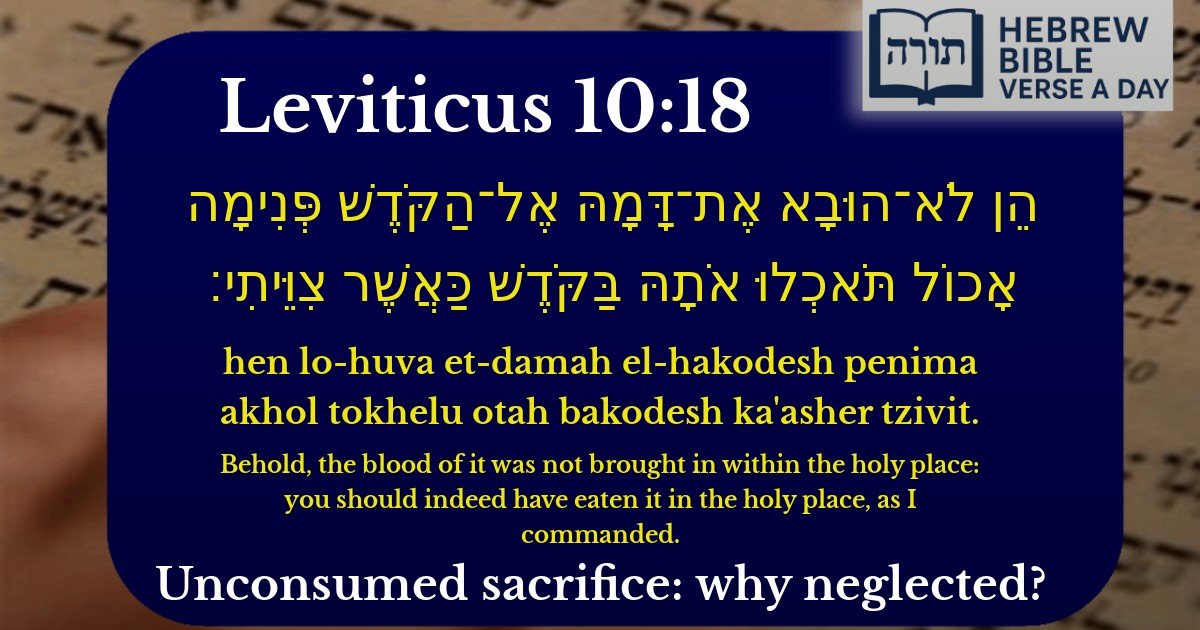
Q: What does Leviticus 10:18 mean?
A: Leviticus 10:18 refers to a situation where the blood of a sin offering was not brought into the inner part of the Mishkan (Tabernacle) as required. Instead, it should have been eaten by the kohanim (priests) in a holy place, as commanded by Hashem. Rashi explains that this verse is part of Moshe's rebuke to Aharon's surviving sons, Elazar and Itamar, for not eating the sin offering properly after the death of their brothers Nadav and Avihu.
Q: Why is Leviticus 10:18 important?
A: This verse is important because it teaches about the precise laws of korbanot (offerings) and the seriousness of following Hashem's commandments exactly as given. The Rambam (Hilchos Maaseh HaKorbanos) emphasizes that every detail in the avodah (Temple service) must be performed correctly. This incident also shows that even great people like Aharon's sons could be corrected when they made mistakes in divine service.
Q: What can we learn from Leviticus 10:18 today?
A: We learn that when serving Hashem, we must be careful to follow the halacha (Jewish law) precisely, not adding or subtracting from it. The Talmud (Eruvin 63a) derives from this that one must be meticulous in Torah study and mitzvah observance. Even when experiencing personal tragedy (as Aharon's sons were), we must still maintain proper observance.
Q: Why didn't Elazar and Itamar eat the sin offering properly?
A: According to Rashi and the Midrash (Toras Kohanim), Elazar and Itamar didn't eat the offering because they were in a state of onen (mourning before burial) for their brothers Nadav and Avihu. While their intentions were respectful, Moshe pointed out that since this was a public offering (korban tzibur), the usual mourning restrictions didn't apply, and they should have eaten it as commanded.
Q: How does Leviticus 10:18 relate to the earlier verses about Nadav and Avihu?
A: This verse continues the theme of proper service in the Mishkan that began with the account of Nadav and Avihu's death (Leviticus 10:1-2). Both incidents teach that divine service must be performed exactly as commanded. While Nadav and Avihu erred by bringing unauthorized fire, Elazar and Itamar erred by being overly strict in their mourning. The Torah shows that balance and precision are needed in avodas Hashem (service of God).


Context in Vayikra (Leviticus)
The verse (Vayikra 10:18) is part of the narrative following the tragic deaths of Nadav and Avihu, Aharon's sons, who brought an unauthorized offering. Moshe reprimands Elazar and Itamar, Aharon's remaining sons, for not eating the chatas (sin-offering) in the Mishkan as commanded.
Rashi's Explanation
Rashi (Vayikra 10:18) clarifies that Moshe is emphasizing the proper procedure for the chatas offering. Since its blood was not brought into the Kodesh HaKodashim (unlike the Yom Kippur offering), it should have been eaten by the Kohanim in the Mishkan's courtyard. Moshe reminds them of the original command (Vayikra 6:19) that such offerings must be eaten in a holy place.
Rambam's Halachic Perspective
In Hilchos Maaseh HaKorbanos (10:6), the Rambam rules that a chatas whose blood is not brought inside the Heichal must be eaten by Kohanim in the Azarah (Temple courtyard). This aligns with Moshe's rebuke, stressing the importance of precise adherence to sacrificial laws.
Midrashic Insight
The Midrash (Toras Kohanim 10:18) suggests that Moshe's rebuke stemmed from concern for the honor of the korbanos. By not eating the chatas properly, its sanctity was diminished. This teaches that mitzvos must be performed with exactness to uphold their kedushah.
Key Lessons