Frequently Asked Questions
Q: What is the context of Leviticus 10:19?
A: Leviticus 10:19 takes place after the tragic death of Aaron's two sons, Nadav and Avihu, who brought an unauthorized fire offering. Aaron and his remaining sons, Eleazar and Ithamar, were in a state of mourning and refrained from eating the sin offering. Moses questioned this, and Aaron explained that given their mourning, eating the offering would not have been proper in Hashem's eyes (Rashi on Leviticus 10:19).
Q: Why didn't Aaron eat the sin offering in Leviticus 10:19?
A: Aaron did not eat the sin offering because he was in a state of mourning (onen) after the death of his sons. The Torah teaches that a mourner is exempt from certain mitzvot, including eating sacred offerings. Aaron reasoned that consuming the offering in his state of grief would not have been fitting before Hashem (Rambam, Hilchot Avel 6:1; Talmud, Zevachim 101a).
Q: What lesson can we learn from Aaron's response in Leviticus 10:19?
A: Aaron's response teaches the importance of sincerity in serving Hashem. Even in grief, he prioritized proper intent over ritual action. The Talmud (Berachot 20a) explains that Hashem values the heart's devotion over mechanical observance. This teaches us that mitzvot should be performed with the right mindset, not just outward compliance.
Q: How does Leviticus 10:19 relate to mourning practices today?
A: This verse reinforces the Jewish principle that mourners (onenim) are exempt from positive commandments until after burial. Today, this halacha applies to mourners before burial—they are not required to perform mitzvot like prayer or tefillin (Shulchan Aruch, Yoreh De'ah 341:1). Aaron's example shows that emotional and spiritual readiness matters in divine service.
Q: Why was Moses initially upset with Aaron in Leviticus 10:19?
A: Moses thought Aaron and his sons were required to eat the sin offering as part of the atonement process (Vayikra 6:19). However, Aaron explained that due to their mourning, eating it would have been improper. The Midrash (Torat Kohanim) notes that Moses later acknowledged Aaron's reasoning was correct, showing that even great leaders can learn from each other.


Context of the Verse
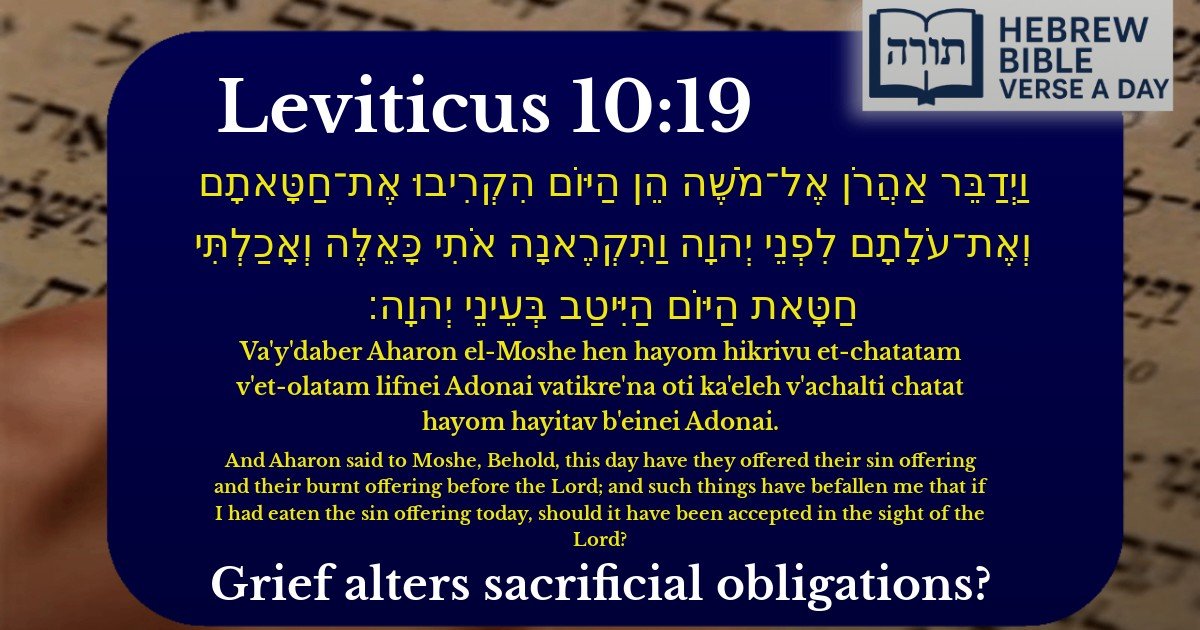
This verse (Vayikra 10:19) appears in the aftermath of the tragic deaths of Nadav and Avihu, Aharon's sons, who offered an unauthorized fire before Hashem. Following their deaths, Moshe instructs Aharon and his remaining sons, Elazar and Itamar, regarding the proper handling of the sacrificial offerings. Aharon responds with this statement, expressing his hesitation to eat the sin offering due to his state of mourning.
Aharon's Concern
Aharon explains that despite the people having brought their sin offering (chatat) and burnt offering (olah), he could not bring himself to eat the sin offering as prescribed. His reasoning is rooted in his mourning—had he eaten it in his current state, he questions whether it would have been acceptable before Hashem. Rashi (Vayikra 10:19) explains that Aharon was concerned that eating the sin offering while in mourning might render it invalid, as a mourner is prohibited from partaking of sacred offerings (see Vayikra 10:6).
Moshe's Response
Moshe ultimately accepts Aharon's reasoning (Vayikra 10:20), acknowledging that Aharon's abstention was justified under the circumstances. The Ramban (Nachmanides) elaborates that Moshe initially believed the prohibition against mourning priests applied only to the initial period of the inauguration of the Mishkan (Tabernacle), but Aharon correctly understood that the sanctity of the moment required restraint even beyond that.
Key Teachings from the Verse
Midrashic Insight
The Midrash (Torat Kohanim) notes that Aharon's phrasing, "Had I eaten the sin offering today, would it have been pleasing to Hashem?" reflects his deep sensitivity to the will of Hashem. Unlike his sons, who acted impulsively, Aharon carefully weighed his actions to ensure they aligned with divine expectations.