Frequently Asked Questions
Q: What does Leviticus 11:18 teach us about kosher animals?
A: Leviticus 11:18 lists certain birds (the barn owl, jackdaw, and gier eagle) as non-kosher (tamei). According to Jewish law (halacha), these birds are forbidden to eat. The Torah provides signs to identify kosher birds, but traditionally, we only eat birds with a known kosher tradition (mesorah). Rashi explains that these birds are predatory or have negative traits, teaching us to avoid cruelty and impurity in our diet.
Q: Why does the Torah specify non-kosher birds like in Leviticus 11:18?
A: The Torah specifies non-kosher birds to guide Jews in maintaining spiritual purity (kedusha). Rambam (Hilchot Ma'achalot Asurot) explains that forbidden foods affect the soul's sensitivity. The Talmud (Chullin 59a) discusses identifying non-kosher birds based on physical traits or behavior. By avoiding these birds, we elevate our eating habits to align with holiness.
Q: How do we know which birds are kosher today based on Leviticus 11:18?
A: Since the exact identities of some biblical birds are unclear, Orthodox Judaism relies on a transmitted tradition (mesorah) for which birds are kosher. The Shulchan Aruch (Yoreh De'ah 82) states that we only eat birds with an established kosher tradition, like chicken or turkey. Without a mesorah, even birds without the Torah's listed signs are not eaten to avoid doubt.
Q: What lesson can we learn from the list of non-kosher birds in Leviticus 11:18?
A: The Midrash (Vayikra Rabbah 13:2) teaches that non-kosher birds often symbolize cruelty or negative traits (e.g., predators). By avoiding them, we train ourselves to reject harmful behaviors. The Sefer HaChinuch (Mitzvah 157) adds that kosher laws remind us to sanctify even mundane acts like eating, directing our lives toward holiness.


Overview of the Verse
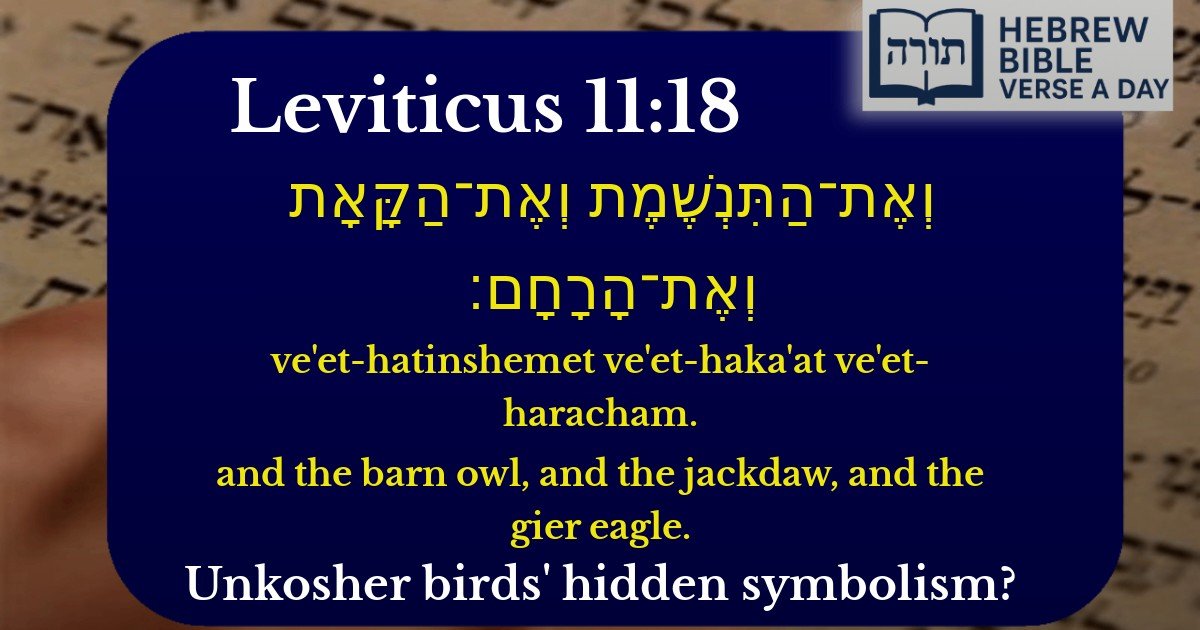
The verse lists three non-kosher birds: the תנשמת (barn owl), the קאת (jackdaw), and the רחם (gier eagle). These birds are among the 24 species of non-kosher birds enumerated in Vayikra (Leviticus) 11:13-19 and Devarim (Deuteronomy) 14:12-18. The Torah prohibits their consumption, and the Sages provide further insights into their characteristics and symbolism.
Commentary from Rashi
Rashi (Vayikra 11:18) explains that the תנשמת (tinshemet) is a bird that emits a sound resembling a sigh (tenasham), likely referring to the barn owl's haunting call. He identifies the קאת (ka'at) as a bird that "spits" (ha-yorek) its food, possibly alluding to the jackdaw's feeding habits. Regarding the רחם (racham), Rashi notes that its name suggests mercy (rachamim), but it is nevertheless non-kosher, teaching that outward appearances can be deceptive.
Midrashic Insights
The Midrash (Vayikra Rabbah 22:10) connects these birds to moral lessons:
Halachic Perspective (Rambam)
Rambam (Hilchot Ma'achalot Asurot 1:15-16) emphasizes that the Torah's prohibition against these birds is absolute, regardless of their physical traits. The Sages derived signs to identify non-kosher birds (e.g., predatory behavior), but the listed species remain forbidden even if they lack these signs, as the Torah explicitly names them.
Symbolism in Kabbalah
According to Kabbalistic sources (Zohar Chadash, Ruth), non-kosher birds represent negative spiritual forces (kelipot). The תנשמת is linked to despair, the קאת to arrogance, and the רחם to false compassion. Avoiding them elevates the soul by distancing it from these traits.