Frequently Asked Questions
Q: Why are certain birds like the stork and hoopoe listed as non-kosher in Leviticus 11:19?
A: The Torah lists specific non-kosher birds based on characteristics that make them unfit for consumption according to Jewish law (halacha). Rashi explains that these birds are predatory or have other traits that make them spiritually or physically harmful. The Talmud (Chullin 63a) discusses the identifying signs of non-kosher birds.
Q: What is the significance of the stork being called 'chasidah' (the pious one) if it's non-kosher?
A: The stork is called 'chasidah' (meaning pious or kind) in the verse because it shows kindness to its fellow storks (Rashi on Leviticus 11:19). However, the Talmud explains that it only shows kindness to its own kind, not to other creatures, which is why it's still non-kosher. This teaches that true righteousness extends beyond one's own circle.
Q: How do we identify which birds are kosher today based on this verse?
A: The Torah doesn't specify the signs of kosher birds, but the Talmud (Chullin 59a, 61a) gives identifying features. Generally, kosher birds are not birds of prey and have certain physical characteristics. We rely on tradition (mesorah) - only eating birds with a known kosher tradition. The Rambam (Hilchot Ma'achalot Asurot 1:14) emphasizes this point.
Q: Why is the bat listed with birds when it's actually a mammal?
A: Although bats are mammals, the Torah classifies creatures based on visible characteristics. Since bats fly like birds, they're mentioned in the bird section (Rashi on Leviticus 11:19). This teaches that Torah classification sometimes follows observable traits rather than modern scientific categories.
Q: What lesson can we learn from the detailed kosher laws about birds?
A: The detailed kosher laws teach us that Hashem cares about what enters our bodies, as food affects our spiritual nature. The Sefer HaChinuch (Mitzvah 157) explains that non-kosher birds have cruel characteristics that could negatively influence those who eat them. By being selective, we elevate our physical acts into spiritual ones.

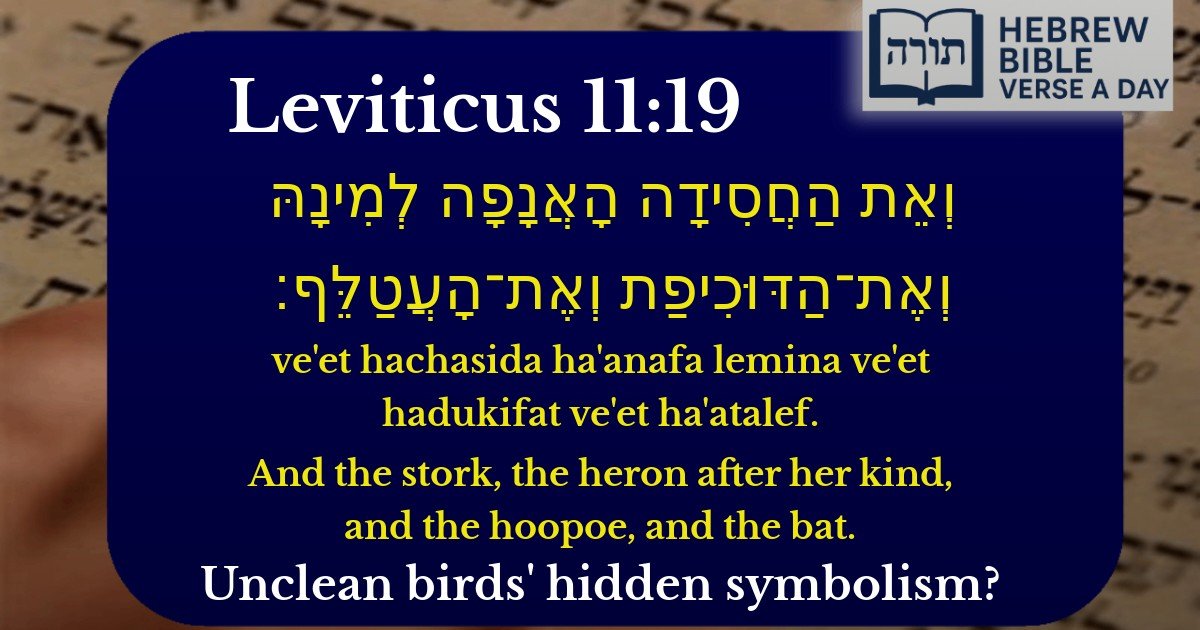

Overview of the Verse
The verse lists several non-kosher birds, including the chasidah (stork), anafah (heron), duchifat (hoopoe), and atalef (bat). These are among the birds prohibited for consumption according to the Torah's dietary laws (Vayikra 11:19, Devarim 14:18).
The Chasidah (Stork)
Rashi explains that the name chasidah (stork) derives from the word chesed (kindness), as this bird is known for its acts of kindness toward its fellow storks. However, the Talmud (Chullin 63a) questions why it is non-kosher if it exhibits kindness. The answer given is that the stork only performs kindness for its own kind, not for other species, reflecting a limited form of chesed that does not align with the Torah's universal ideals.
The Anafah (Heron)
The anafah is identified as a heron-like bird. The Talmud (Chullin 63a) notes that it is aggressive and quarrelsome, which may be why it is deemed non-kosher. The Rambam (Hilchot Ma'achalot Asurot 1:15) explains that birds of prey or those with cruel tendencies are generally forbidden.
The Duchifat (Hoopoe)
The duchifat is identified as the hoopoe, known for its distinctive crown-like crest. The Midrash (Bereishit Rabbah 19:10) mentions that the hoopoe was the bird King Solomon used to locate the shamir worm for building the Beit HaMikdash. Despite this positive role, it remains non-kosher, possibly due to its scavenging habits.
The Atalef (Bat)
Though the atalef (bat) is a mammal, it is listed among birds, leading to discussion in the Talmud (Chullin 63b). Rashi clarifies that it is included here because it flies like a bird, even though it does not meet the criteria of a kosher bird (lacking certain signs like an extra toe or a crop). The Rambam (Hilchot Ma'achalot Asurot 1:16) emphasizes that only birds explicitly permitted may be eaten, and all others, including the bat, are forbidden.
Halachic Implications