Frequently Asked Questions
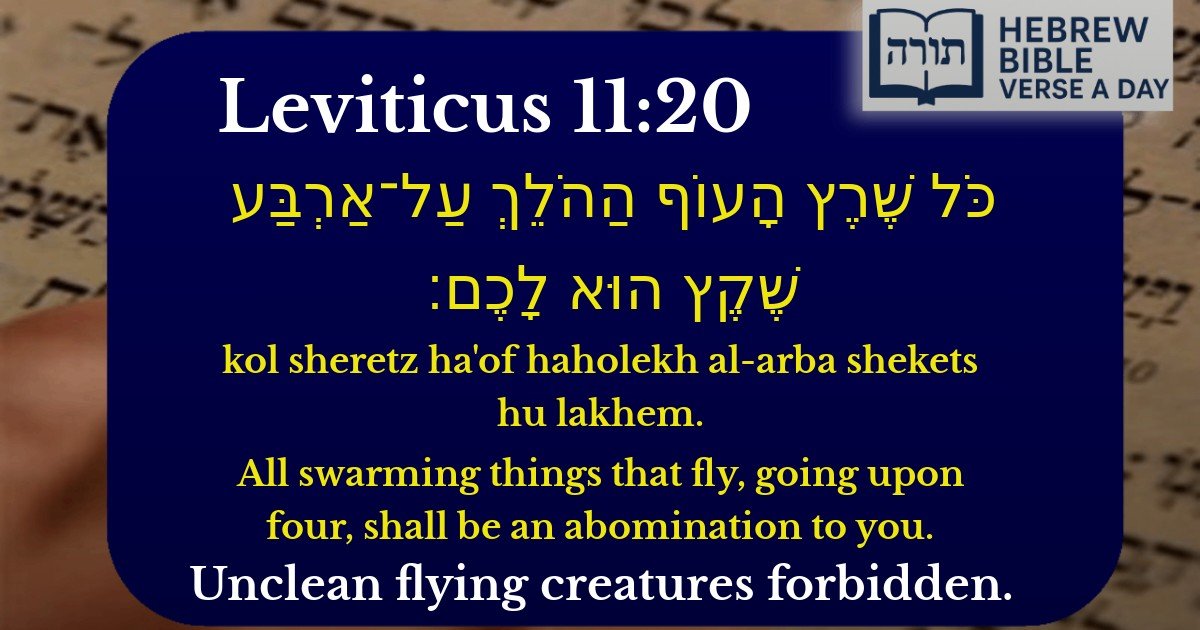
Q: What does Leviticus 11:20 mean when it talks about flying creatures with four legs?
A: Leviticus 11:20 refers to certain flying insects or swarming creatures that walk on four legs, which are considered non-kosher and spiritually impure ('sheketz'). According to Rashi and the Talmud (Chullin 65a), this excludes locusts, which have legs for hopping but are permitted when they meet specific criteria (as mentioned later in Leviticus 11:21-22).
Q: Why does the Torah prohibit eating certain flying insects?
A: The Torah prohibits certain flying insects to teach us discipline in our eating habits and to elevate the physical act of eating into a spiritual practice. Rambam (Hilchot Ma'achalot Asurot) explains that these laws help refine a person's character by avoiding 'abominable' creatures, as they are associated with impurity.
Q: Are all flying insects forbidden according to Leviticus 11:20?
A: No, not all flying insects are forbidden. The verse specifically refers to those that 'go upon four' (walk on four legs). The Talmud (Chullin 59a, 65b) clarifies that certain locusts are permitted if they have the signs of kosher locusts (e.g., four walking legs and additional hopping legs, as per Leviticus 11:21).
Q: How do we apply the laws of forbidden insects today?
A: Today, most Jewish communities follow the ruling of the Shulchan Aruch (Yoreh De'ah 85:1) that we only eat insects with a clear tradition of being permitted (like certain types of locusts in some Yemenite communities). Otherwise, all other flying insects mentioned in Leviticus 11:20 are avoided, and vegetables/fruits are carefully checked for bugs to comply with kosher laws.
Q: What is the spiritual lesson behind avoiding these creatures?
A: The Midrash (Vayikra Rabbah 13:2) teaches that kosher laws, including the prohibition of certain insects, help separate the Jewish people for holiness. By being mindful of what we eat, we train ourselves to reject impurity and seek purity in all aspects of life, as emphasized in Jewish teachings on kedushah (holiness).


Verse Context
The verse (Vayikra 11:20) appears in the Torah's detailed list of kosher and non-kosher creatures, specifically addressing flying insects that "go upon four." This is part of the broader laws of kashrut given to Bnei Yisrael.
Grammatical Analysis
The phrase "הֹלֵךְ עַל־אַרְבַּע" (going upon four) presents a difficulty since insects typically have six legs. Rashi explains this apparent contradiction by noting that these creatures move predominantly on four legs while using the front two legs for other purposes (Rashi on Vayikra 11:20). The Rambam (Hilchos Ma'achalos Asuros 1:22) similarly states that these insects appear to walk on four legs.
Halachic Classification
This verse establishes that certain flying insects are prohibited:
Philosophical Significance
The Sefer HaChinuch (Mitzvah 156) explains that these laws:
Kabbalistic Perspective
The Zohar (Vayikra 42b) suggests that non-kosher creatures contain negative spiritual energies, and consuming them can damage the neshama. The Arizal teaches that permitted locusts contain unique spiritual sparks that certain individuals (like Yochanan ben Zakai) could properly elevate through consumption.