Frequently Asked Questions
Q: What animals does Leviticus 11:3 say are kosher?
A: Leviticus 11:3 states that land animals are kosher if they have two signs: they must chew their cud (ruminate) and have split hooves. Examples include cows, sheep, and goats, which have both signs. Animals like pigs have split hooves but do not chew their cud, making them non-kosher.
Q: Why does the Torah require both split hooves and chewing cud for kosher animals?
A: The Torah requires both signs (split hooves and chewing cud) to ensure clarity in identifying kosher animals. Rashi explains that these signs are easily recognizable, preventing mistakes. The dual requirement also teaches discipline in following Hashem's commandments, as we must carefully examine an animal before consuming it.
Q: What is the spiritual meaning behind eating only animals that chew their cud and have split hooves?
A: The Midrash teaches that chewing the cud symbolizes meditation on Torah (like 'ruminating' on wisdom), and split hooves represent walking on a straight, morally upright path. Thus, kosher animals remind us to live thoughtfully and righteously.
Q: How do we know if an animal chews its cud according to Jewish law?
A: The Talmud (Chullin 59a) describes how to identify cud-chewing animals: they regurgitate food to re-chew it and have a multi-chambered stomach. Jewish tradition relies on a mesorah (transmitted knowledge) of which species meet these criteria, as physical inspection alone may not suffice.
Q: Can we eat an animal that has only one kosher sign (e.g., split hooves but no cud-chewing)?
A: No. The Rambam (Hilchot Ma'achalot Asurot 1:2) emphasizes that both signs are mandatory. An animal missing even one trait (like a pig, which has split hooves but doesn’t chew cud) is forbidden. This strict rule underscores the Torah’s precision in mitzvot.


Overview of the Verse
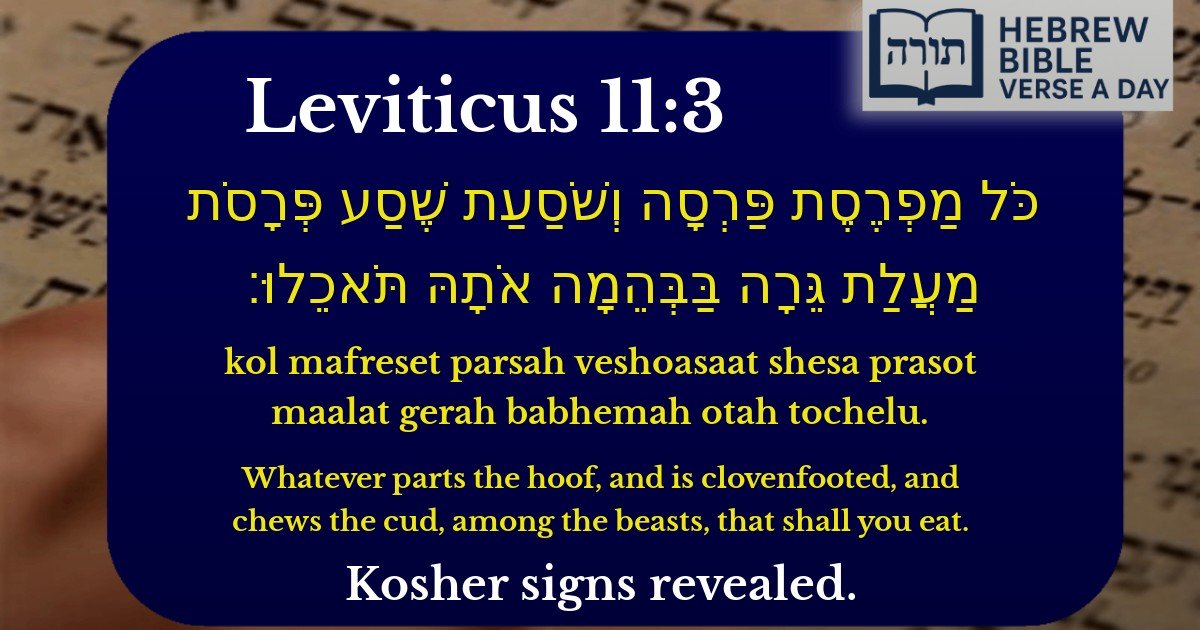
The verse (Vayikra 11:3) outlines the criteria for identifying kosher animals, specifying that a land animal must meet two conditions to be permissible for consumption: it must have split hooves (mafreset parsah) and chew its cud (ma’alat gerah). This is part of the broader Torah laws of kashrut given in Parashat Shemini.
Explanation of the Signs
Halachic Implications
The Talmud (Chullin 59a) emphasizes that both signs must be present for an animal to be kosher. If one is missing—such as with a pig (which has split hooves but does not chew its cud) or a hare (which chews its cud but lacks split hooves)—the animal is forbidden. The Midrash (Vayikra Rabbah 13:2) teaches that these laws are divine decrees (chukim) beyond human rationale, underscoring obedience to Hashem’s will.
Symbolic Meaning
The Kli Yakar suggests that these signs carry moral lessons: split hooves symbolize discernment (havdalah) between right and wrong, while chewing the cud represents deep, reflective study of Torah—ingesting its wisdom repeatedly. Thus, kosher animals exemplify traits a Jew should embody.