Frequently Asked Questions
Q: What does Leviticus 11:36 mean?
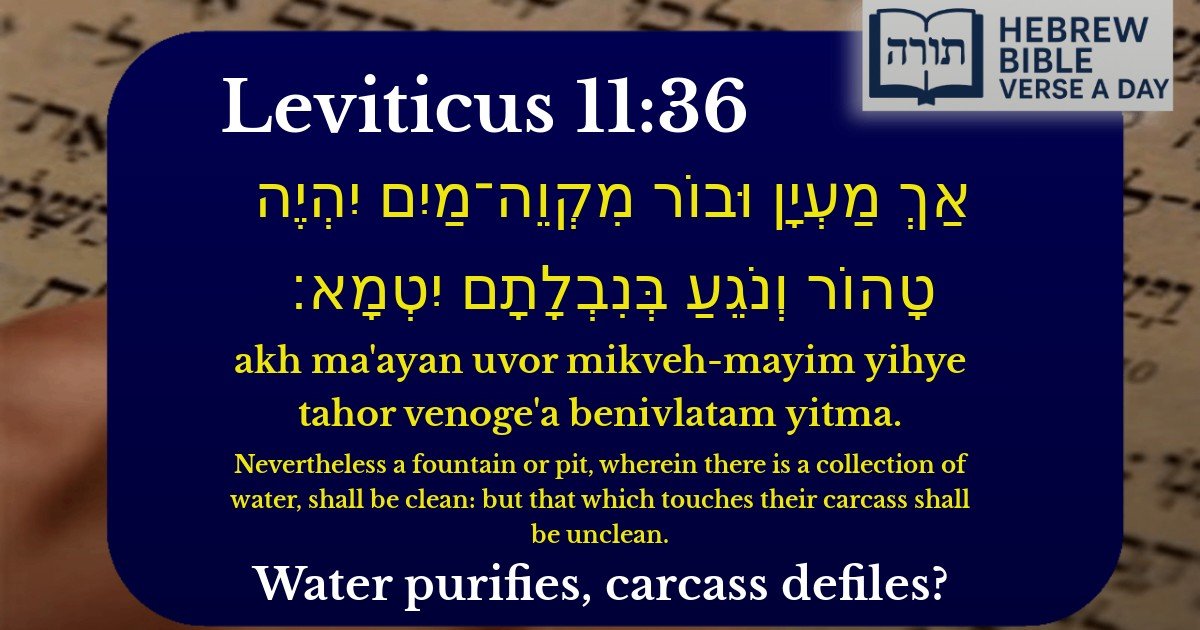
A: Leviticus 11:36 discusses the laws of ritual purity (tumah and taharah) regarding water sources. It states that a natural spring (ma'ayan), pit (bor), or gathered water (mikveh mayim) remains ritually pure, even if an impure animal carcass is nearby. However, if someone or something touches the carcass directly, they become impure (tamei). This verse highlights the distinction between direct and indirect contact with impurity.
Q: Why is a natural spring (ma'ayan) always pure according to this verse?
A: A natural spring (ma'ayan) is always pure because its water is flowing and connected to a natural source, which cannot contract impurity according to Torah law (Rashi on Leviticus 11:36). The Talmud (Chullin 22a) explains that moving water (mayim chayim) has a unique status and does not absorb impurity like standing water. This principle is foundational in Jewish ritual law, especially concerning mikveh (ritual immersion) construction.
Q: What is the difference between a 'bor' (pit) and a 'mikveh mayim' (gathered water) in this verse?
A: A 'bor' (pit) refers to a dug-out pit containing rainwater, while a 'mikveh mayim' refers to any collected body of water (Rambam, Hilchot Tum'at Ochalin 5:1). Both remain pure unless directly contaminated by an impure carcass. However, a mikveh used for ritual immersion must meet specific halachic requirements (40 se'ah of water, proper construction) to be valid, whereas a simple pit may not qualify for ritual use.
Q: How does this verse apply to kosher food preparation today?
A: This verse teaches that water sources used for washing or cooking food must be free from contamination. If an impure carcass touches utensils or food directly, they become non-kosher (tamei). However, flowing water (like a faucet) remains pure for washing, as derived from the principle of 'ma'ayan' (Shulchan Aruch, Yoreh De'ah 116:1). This is why kosher kitchens prioritize proper separation and cleaning of utensils.
Q: What lesson can we learn from Leviticus 11:36 about spiritual purity?
A: The verse teaches that impurity requires direct contact—just as one must actively engage with negativity to become spiritually affected. The purity of a spring symbolizes Torah wisdom (Proverbs 18:4), which remains pure and flowing when connected to its Divine source (Midrash Tanchuma, Chukat 6). Indirect exposure to impurity (like the spring near a carcass) doesn’t defile, reminding us to stay rooted in holiness even in challenging environments.


Verse Context and Overview
This verse (Vayikra 11:36) appears in the Torah portion discussing the laws of ritual purity and impurity (tumah and taharah) concerning animal carcasses. It specifies an exception to the general rule that contact with a dead animal (neveilah) transmits impurity. The verse distinguishes between different types of water sources regarding their susceptibility to impurity.
Rashi's Explanation
Rashi (Vayikra 11:36) explains that a natural spring (ma'ayan) or a pit (bor) containing collected rainwater (mikveh mayim) remains ritually pure even if a dead animal falls into it. However, if a person or vessel touches the carcass itself, they become impure. Rashi emphasizes that the water itself does not contract impurity from the carcass, but direct contact with the carcass does transmit impurity.
Rambam's Halachic Analysis
In Mishneh Torah (Hilchot Tum'at Met 5:1), the Rambam codifies this law, stating that springs and gathered rainwater in pits are immune to impurity. He clarifies that this applies only to water naturally collected in the ground, not to drawn water (mayim she'uvim) in man-made vessels, which can become impure.
Talmudic Discussion
The Gemara (Chullin 70b) discusses this verse extensively, deriving several principles:
Midrashic Insight
Torat Kohanim (Shemini 11:36) connects this law to the concept that naturally occurring water sources represent life and purity in their natural state. The Midrash suggests this teaches that what HaShem creates in nature inherently possesses a degree of kedushah (holiness) that resists impurity.
Practical Halachic Implications
Based on this verse and its interpretations: